Hidden Fees in Austin Solar Leases: Contract Terms Solar Lease Companies Bury
If a salesman has been at your door promising free solar, you already know the pitch. What you have probably not seen is the contract behind it. Solar lease companies working the Austin area write agreements that run 20 to 25 years, and the terms that decide whether you come out ahead sit in the middle pages, not the sales brochure. This guide walks through those terms one at a time: the escalator clause, the buyout schedule, the home-sale transfer rules, the insurance and roof provisions, and the fees nobody mentions at the kitchen table. I work in this industry. I am not going to tell you every lease is a scam, because that is not true. Additionally, I am going to show you where the money hides so you can read your own paperwork before you sign it.
One note before we start. Which utility sends your bill matters more than which company puts panels on your roof. Austin Energy, Pedernales Electric Cooperative, and the retail providers on Oncor's wires all credit exported solar differently, and a lease payment that pencils out under one utility can fail under another. I will flag those differences as we go.
Why Solar Lease Company Contracts Got Longer and Fine Print Got Finer in 2026
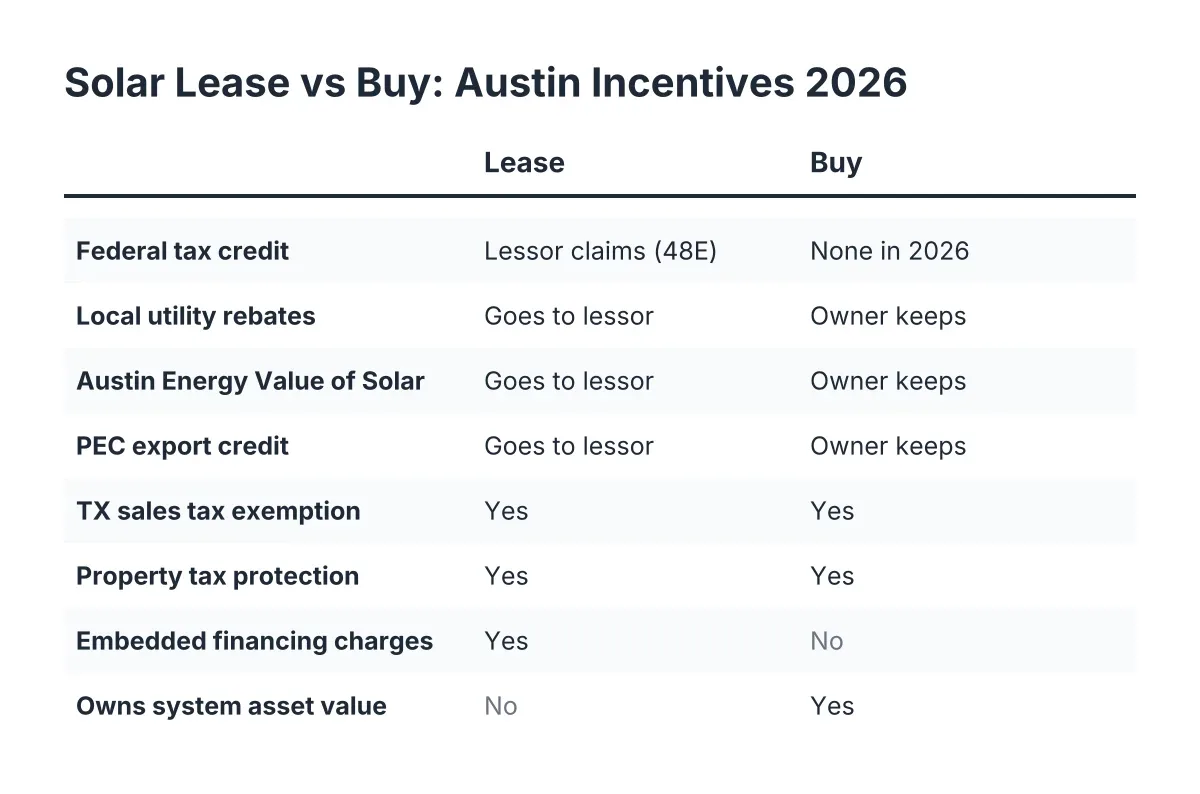
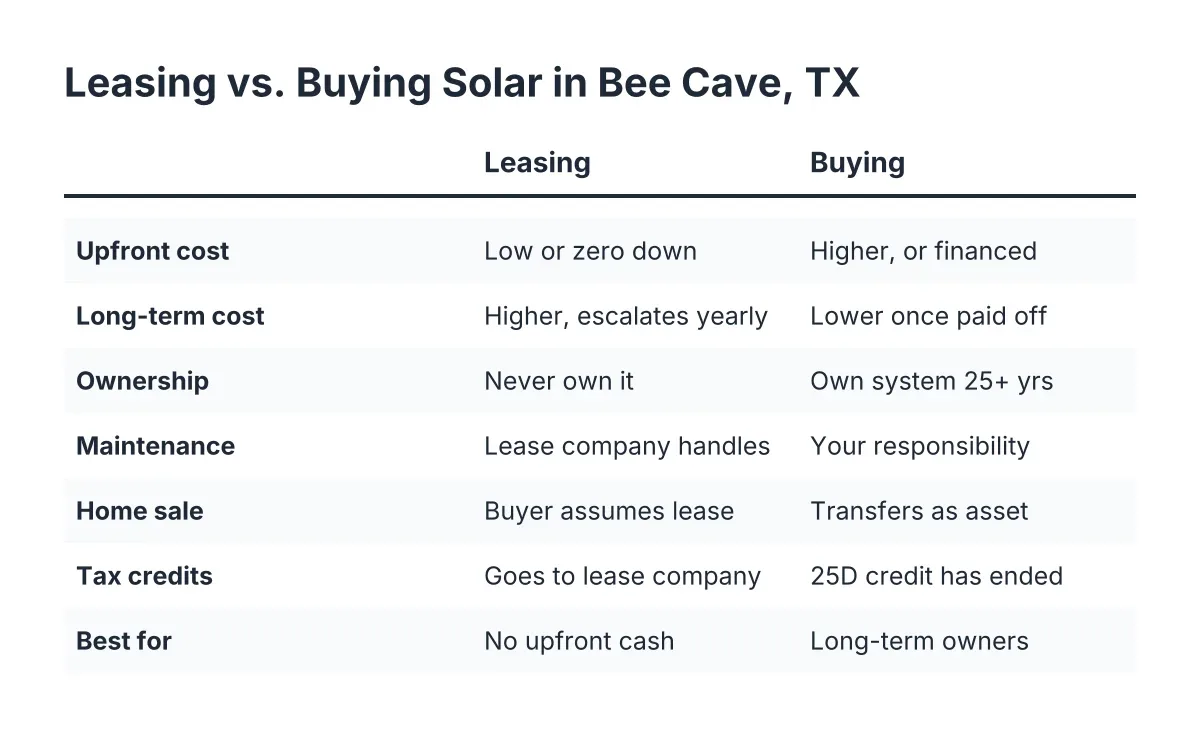
The federal tax landscape changed, and it changed the sales pitch. The purchase credit, the old 25D credit that gave homeowners 30 percent back on a system they bought, has ended. Furthermore, the lease credit, the 48E path, survives, but it goes to the company that owns the system, not to you. Notably, the company may share some of that value through a lower monthly payment, or it may not.
As a result, lease and power purchase agreement offers are heavier in Austin-area sales conversations in 2026 than they were three years ago. The financing companies have a tax incentive that homeowners no longer have, so leasing is where the sales energy went. That does not make a lease wrong for you. It does mean the person at your door has a stronger reason than ever to steer you toward one, and the contract deserves a slower read than the pitch suggests.
Texas is also a booming market, which draws national players with template contracts written for California or Arizona. According to the Solar Energy Industries Association, Texas installed more solar capacity than any other state in the first quarter of 2025, at 2.7 gigawatts, 92 percent more than second-ranked Florida. Big markets attract good companies and bad ones in equal measure.
The Escalator Clause: The Fee That Compounds Quietly
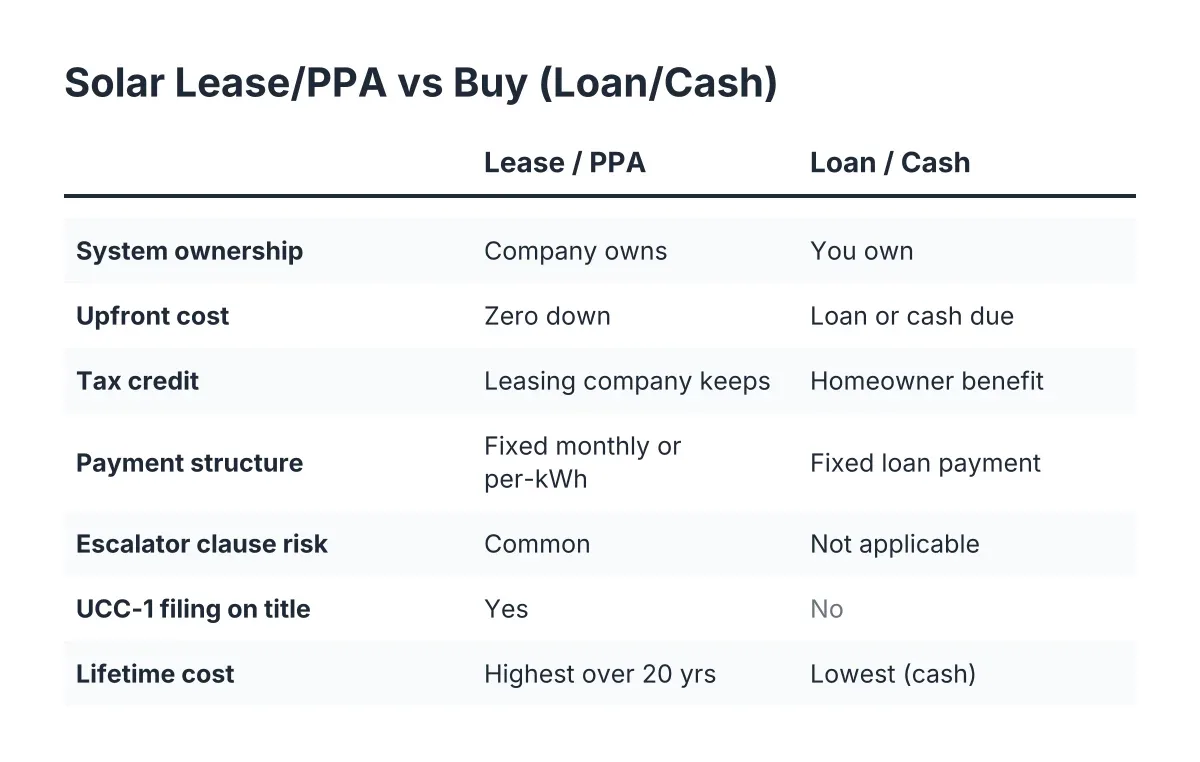
Most solar leases in this market include an annual payment escalator, typically 1.9 to 3.5 percent, compounding every year for the life of the contract. This is the single most expensive line in the document, and it is usually one sentence long.
Here is why it matters. Suppose a retired couple in Round Rock signs a 25-year lease at $145 per month with a 2.9 percent escalator. That is a hypothetical, and your numbers will differ, but the math is simple to check. By year 10 the payment is about $187. By year 20 it is about $249. Over the full term they pay roughly $52,000 for a system that might have cost $22,000 to $28,000 to buy outright in 2026. The escalator alone adds more than $8,000 versus a flat payment.
The sales counter-argument is that utility rates rise too, so an escalating lease payment still saves you money. Sometimes that holds. However, it depends entirely on your utility. Austin Energy credits all solar production through its Value of Solar tariff, 12.89 cents per kilowatt-hour for systems under 1 MW-AC effective October 1, 2026, according to Austin Energy; that rate is set by the utility and can change, and your numbers will differ. If the Value of Solar rate falls while your lease payment climbs 2.9 percent a year, the gap between what solar saves you and what the lease costs you narrows every year. Nobody at the kitchen table models that scenario for you.
If you are on a fixed income, a flat payment matters more than a low starting payment. Some solar lease providers offer a zero-escalator option at a higher initial rate. Ask for it, and ask for both schedules in writing so you can compare total cost over the full term, not just year one.
Buyout Schedules and Early Termination: What Leaving Actually Costs
Every lease has an exit price. Few salespeople volunteer it. The contract will contain a buyout schedule, a table showing what you would pay to own the system outright at year 5, year 7, year 10, and so on. Read it before signing, because it tells you how the company values its own hardware.
Common patterns to watch for:
- No buyout allowed before year 5 or 6. The company needs to hold the system long enough to keep its lease credit under the 48E rules. You are locked in for that window regardless of circumstances.
- Buyout prices based on "fair market value" with no formula. If the contract does not state a dollar figure or a clear calculation, the company decides what the system is worth when you ask. Insist on a printed schedule with numbers.
- Early termination fees separate from the buyout. Some contracts charge a termination fee plus removal costs plus the remaining payments, discounted or not. Removal and roof repair alone can run $2,500 to $5,000 as a rough 2026 estimate; your numbers will differ.
- Prepayment that is not ownership. A "prepaid lease" means you paid 25 years of payments upfront, yet the company still owns the panels. That distinction matters at resale and at end of term.
Can you buy out a solar lease early in Texas? Usually yes, after the initial lock-in period, at the price on the schedule. The practical problem is that the schedule often prices the system above what the same panels would sell for used. You are not negotiating from strength once your signature is on page 30.
Selling the House: The Contract Term That Surprises the Most People
Should you buy a house with leased solar panels? You can, and thousands of people do, but the lease transfers with the house, and the buyer must qualify with the leasing company and accept the remaining payments. That extra step slows closings, and some buyers walk rather than inherit a 15-year payment obligation they never chose.
For the seller, this is where hidden costs surface. Say a homeowner in Bastrop signs a 25-year lease at 68 and decides at 76 to downsize closer to grandchildren. That is a hypothetical, but it is a common shape of story in this area. The options at sale are: transfer the lease to the buyer, prepay the remaining term and fold it into the asking price, or buy the system out at the schedule price. Each option costs money or negotiating leverage. A cash buyer with no lease has none of those conversations.
Transfer terms vary by company, so check three things in any contract:
- Whether the transfer requires a credit check of the buyer, and what score the company requires.
- Whether the company charges a transfer fee, and how much.
- What happens if the buyer refuses the lease. Some contracts make you, the seller, responsible for the buyout before closing.
The same questions apply if you are asking whether a Tesla solar lease is worth it on a home you are buying. Tesla's leased systems transfer like any other; the worth-it answer depends on the remaining payment, the remaining term, and what the local utility pays for exports, not on the brand on the inverter.
How Your Utility Changes the Lease Math
A lease payment is fixed by contract. The savings side of the ledger is set by your utility, and in the Austin area that varies more than the national lease calculators admit.
Austin Energy
Austin Energy does not offer retail net metering. It pays the Value of Solar tariff on everything your panels produce, 12.89 cents per kilowatt-hour for systems under 1 MW-AC effective October 1, 2026, according to Austin Energy; the utility adjusts this rate periodically and your numbers will differ. Because the credit rate is set by tariff, your lease savings depend on a number the utility controls and can lower. A 25-year lease is a bet that the Value of Solar rate holds up for 25 years. Nobody can promise that, including me.
Pedernales Electric Cooperative
PEC credits surplus solar sent to the co-op at 7.1921 cents per kilowatt-hour under its regular interconnect rate, only toward the Base Power Charge, with unused credits expiring at calendar year-end, according to PEC; confirm the current rate on your own bill because your numbers will differ. At 7.1921 cents, and only on power sent to the co-op, exports earn less than production does under Austin Energy's tariff. Therefore a lease sized to export heavily, which is how some solar lease companies size systems to maximize their own production payments, can underperform badly on a PEC bill. On PEC, self-consumption is the game, and a home battery changes the math more than an extra kilowatt of panels does.
Oncor territory with retail choice
If Oncor delivers your power, your buyback rate comes from whichever retail provider you choose, and those plans change yearly. A lease locked for 25 years against a buyback plan that resets every 12 months is the widest mismatch in the region. It can still work, but you carry the rate risk, not the leasing company.
Six Questions to Put to Solar Lease Companies Before You Sign
A lease is not automatically the wrong choice. For a homeowner who cannot use the lease credit, has no cash to spare, and wants no loan on a fixed budget, a well-written lease with honest terms can beat doing nothing while summer bills climb. The problem is separating honest terms from buried ones. These questions do that work:
- What is the annual escalator, and what is the total of all payments over the full term? Ask for the total in dollars, on paper. If they will only quote the monthly payment, that is your answer about the company.
- Show me the buyout schedule as a printed table. No formula-only language, no "fair market value to be determined."
- What are the transfer requirements and fees if I sell my home? Get the buyer credit requirement in writing.
- Who insures the system, and who pays if my roof needs work under the panels? Panel removal and reinstallation for a reroof commonly runs $3,000 to $6,000 as a 2026 estimate; your numbers will differ. Find out whose bill that is.
- What production do you guarantee, and what do you pay me if the system underperforms? A guarantee without a stated remedy is a sentence, not a guarantee.
- What happens at the end of the term? Renewal, removal, or purchase, and at what price for each.
Any of the established solar lease programs operating in Central Texas can answer all six in an afternoon. A company that stalls on question one or two is telling you where its margin lives.
Lease, Loan, or Cash: Where the Hidden Fees Sit in Each
Every financing path has costs that do not appear in the headline number. The solar lease vs buy decision is less about which is cheaper on paper and more about which set of hidden costs you can live with.
A lease hides its cost in the escalator, the buyout schedule, and the transfer terms, as covered above. A solar loan hides its cost in dealer fees, which are markups of 15 to 30 percent baked into the system price to buy down the interest rate; your numbers will differ, and the fee rarely appears as a line item. Cash has no financing fees, but in 2026 it comes without the ended purchase credit, so the payback runs longer than the 2022-era guides still ranking on Google suggest.
For the retiree weighing all three: a loan adds a fixed payment to a fixed income, which many people rightly refuse. A lease adds a payment too, one that grows. Cash spends savings you may need for other things. There is no free option, only the option whose costs you understand fully. On a house with heavy shade, a small bill under $100 a month, or a roof due for replacement within five years, the honest answer may be that no version of solar fits right now.
What a Fair Lease Looks Like, for Comparison
To close, here is the shape of a lease I would not object to, so you have a benchmark. Zero or low escalator, stated total cost over the term, a printed buyout table starting no later than year 6, a production guarantee with a per-kilowatt-hour remedy, transfer terms with a named fee and a stated credit threshold, and the leasing company carrying roof-penetration warranty and reinstallation costs for a reroof. Contracts like this exist. They tend to carry higher starting payments, because the cost is visible instead of buried, and visible cost is exactly what you want on a fixed income.
Before signing anything, have the full contract reviewed by someone with no commission at stake, whether that is a real estate attorney, a financially sharp adult child, or both. A 25-year obligation deserves at least one reader who is not selling it. Take the contract home, take a week, and check every number against your own Austin Energy or PEC bill. The panels will still be for sale next month. The good terms will be too.
For help with solar lease vs buy, Austin Solar FAQ is the place to start.
Prefer to talk it through? Call +15125571906 — a quick call is usually the fastest way to get a straight answer for your situation.