Monthly Cost of a Solar Lease vs. Buying in Austin: The Numbers Nobody Puts Side by Side
If a salesperson has knocked on your door promising solar for "no money down," the number you actually need is the monthly cost of a solar lease compared with what buying the same system would cost you each month, on your utility, at today's rates. Understanding the solar lease escalator cost is essential to this comparison, which is the whole decision. Yet most of the pages ranking for this topic quote national averages and never mention which utility sends your bill. In the Austin area, that detail changes the math more than the panels do.
I have worked in residential solar around Austin long enough to know how both paths look on a real bill. This article puts the two side by side: what a lease costs per month, what a purchase costs per month, and how each behaves over 25 years on Austin Energy, Pedernales Electric Co-op (PEC), and the other utilities that serve this area. I will also tell you where the lease genuinely wins, because in 2026 it sometimes does.
Why the Monthly Framing Hides More Than It Shows
Lease marketing lives on one sentence: "Your solar payment will be lower than your electric bill." Sometimes that sentence is true in year one. The problem is what happens in years 2 through 25.
Most solar leases include an annual escalator, typically 1.5 to 3 percent. A payment that starts at $115 a month with a 2.9 percent escalator reaches about $230 a month by year 25. Those are illustrative figures, not a quote from any company, and your numbers will differ. However, the pattern is standard across the industry.
A purchased system flips that curve. Whether you pay cash or take a solar loan, the payment is fixed. It never escalates. And once the loan is paid off, usually in 10 to 15 years, the monthly cost drops to maintenance only. For a retiree planning around a fixed income, that difference matters more than any first-year comparison a salesperson will show you.
What a Solar Lease Escalator Cost Means Per Month in the Austin Area
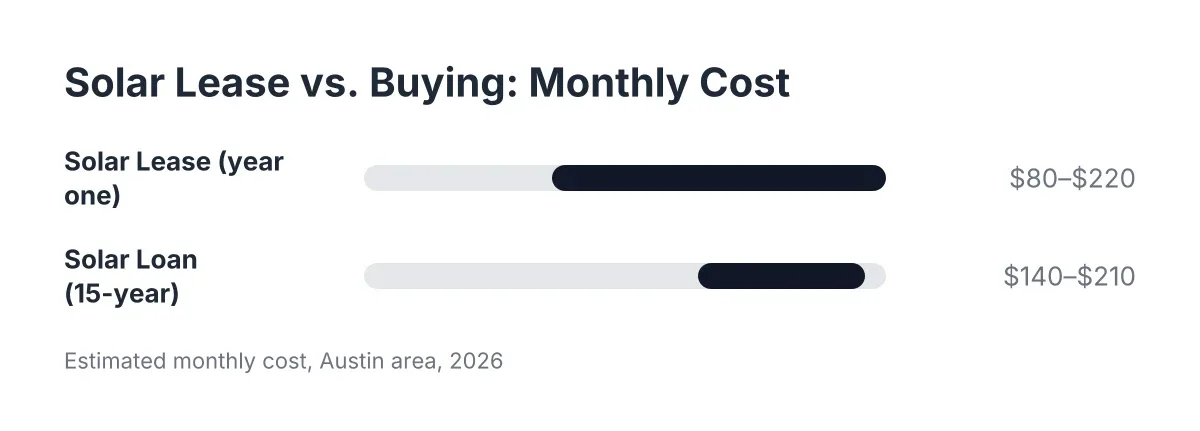
A residential solar lease in the Austin area in 2026 generally runs $80 to $220 per month in year one, depending on system size, roof complexity, and the leasing company. That is my estimate from reviewing local agreements, not a published rate, and your numbers will differ. Almost every lease adds an annual escalator on top of that starting figure.
Here is what typically sits inside that payment:
- The financing cost of the system, which the leasing company owns, not you
- The leasing company's margin and the cost of its 25-year performance guarantee
- Monitoring and, in most agreements, panel maintenance and inverter replacement
- The value of the federal lease credit, which the company keeps because it owns the system
That last point deserves a plain explanation. The federal purchase credit for homeowner-owned systems, the old 25D credit, has ended. The lease credit under the 48E path survives, but it goes to the system owner, which in a lease is the company. Good leasing companies pass some of that value through as a lower monthly payment. You have no way to verify how much they pass through, and that is one honest weakness of the lease structure.
The Solar Lease Escalator Cost Is the Number to Circle
Before you compare anything else, find the escalator clause. A 0 percent escalator lease at $130 a month can cost less over 25 years than a $100 lease with a 2.9 percent escalator. If you run any solar lease calculator, make sure it asks for the escalator; if it does not, the calculator is a sales tool, not a planning tool.
What Buying Costs Per Month, With and Without a Loan
Buying a typical 8 kW system in the Austin area in 2026 costs roughly $20,000 to $28,000 before incentives, based on quotes I have seen locally; your numbers will differ. Paid in cash, the monthly cost is close to zero after installation, aside from occasional maintenance and an inverter replacement somewhere around year 12 to 15, often $2,000 to $4,000 at today's prices.
Financed with a 15-year solar loan, that same system lands around $140 to $210 a month depending on rate and down payment. That looks worse than a year-one lease payment, and often is. The difference shows up later. The loan payment never rises, and it ends. Additionally, the lease payment rises and runs the full term.
Understanding the true solar lease escalator cost over time reveals why the honest summary is this: a lease usually costs less per month in the first five to eight years, and a purchase usually costs less per month in every year after that. The crossover point depends on the escalator, the loan rate, and your utility's export credit.
Your Utility Decides How Much the Panels Earn Back
The monthly payment is only half the ledger. The other half is what your solar production knocks off your electric bill, and that depends entirely on which utility sends the bill. Not your town, your utility.
Austin Energy
Austin Energy does not offer retail-rate net metering. It pays a Value of Solar tariff for what your panels produce. According to NuWatt Energy, that Value of Solar rate is 9.91 cents per kWh for residential customers. That rate is set by the utility and can change, so confirm it on your own bill before running numbers; your numbers will differ.
At 9.91 cents, solar production offsets a meaningful share of an Austin Energy bill, but not dollar for dollar against the highest summer tiers. A lease payment that assumed one-for-one offset will disappoint here.
Pedernales Electric Co-op
PEC handles exports differently. According to SolarSavingsAI, PEC offers retail-rate net metering to its roughly 375,000 customers, crediting solar exports at $0.06 per kWh. Export credit structures at co-ops get revisited by their boards, so treat any figure as a snapshot with an as-of date of early 2026, and check your current PEC rate schedule before signing anything.
Oncor, Bluebonnet, Georgetown Utility Systems, and San Marcos
Oncor territory means retail choice, so your buyback depends on which retail electric provider you pick, and those plans change yearly. Bluebonnet and the municipal utilities in Georgetown and San Marcos each set their own export credit. The same lease payment can pencil out on one side of a county line and fail on the other. This is why national lease comparison articles mislead Austin-area readers; they assume a net metering world that does not exist here.
A Side-by-Side Look at the Monthly Cost: Solar Lease vs. Purchase Over 25 Years
Suppose a retired homeowner in PEC territory, say near Dripping Springs, gets two proposals for the same 8 kW system in 2026. These figures are illustrative estimates, and your numbers will differ.
- Lease: $110 per month in year one, 2.9 percent annual escalator, 25-year term. Total paid over 25 years: about $48,000. Ownership at the end: none. Buyout available at set intervals, priced by the company.
- Loan purchase: $175 per month for 15 years on a $24,000 system. Total paid: about $31,500 plus an estimated $3,000 inverter replacement. Years 16 through 25: near zero monthly cost. Ownership: full, from day one.
- Cash purchase: $24,000 up front plus the inverter reserve. Monthly cost: effectively the maintenance reserve, maybe $20 to $30 a month averaged out.
In that scenario the lease wins the first-year comparison and loses the 25-year comparison by roughly $15,000 against the loan. The gap widens against cash. However, the lease carried no upfront cost, no maintenance risk, and no equipment ownership headaches for a homeowner who did not want them. Both sides of that trade are real.
The Solar lease vs buy question also turns on how long you plan to stay in the house. Selling a home with an owned system is straightforward; the system transfers with the deed. Selling with a lease means the buyer must qualify for and assume the lease, or you must buy it out. In the Austin-area resale market, that assumption step has killed closings. It is the single most common regret I hear from lease holders.
Where the Lease Genuinely Makes Sense in 2026
A lease is not automatically the wrong answer, and anyone who tells you it always is has stopped thinking. With the federal purchase credit gone and the lease credit surviving on the 48E path, the lease structure captures a federal incentive that a cash buyer in 2026 cannot. A well-priced lease can pass part of that through to you.
The lease case is strongest when:
- You cannot or do not want to deploy $20,000-plus of savings, and a loan payment on a fixed income feels like a risk you should not take. That instinct is sound.
- You want zero maintenance responsibility, including inverter replacement, for the full term.
- The lease has a low or zero escalator and a clearly stated buyout schedule you have read yourself.
- You expect to stay in the home longer than the lease term, so the resale complication never arrives.
The purchase case is strongest when you can pay cash or carry a fixed loan comfortably, you may sell within 10 to 15 years, and you are on a utility where the export credit rewards ownership over decades. Texas is not a small solar market; according to the Solar Energy Industries Association, the state installed 2.7 GWdc in the first quarter of 2025, more than any other state. Scale has pushed hardware prices down, which favors buyers more than lessees.
If Backup Power Is Your Real Motive, Run a Different Calculation
Some readers here are not chasing bill savings at all. If a multi-day outage in PEC or Bluebonnet territory is what put you on this page, know that most standard leases cover panels only. A home battery, whether a Tesla Powerwall, an Enphase system, or a Generac PWRcell, is usually a separate purchase or a separate line in the agreement, and it changes the monthly math substantially.
For example, adding a home battery to a lease can raise the payment $40 to $80 a month at 2026 pricing; those are my estimates and your numbers will differ. If resilience is the goal, compare that against owning a battery outright, or against a whole-house standby generator, before letting a solar lease drive the decision. Panels without storage shut off during a grid outage on almost every utility in this area.
How to Choose
Strip the decision to three questions and answer them in order.
First, how long will you own this house? Under ten years leans purchase or no solar at all; a lease you cannot easily hand off is a liability at closing.
Next, what does your utility pay for exports right now? Pull your latest bill, find the export credit or Value of Solar line, and use that figure, not the one in the proposal. If the proposal's rate does not match your bill, that tells you something about the proposal.
Finally, which monthly shape fits your budget: lower now and rising for 25 years, or higher now, fixed, and ending? For a retiree protecting a fixed income, the second shape is usually safer, but only if the payment fits today without strain. If it does not, a zero-escalator lease with a written buyout schedule is a defensible middle path.
One caution to close on. Lease agreements run 40-plus pages, and escalators, transfer terms, and buyout formulas hide in the appendices. Before signing either a lease or a loan, have someone with no commission at stake, an attorney, a fee-only financial planner, or a sharp-eyed family member, read the full agreement. The monthly cost of a solar lease is knowable in advance; the cost of a clause you did not read is not.
If you need solar with austin energy, Austin Solar FAQ can help.
Prefer to talk it through? Call +15125571906 — a quick call is usually the fastest way to get a straight answer for your situation.