Georgetown Utility Systems Power Outages and Solar: When Battery Backup Actually Helps
If you lost power for two days during the last winter storm and you buy electricity from Georgetown Utility Systems, you are probably asking the same question I hear over the fence a lot: will solar keep my lights on next time? The short answer is no, not by itself. Georgetown Utility Systems power comes back when their crews restore it, and a standard grid-tied solar system goes dark the moment the grid does. What changes that is a home battery and backup power for outages, and sometimes a generator instead. This guide walks you through the decision step by step, in the order I would actually do it.
One note before we start. I work in this industry. I am not affiliated with Georgetown Utility Systems or any government program, and nothing here is a quote or an offer. Every number carries its as-of date, and your numbers will differ.
Step 1: Understand Why Solar Alone Does Not Ride Through a Georgetown Utility Systems Power Outage
A grid-tied solar system without a battery shuts off automatically when Georgetown Utility Systems power goes down. The National Electric Code requires this, because a solar array feeding electricity back into a dead line could hurt a lineman working on it. So panels on your roof do nothing for you during an outage unless a battery and transfer equipment are part of the system.
This surprises people every time. A neighbor with panels and no battery sat in the dark during Winter Storm Uri just like everyone else. According to Tesla, that storm in February 2021 left 69% of Texans without power for an average of 42 hours. PowerOutage.us recorded 4.8 million U.S. customers losing power in that event, with Texas enduring multi-day rolling blackouts.
Therefore, the real question is not "should I get solar," it is "what combination of equipment keeps my fridge, internet, and some heat or cooling running when the grid fails." Solar is one possible piece of that answer, not the answer itself.
Step 2: Decide What You Actually Need to Keep Running
Before you compare a Tesla Powerwall against a Generac standby generator, write down what failed you last time. Be specific. Most people who lived through a multi-day outage land on a list like this:
- Refrigerator and freezer, so you do not lose the food again
- Internet router and phone charging
- A few lights and ceiling fans
- Furnace blower in winter, or one window unit or mini-split in summer
- Medical equipment or a home office setup, if that applies to you
That list matters because it splits the market. A single home battery, around 13 kilowatt-hours of usable storage, can run that essentials list for a day or more, longer if solar recharges it. Running whole-house central air through a Texas summer outage is a different job. It usually takes two or three batteries or a whole-house generator, and the cost roughly doubles or triples.
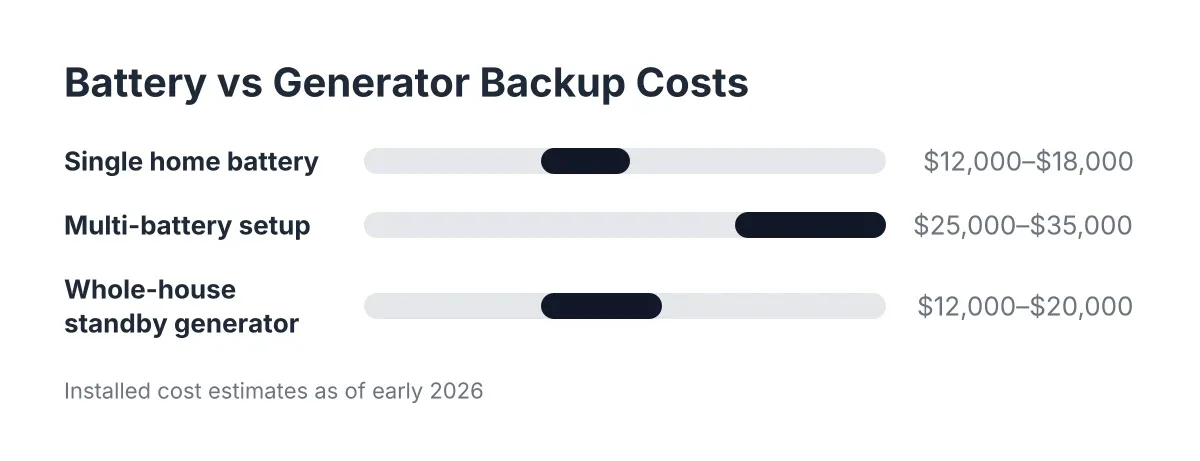
As a rough illustration, and these are estimates, not quotes: one battery installed often lands in the $12,000 to $18,000 range as of early 2026, a multi-battery setup can reach $25,000 to $35,000, and a whole-house standby generator with gas plumbing and transfer switch commonly runs $12,000 to $20,000 installed. Your numbers will differ with your panel, your gas service, and your house.
Step 3: Weighing Home Battery Backup Power During Outages Against a Standby Generator
Neither option wins outright. The right answer depends on fuel, duration, and what Georgetown Utility Systems power does for your bill the rest of the year.
A standby generator runs as long as natural gas flows. That is its strength. Its weaknesses are noise, annual maintenance, and the fact that it does nothing for you the other 360 days a year. Gas supply also strained in some areas during Uri, so "unlimited runtime" has an asterisk in a true statewide event.
A home battery is silent, needs no fuel, and works year-round, shifting energy and smoothing your bill even when the grid is fine. Many systems include storm-watch features that charge to full automatically when severe weather approaches. The weakness is capacity. A battery alone holds a fixed amount of energy. Once it is drained, you wait for the grid, unless solar is recharging it.
That last point is where solar earns its place for a storm-prepper. During a daytime outage, panels can power the house directly and recharge the battery at the same time. In a two or three day event, that is the difference between one night of backup and nearly indefinite backup for an essentials load. Pairing solar with storage is the only setup that extends itself.
For example, suppose a homeowner in Sun City with a 2,000 square foot house adds an 8 kilowatt solar array and two batteries. In a hypothetical February outage, the batteries carry the essentials overnight, and even weak winter sun recharges them enough by afternoon to do it again. A battery-only neighbor in that same scenario runs dry sometime on day two.
Step 4: Learn How Georgetown Utility Systems Treats Solar and Batteries
Georgetown Utility Systems is a municipal utility. You do not shop retail plans the way Oncor-area homeowners do. According to Solar United Neighbors, homeowners in regulated utility areas typically have only one or a few solar buyback options, rather than the wide plan selection in deregulated markets. So the export credit you get for surplus solar is whatever the city's current tariff says, and you should confirm the current rate directly with the utility before you sign anything, because these rates change and stale 2022 numbers still circulate online.
Do not assume full retail net metering exists here. Ask the utility, in writing, what they credit per exported kilowatt-hour today. If the export credit is modest, that actually strengthens the case for a battery: storing your surplus and using it yourself is worth more than exporting it cheaply.
Also plan for interconnection paperwork. Utilities that allow residential solar commonly require engineering documentation and drawings for review before installation is approved, according to Arizona Public Service, and Georgetown Utility Systems has its own application process for systems in its territory. Your installer should handle this, but it adds weeks to the timeline, so start it early if you want backup ready before next winter. A note on geography: despite what some search results suggest, Georgetown Utility Systems serves Georgetown and nearby areas, not Buda, Kyle, Pflugerville, or San Marcos. If your bill comes from PEC, Oncor, or another utility, your rules differ.
Step 5: Sort Out the Incentives That Still Exist in 2026
The federal landscape changed. The 25D purchase credit, the 30% federal tax credit that according to the Internal Revenue Service historically applied to the total cost of a residential solar installation, has ended for homeowner purchases. What survives is the 48E path, which I call the lease credit: third-party-owned systems, meaning leases and power purchase agreements, can still capture a federal credit that the leasing company may pass through as a lower monthly payment.
According to the U.S. Environmental Protection Agency, both solar leases and PPAs let you get a system installed with no upfront cost, but in neither case do you own the equipment. A lease works like a car lease: fixed monthly payment regardless of production. For a backup-first buyer, read lease terms carefully, because some agreements complicate adding batteries later or selling the house.
In addition, you may run into income-qualified programs under the federal Solar for All program umbrella in parts of Texas, and some battery programs supply a battery but require you to obtain and pay for solar separately. Eligibility and availability change; verify anything current before you count on it. Georgetown Utility Systems itself does not run a rebate comparable to Austin Energy's, so do not let a quote assume one. If you see a rebate on a quote, ask exactly who pays it and as of what date.
Step 6: Quotes Scoped for Battery Backup Power Outages
Tell every installer the same thing up front: backup power is the goal, bill savings are secondary. That changes the design. A good backup-first quote should include all of the following in scope, not as extras:
- A critical-loads panel or whole-home backup gateway, stated clearly as one or the other
- The battery count, usable kilowatt-hours, and what loads it will carry in July and in February
- Interconnection application and any city permits, handled by the installer
- The export credit assumption, with the rate and its as-of date written on the quote
- Warranty terms for battery, inverter, and workmanship, each stated separately
Timeline expectations: from signed contract to a working system, two to four months is a realistic range in this area as of 2026, driven mostly by permitting and utility review rather than the install itself, which typically takes one to three days on the roof and one to two days for batteries. Your timeline will differ.
This is not a DIY project. Battery and generator installs involve service panel work, transfer equipment, and utility interconnection, all of which require licensed trades and inspection. If any quote proposes skipping the utility application, walk away. I cover the broader decision, including whether solar pencils at all here, in my full guide to Solar in Georgetown Utility Systems territory.
Step 7: Configure the System Before the Next Storm, Not During It
Once installed, spend an hour on settings. Most batteries offer a self-powered mode for grid independence, time-based modes for bill management, and a storm-watch mode that tops the battery off when severe weather is forecast. Turn storm watch on and leave it on. Set a minimum reserve, 20% or more, so daily cycling never leaves you empty when an unannounced outage hits.
Then test it. Flip your main breaker on a mild Saturday and confirm the house transfers, the backed-up circuits run, and the solar keeps producing into the battery. Finding a configuration problem on a sunny afternoon beats finding it at 2 a.m. in an ice storm.
One honest caveat to close on. If your house has heavy shade, a complicated roof, or all-electric heat with no way to shed load, a battery backup power during outages system may disappoint you, and a generator or even a smaller essentials-only design may serve you better. Texans saw a 17% increase in outage frequency between 2017 and 2022, according to Tesla, so the problem is real, but the right fix is house-specific. Have a licensed installer or electrician evaluate your panel and loads before you commit, and make every assumption on the quote carry a date.
For help with home battery storage and backup, Austin Solar FAQ is the place to start.
Prefer to talk it through? Call +15125571906 — a quick call is usually the fastest way to get a straight answer for your situation.