Solar in Georgetown Utility Systems Territory Terms Explained: A Plain-English Glossary
If you are reading solar quotes for a house served by Georgetown Utility Systems, you will hit terms that installers never stop to explain. This solar in georgetown utility systems territory glossary defines the ones that actually show up on quotes, bills, and permit paperwork, in plain English. Use it to read a proposal line by line, ask sharper questions, and spot the places where a salesperson is counting on your confusion. Each definition stands on its own, so you can skim to the term you need and move on.
- Georgetown Utility Systems: the city-owned utility that bills you
- Municipal utility: a utility the city owns and runs
- Export credit (buyback): what you get paid for surplus power
- Net metering: the billing setup people assume exists
- Kilowatt (kW) vs. kilowatt-hour (kWh): power vs. energy on your bill
- Interconnection agreement: the utility's permission to connect
- Production estimate: the installer's forecast of annual output
- Offset: how much of your usage solar covers on paper
- Payback period: years until savings equal cost
- Solar loan: borrowed money to own the system
- Solar lease: paying a company that owns your panels
- Purchase credit vs. lease credit: the two federal tax paths
- Inverter: the box that makes solar power usable
- Home battery: stored power for night or outages
- Whole-house standby generator: fuel-powered backup, no panels needed
- Permission to operate (PTO): the final switch-on approval
- Dealer fee: the hidden markup inside some loans
Who Bills You and How You Get Paid
The money side of solar in Georgetown Utility Systems territory comes down to who sends your bill and what that utility pays for your extra power. This section of the solar in georgetown utility systems territory glossary covers the billing and credit terms that decide whether the math works for your house.
Georgetown Utility Systems in Solar Territory
Georgetown Utility Systems is the city-owned utility that provides electric service to homes inside its Georgetown, Texas service area. It is not a retail choice market and not a co-op; the city sets the rates and the rules for solar customers. That matters because the utility, not the town name on your mailing address, decides your buyback rate, your interconnection process, and ultimately your payback. If you want the full picture for this specific utility, I walk through it in the honest read on Georgetown Utility Systems, buyback, and payback.
Municipal Utility
A municipal utility is an electric utility owned and operated by a city rather than by shareholders or by its customers. Georgetown Utility Systems is one. Municipal utilities write their own solar rules, so the policies you read about for Austin Energy or for the deregulated Oncor area do not apply to you. Always confirm a claim against the utility named on your bill, not against a statewide article.
Export Credit (Buyback)
An export credit, often called buyback, is the amount your utility credits you for each kilowatt-hour your panels send to the grid. It is the single number that most changes solar math, because a low export credit means surplus daytime power earns less than the power you buy back at night. Rates change, so any figure in a quote or an old blog post needs an as-of date; your numbers will differ. If a quote assumes a generous export credit without naming the current Georgetown Utility Systems rate and its date, that is a red flag.
Net Metering
Net metering means the utility credits exported power at the same rate you pay for imported power, so your meter effectively runs backward. Many national sales scripts assume net metering exists everywhere. It does not, and you should never assume it applies in Georgetown Utility Systems territory without checking the current policy. Ask the installer to say the words "export credit" and name the rate and its effective date.
Kilowatt (kW) vs. Kilowatt-Hour (kWh)
A kilowatt (kW) measures power at an instant, while a kilowatt-hour (kWh) measures energy used or produced over time. Your system size is quoted in kW; your bill and your production estimate are in kWh. A 6 kW system running at full output for one hour makes 6 kWh. Keeping these two straight lets you check whether a quote's production claim is plausible for its size.
Offset
Offset is the share of your annual electricity use that the proposed system is expected to produce on paper. A 100 percent offset does not mean a zero bill, because fixed charges remain and because exported power may earn less than imported power costs. In a territory without full net metering, a high offset can produce a lot of low-value exports. Ask how the offset interacts with the current Georgetown Utility Systems export credit.
Payback Period
A payback period is the number of years before your cumulative savings equal what you paid for the system. It depends on your usage pattern, the utility's rates, the export credit, and how you financed the system. Treat any payback figure in a quote as an estimate built on assumptions you can ask to see. Your numbers will differ, and an honest installer will say so.
Paperwork and Process for Georgetown Utility Systems Solar
Interconnection Agreement
An interconnection agreement is the contract between you and your utility that allows your solar system to connect to the grid. Georgetown Utility Systems has its own process and forms; your installer should handle the filing, but you sign it and you are the customer of record. No agreement, no legal connection. Ask who files it and how long approval typically takes before you sign an installation contract.
Permission to Operate (PTO)
Permission to operate, or PTO, is the utility's final written approval to switch your system on after inspection. Panels on the roof earn nothing until PTO arrives. The gap between installation day and PTO varies by utility and season, so ask the installer what they are currently seeing for Georgetown Utility Systems customers. A quote that implies same-week savings is skipping this step.
Production Estimate
A production estimate is the installer's forecast of how many kilowatt-hours your system will make per year. It should account for your roof's direction, tilt, and shade, not just the system's size. Two quotes for the same size system can carry different estimates, and the difference is usually shade and orientation assumptions. Ask what software produced the estimate and whether the installer did a shade measurement on site.
Money and Financing
Solar Loan
A solar loan is borrowed money you use to buy and own the system, repaid in monthly installments. You own the equipment, you keep any tax benefit you qualify for, and the system transfers with the house like any other improvement. Compare the loan's total cost over its life, not just the monthly payment. A low payment with a long term can cost more than it saves.
Solar Lease
A solar lease means a company owns the panels on your roof and you pay that company a monthly fee for the power or the equipment. You do not own the system, and selling the house means transferring or buying out the lease. Leases survived the end of the federal purchase credit because the leasing company claims its own credit, which is why you now see them pushed harder. Read the escalator clause; many leases raise the payment each year.
Purchase Credit vs. Lease Credit
The purchase credit is the federal tax credit (the old 25D path) that homeowners claimed when they bought a system, and it has ended; the lease credit is the surviving 48E path that a leasing company claims when it owns the system on your roof. This split explains why sales pitches shifted toward leases. If someone quotes you a homeowner tax credit on a 2026 cash or loan purchase, ask them to put it in writing and cite the rule. When in doubt, ask a tax professional, not a salesperson.
Dealer Fee
A dealer fee is a markup, often a percentage of the system price, that some lenders build into the cash price of a financed solar system to buy down the loan's interest rate. It is why the same system can cost noticeably more with certain loans than with cash. The fee is frequently not labeled on the quote. Ask directly: "What is the cash price without financing, and what dealer fee is in this loan?"
Equipment and Backup
Inverter
An inverter is the device that converts the direct current (DC) your panels make into the alternating current (AC) your home and the grid use. The two common designs are a single string inverter for the whole array and microinverters mounted under each panel. Which one fits depends on your roof's shade and layout. The inverter usually has a shorter warranty than the panels, so check both numbers in the quote.
Home Battery
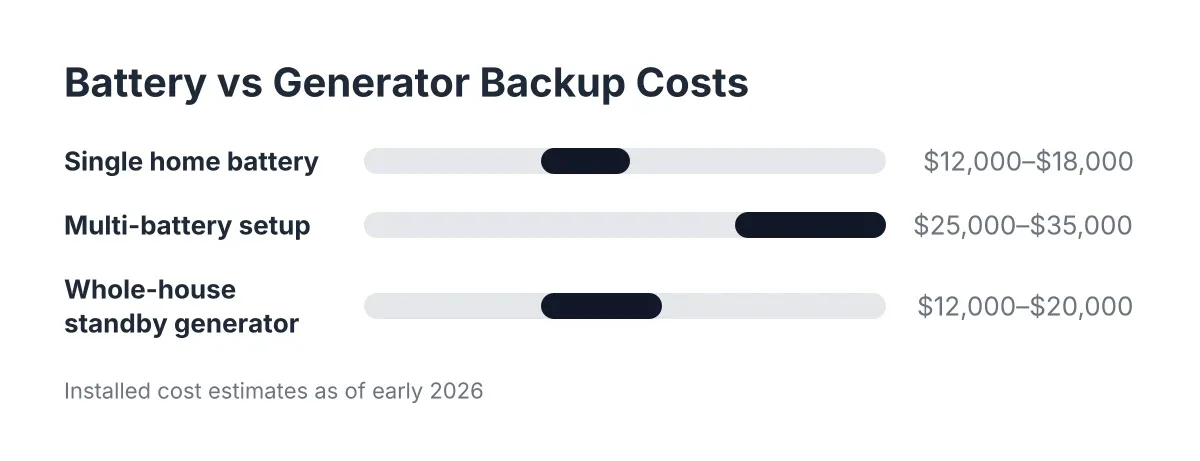
A home battery stores electricity so you can use solar power after sunset or keep selected circuits running during an outage. In a territory where exported power earns less than retail, a home battery can shift surplus daytime production to evening use instead of selling it cheap. Batteries add real cost, so run the math with the current Georgetown Utility Systems export credit before assuming one pays for itself. Backup during outages is a separate benefit from bill savings; decide which one you are buying.
Whole-House Standby Generator
A whole-house standby generator is a permanently installed, fuel-powered unit that automatically powers your home during a grid outage. It needs no panels and no sun, and for pure outage protection it can be the simpler tool than solar plus battery. It does nothing for your monthly bill. If backup is your main goal, compare a generator against a battery honestly before an installer bundles one into a solar quote.
Using These Terms
What this solar in georgetown utility systems territory glossary gives you is the vocabulary to read a quote line by line instead of trusting the summary page. You can now ask for the current export credit with its as-of date, the cash price without the dealer fee, and the assumptions behind the production estimate. If an answer is vague, that vagueness is information too.
For help with solar with Austin Energy, Austin Solar FAQ is the place to start.
Prefer to talk it through? Call +15125571906 — a quick call is usually the fastest way to get a straight answer for your situation.