Bluebonnet Solar Installation Costs in 2026: Real Solar Cost per kWh and Incentives
If Bluebonnet Electric Cooperative sends your bill, your solar math is different from your neighbor's in Austin Energy or Oncor territory. The number that cuts through the sales noise is solar cost per kWh: what you actually pay for every kilowatt-hour your panels produce over their life, and what Bluebonnet pays you for the ones you export. This guide works through both numbers for 2026, with the incentive picture as it actually stands, so you can put your three quotes side by side and know which one is honest.
I write this as someone who has worked inside residential solar in the Austin area. I am not an installer, I do not take referral fees, and nothing here is affiliated with Bluebonnet or any government program. Every dollar figure carries its as-of date, and your numbers will differ.
Why Bluebonnet Territory Changes Your Solar Math
Bluebonnet is a member-owned cooperative, not a deregulated retail market and not a municipal utility. That distinction decides your outcome more than which installer you pick. In deregulated parts of Texas, homeowners choose among multiple solar buyback plans from competing retail providers, according to Solar United Neighbors. In regulated and cooperative areas like Bluebonnet, you get the buyback terms the co-op offers, and that is the whole menu.
This matters for how you read a quote. A national sales rep will often model your savings using full retail-rate net metering, because that assumption makes the payback look shorter. Bluebonnet does not work that way. You are credited for exports at the co-op's rate, not automatically at one-to-one retail. For comparison, Pedernales Electric Cooperative next door credits surplus solar sent to the co-op at 7.1921 cents per kWh, only toward its Base Power Charge, according to PEC, which is below the full per-kWh cost of the power members buy. Rates like these change periodically, so confirm Bluebonnet's current export credit directly with the co-op before you sign anything. Any installer who cannot tell you the current Bluebonnet export rate off the top of their head has not done many jobs in this territory.
The practical consequence: in Bluebonnet territory, solar you use yourself is worth full retail value, and solar you export is worth less. System sizing should follow from that, and so should your skepticism about any quote that ignores it.
How to Calculate Solar Cost per kWh From Your Quotes
Solar cost per kWh is your total lifetime system cost divided by total lifetime production. It is the single best number for comparing quotes because it strips out panel brand talk, monthly payment framing, and rebate hand-waving. If one quote lands at 6 cents per kWh and another at 11 cents, you have found your answer regardless of what the reps say.
Here is the calculation, step by step:
- Take the total contract price. For a loan, use the full financed cost including dealer fees, not the sticker price. Dealer fees on solar loans commonly run 15 to 30 percent of the system price and are often buried.
- Subtract any incentives you will actually receive, with dates attached, not "estimated savings".
- Estimate lifetime production. Run your address, system size, tilt, and azimuth through the PVWatts calculator from NREL. In Central Texas, a well-oriented system produces about 1,400 to 1,500 kWh per kW per year as a rough planning figure; PVWatts will give you a site-specific number. Google Project Sunroof is a faster first pass for checking whether your roof gets enough sun at all.
- Multiply year-one production by 25 years, then reduce the total by about 8 to 10 percent for panel degradation.
- Divide net cost by lifetime kWh.
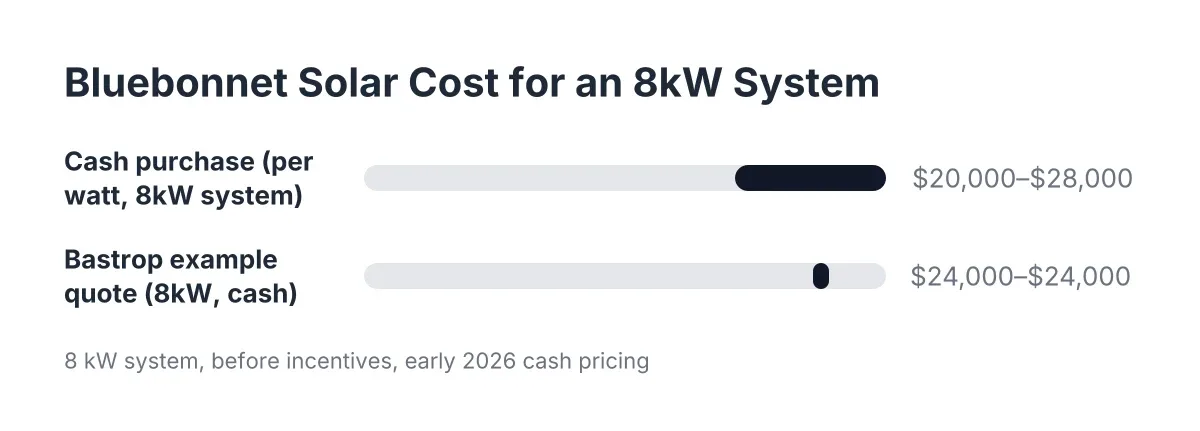
Suppose a homeowner in Bastrop gets a quote for an 8 kW system at $24,000 cash, as of early 2026. The PVWatts solar calculator estimates 12,000 kWh in year one. Over 25 years with degradation, that is roughly 275,000 kWh. The math works out to about 8.7 cents per kWh. That is an illustrative estimate, not a promise; your roof, your shading, and your contract will differ. But now compare that 8.7 cents to what Bluebonnet charges you per kWh on your bill, and the value proposition is suddenly concrete instead of scripted.
One warning on how installers use this number. Some reps quote a cost per kWh that assumes every kilowatt-hour offsets retail rates. In Bluebonnet territory it does not, because exported energy earns the lower credit rate. Ask each installer what share of your production they assume you use on site. If they cannot answer, the model behind their savings chart is guesswork.
What Bluebonnet Solar Installations Cost in 2026
A residential solar installation in Bluebonnet territory in 2026 typically runs $2.50 to $3.50 per watt for a cash purchase before incentives, based on what I see in the local market as of early 2026. An 8 kW system therefore lands between about $20,000 and $28,000. Financed prices run higher once dealer fees are included. Your numbers will differ by roof complexity, equipment, and installer overhead.
Price per watt is the right unit for comparing hardware and labor. Solar cost per kWh is the right unit for comparing outcomes. Use both. A cheap price per watt on a badly oriented roof can produce an expensive cost per kWh, and a premium quote on a perfect south-facing roof can be the better lifetime deal.
For the quote-comparing reader, here is what a fair 2026 quote in this territory should itemize:
- System size in kW DC and expected year-one production in kWh, with the modeling assumptions stated
- Total price, and if financed, the cash price and the financed price side by side
- Equipment by model, not just brand, for panels, inverters, and any home battery
- The Bluebonnet export credit rate the savings model assumes, with a date on it
- Interconnection scope, since Bluebonnet, like most utilities, requires engineering documentation for review before installation is approved, a standard practice according to Arizona Public Service
- Roof warranty terms and who handles penetration leaks
If a quote is missing three or more of these, that is not a paperwork oversight. It is a sign the company sells on monthly payment and hopes you never do the division.
Solar Incentives in Bluebonnet Territory: What Survives in 2026
The incentive picture changed, and this is where stale suburb guides will mislead you. Historically, a 30 percent federal tax credit applied to the total cost of a residential solar installation, according to the Internal Revenue Service. That purchase credit, the 25D path for homeowner-owned systems, has ended. If a sales rep models a 30 percent purchase credit on a 2026 cash or loan deal, walk away, because either they do not know the rules or they are hoping you do not.
What remains as of 2026:
- The lease credit. The 48E path survives for third-party-owned systems. A leasing company can still claim a federal credit and may pass some of that value through in your lease rate. A solar lease works like an equipment lease, similar to a car lease, where you pay a fixed monthly amount regardless of production, according to the U.S. Environmental Protection Agency. You do not own the system under a lease or a power purchase agreement; the EPA notes that in neither arrangement does the building owner actually own the system. That trade-off deserves a hard look, especially if you plan to sell the house.
- Texas property tax exemption. The added home value from a solar installation is exempt from property tax assessment in Texas. Confirm the paperwork with your county appraisal district.
- Texas sales tax exemption. Solar equipment carries a sales tax exemption at purchase, which quietly trims the installed cost.
- Bluebonnet-specific programs. Co-op incentives come and go, and some utility programs pay more for solar paired with a home battery than for panels alone, sometimes varying by system size and orientation. Check Bluebonnet's current offerings directly before you sign, and get any rebate promise in writing inside the contract.
Do not use Austin Energy's numbers as a proxy. Austin Energy credits all of a home's solar production at its Value of Solar rate, 12.89 cents per kWh for systems under 1 MW-AC effective October 1, 2026, according to Austin Energy, but that tariff applies only to Austin Energy customers, and it changes periodically. Bluebonnet members get Bluebonnet's terms, full stop. If your quote's savings page shows Austin Energy's Value of Solar rate and your bill says Bluebonnet, the model was built for the wrong utility.
What Happens to Your Bluebonnet Bill After Solar
Your Bluebonnet bill after solar shows energy charges reduced by self-consumed solar, export credits for surplus sent to the grid, and fixed charges that never go away. Expect a smaller bill, not a zero bill. Fixed monthly charges cover the wires, poles, and grid service, and no amount of rooftop production bypasses them.
The mechanics run like this. During a sunny afternoon, your panels serve your house first. Whatever you do not use flows to the grid and earns the export credit. At night you buy power from Bluebonnet at the normal rate. Your bill nets these together: energy charges, minus solar credits, plus fixed charges. In practice, a system sized close to your daytime usage delivers a better solar cost per kWh outcome in this territory than an oversized system that exports half its production at the lower credit rate.
Net metering programs elsewhere let homeowners sell excess energy back at rates that can offset most of a bill, according to Mass.gov, but that framing does not transfer cleanly to a Texas co-op. Say "export credit" when you talk to installers, and make them use Bluebonnet's actual rate in the model.
Backup Power in Bluebonnet Territory: Batteries, Generators, and Outages
If a multi-day outage is the reason you started this research, get one fact straight first: a standard grid-tied solar system shuts off during an outage. It does this by design, to protect line workers. Panels alone give you nothing when the grid goes down. You need a home battery with backup capability, or a whole-house standby generator, or both.
For the outage-motivated homeowner in co-op territory, the 2026 decision tree looks like this:
- A home battery, in the Tesla Powerwall, Enphase, or Generac PWRcell class, backs up selected circuits or the whole house for hours to a day or two, recharges from solar during extended outages, and works silently with no fuel logistics. Installed costs commonly run $12,000 to $20,000 per battery as of early 2026; your numbers will differ.
- A whole-house standby generator runs indefinitely on natural gas or propane and usually costs less upfront than a multi-battery setup, but it needs fuel supply, maintenance, and it does nothing for your monthly bill.
- Solar plus battery is the only combination that rides through a week-long outage without fuel deliveries, because the panels recharge the battery every day.
For example, suppose a household outside Bastrop lost power for three days in a winter storm and now runs a home office with medical equipment in the house. In that scenario, a battery-first purchase around $15,000 to $25,000 with solar added now or deferred a year is a coherent plan, and the solar portion still deserves the cost per kWh analysis above even though resilience, not savings, drives the decision. Sizing backup for well pumps, HVAC, or medical loads is a job for a licensed electrician; get a load calculation before you pick a battery count.
Is Solar Still Worth It in Bluebonnet Territory?
Solar is worth it in Bluebonnet territory for many homes in 2026, but not for all of them, and the honest answer depends on your roof, your usage pattern, and the current export credit. The strongest candidates share a profile: monthly bills in the $100 to $300 range, unshaded south or west roof space or room for a ground mount, an HOA that cooperates, and daytime usage that soaks up most of the production.
The scale of the Texas market says the technology works here. Texas had 34,907 MW of solar installed as of Q2 2024, enough to power over four million homes, according to Go Solar Texas, and the state led the nation in new capacity in early 2025 with 2.7 GWdc, 92 percent more than second-ranked Florida, according to the Solar Energy Industries Association. However, statewide totals do not decide whether your specific house pencils out. A heavily shaded roof, a bill under $80 a month, or a planned move within five years all argue for waiting, and I will say so even though this is a solar guide.
Solar in Bluebonnet and San Marcos territory follows the same core rule everywhere in the region: the utility on your bill, not your town or your installer, sets the terms that decide your payback. Two houses a mile apart in San Marcos can sit in different territories with different export credits, and their identical quotes will produce different outcomes.
Questions to Ask Before You Sign Anything
You have quotes in your inbox and reps calling back. Before the next conversation, put these on paper:
- What Bluebonnet export credit rate does your savings model use, and what is its as-of date?
- What percentage of my production do you assume I use on site rather than export?
- What is the cash price, and separately, what is the financed price including all dealer fees?
- What does this system cost per kWh over 25 years using your own production estimate?
- Which purchase or lease credit are you claiming applies in 2026, and can you show me the rule?
- Who submits the interconnection application and engineering documents to Bluebonnet, and what happens if the co-op requires changes?
- If I add a home battery later, does your inverter choice support it, or will I pay for rework?
An honest installer answers all seven without flinching. A script-driven one stalls on questions one, four, and five. If someone pressures you to sign before a rebate expires, ask for the program name and expiration date in writing; real deadlines survive that request and invented ones do not.
Run your own production estimate through the PVWatts calculator before the follow-up call. When your number and the installer's number disagree by more than about 10 percent, make them explain the gap. The rep who welcomes that conversation is usually the one whose quote holds up. The math is not complicated. It is just rarely shown to you, and in Bluebonnet territory in 2026, the homeowner who does the division wins.
For help with solar in Bluebonnet and San Marcos territory, Austin Solar FAQ is the place to start.
Prefer to talk it through? Call +15125571906 — a quick call is usually the fastest way to get a straight answer for your situation.