Austin Energy Solar Rebates in 2026: Stacking Federal, State, and Utility Incentives
If Austin Energy sends your electric bill, the incentives you can stack in 2026 look different than they did two years ago, and different than what most national websites still say. This guide walks through stacking solar incentives in 2026, Austin Energy solar rebates, the federal picture after the purchase credit ended, what Texas does and does not offer, and the order to claim everything. I work in this industry locally. I am not an installer, not affiliated with Austin Energy or any government program, and I am not selling anything. The numbers here carry their as-of dates. Your numbers will differ, and I will tell you why at each step.
Who This Guide Is For
Two kinds of readers end up on this page. The first opened a summer bill that was $100 higher than last year, is living on a fixed income, and wants a straight answer on whether solar lowers the bill enough to justify the upfront cost. The second cares less about the bill and more about keeping the lights on, often after a multi-day outage, and is weighing a home battery or a whole-house standby generator first.
Both of you need the same foundation: what Austin Energy actually pays and rebates in 2026, what the federal government still offers, and how those pieces stack. The stacking order matters because one choice, buying versus leasing, changes which federal path you can use at all.
One note on territory. Austin Energy is the City of Austin's municipally owned utility. It serves most of Austin proper and slices of some surrounding areas. If your bill comes from Pedernales Electric Cooperative, Bluebonnet, Oncor through a retail provider, or Georgetown Utility Systems, the rules in this article do not apply to you. The utility, not your town, decides your outcome. Parts of Leander and Lakeway, for example, split between Austin Energy and PEC, so check the logo on your bill before you read further.
Austin Energy Solar Rebates for Stacking Incentives in 2026
Austin Energy runs a residential solar rebate program that pays a one-time, upfront amount when you install a qualifying rooftop system. It is a utility rebate, paid by Austin Energy, separate from anything federal. The rebate reduces your installed cost directly rather than waiting for tax season, which matters if you are retired and no longer have much federal tax liability.
Three program rules trip people up, and all three are standard for utility-run rebate programs:
- You must use a contractor registered with Austin Energy. Hiring an out-of-network installer, even a good one, forfeits the rebate entirely. Ask any installer, in writing, whether they are currently on Austin Energy's participating contractor list before you sign anything.
- You must complete Austin Energy's solar education course first. It is a short online course, sometimes informally called the solar rebate quiz. It is free, and finishing it is a hard prerequisite for the rebate application. If a salesman at your door says you can skip it, that tells you something about the salesman.
- The equipment and system design must be approved. Austin Energy reviews the application, the equipment list, and the engineering documentation before installation. Utilities commonly require this review before approving interconnection, according to Arizona Public Service, and Austin Energy is no exception. A system installed before approval can lose the rebate.
Rebate amounts change. Austin Energy has adjusted the residential rebate several times, including increases, and the budget for the program is finite within a fiscal year. Whatever dollar figure you saw in a 2022 suburb guide or a national template page is probably stale. Confirm the current residential rebate amount on Austin Energy's own program page the week you apply, because that figure, not an article's, is the one you will receive. Austin Energy's residential and commercial solar rebate programs are formally tracked in the DSIRE incentives database maintained by the NC Clean Energy Technology Center, which is a reasonable second place to verify what is live.
Austin Energy also rebates other measures, including solar screens, through separate programs. Those do not stack onto the solar PV rebate for the same equipment, but a solar screen rebate on your west windows can shrink your cooling load before you size a solar system. Smaller load, smaller system, smaller check to write. That ordering, efficiency first, panels second, is the cheapest money in this whole process.
The Value of Solar Tariff, Not Net Metering
Austin Energy does not offer net metering. This is the single most misunderstood fact in the Austin market, and it changes the math more than any rebate does.
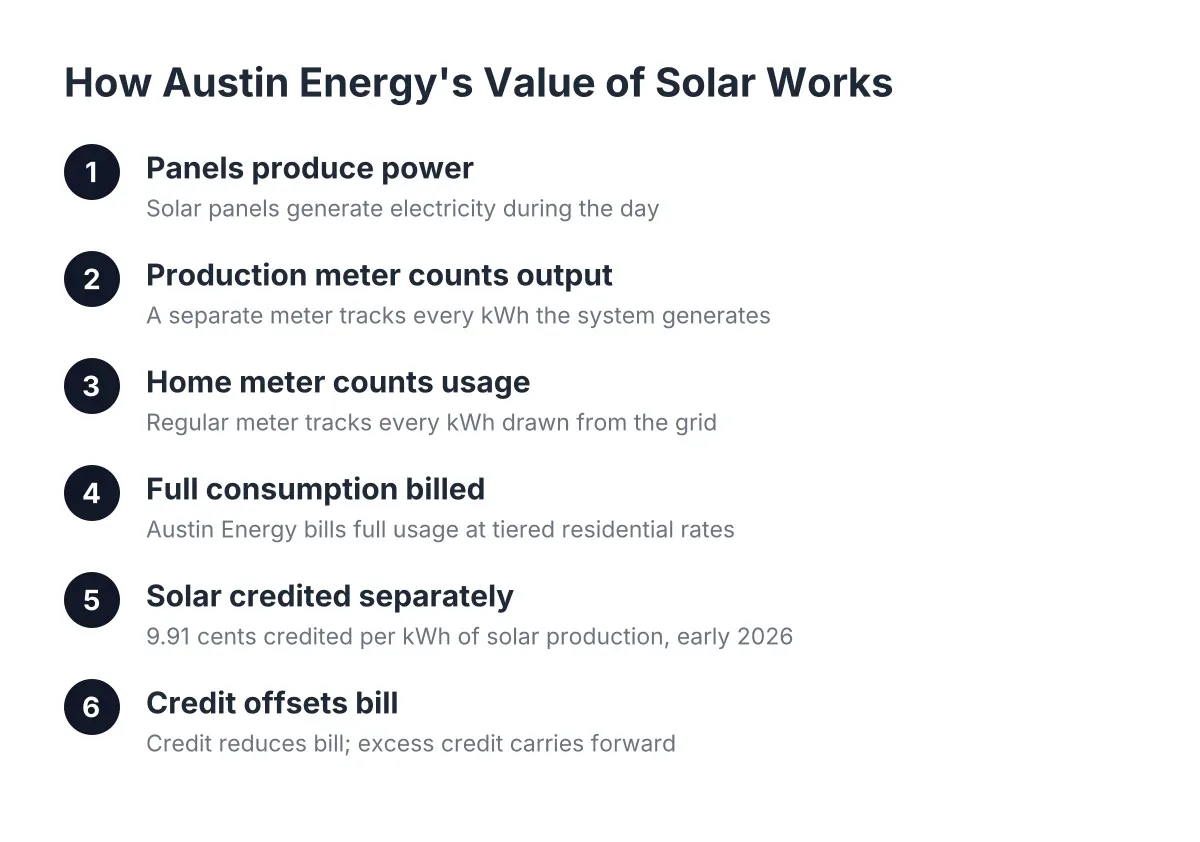
Under classic net metering, your exported solar energy offsets your consumption one-for-one at the retail rate, and you can earn credits when the system produces more than the home uses, as Mass.gov describes the model. Austin Energy replaced that with the Value of Solar tariff. Under Value of Solar, Austin Energy bills you for every kilowatt-hour your home consumes at the normal retail rate, then credits you separately for every kilowatt-hour your panels produce at the Value of Solar rate.
As of the most recent published figure, Austin Energy's Value of Solar tariff credits residential solar customers 9.91 cents per kilowatt-hour for exported production, according to NuWatt Energy. That rate is set administratively and can change; treat 9.91 cents as a reference point with an as-of date, not a promise. Your rate when you interconnect will be whatever is in the tariff that year.
For comparison, Pedernales Electric Cooperative next door credits solar exports at 6 cents per kilowatt-hour under its buyback arrangement, according to SolarSavingsAI. In regulated and municipal territories like these, you get the one buyback plan your utility offers; only customers in deregulated areas served through Oncor can shop among competing solar buyback plans, as Solar United Neighbors notes. So if a door-knocker promises you "full net metering with Austin Energy," he is describing a product that does not exist here.
What does Value of Solar mean practically? Oversizing a system to bank huge export credits is a weaker strategy than it is under true net metering. The better strategy is sizing the system near your actual annual usage and, for some households, adding a home battery so more of your own production serves your own load. As buyback rates across the industry drift down and retail rates drift up, the value of storing your energy keeps rising relative to the value of exporting it.
Federal Incentives in 2026: Purchase Credit Gone, Lease Credit Alive
Here is the part where 2026 differs sharply from every article written before it. The federal residential purchase credit, the Section 25D credit that historically returned 30% of a purchased system's total cost according to the Internal Revenue Service, has ended for homeowners who buy their systems outright. If you write a check or take a solar loan in 2026, you should not count on that 30% coming back at tax time.
However, a separate federal path survives. The 48E lease credit still flows to the companies that own leased systems and systems under power purchase agreements. Under a solar lease, you pay a fixed monthly amount for the equipment, similar to a car lease, and the leasing company owns the system, as the EPA describes the structure. Because the company owns it, the company claims the federal lease credit, and competitive lessors pass some of that value through as a lower monthly payment.
That flips a piece of conventional wisdom. For years, the standard advice was that buying beats leasing for almost everyone. In 2026, with the purchase credit gone and the lease credit intact, a well-structured lease can pencil out better than it used to, especially for a retiree with little or no federal tax liability who could never have used the purchase credit fully anyway.
Leases still carry real risks that matter on a fixed income:
- Term length. A 20 or 25 year lease can outlive your plans for the house, and sometimes your budget. Know the buyout schedule before signing.
- Escalators. Some leases raise the payment 1% to 3% per year. On a fixed income, insist on a flat payment or walk.
- Home sale friction. A buyer must qualify to assume the lease or you must pay it off at closing.
- No ownership, ever. As the EPA notes, in neither a lease nor a PPA does the homeowner own the system. The Austin Energy rebate and the Value of Solar credits still apply, but read who receives the rebate in a lease deal; sometimes the lessor keeps it.
If a lease quote claims "free solar," close the door. Nothing here is free. The honest version is "no upfront cost, fixed monthly payment, you do not own it."
What Texas Offers (and Does Not)
Texas has no statewide solar rebate and no state income tax credit, because Texas has no state income tax. Will there be a solar tax credit in Texas in 2026? No state credit exists, and none is scheduled. What Texas does offer is a property tax exemption for the added home value from a solar installation, so your appraisal district does not tax you on the system's value. File the exemption form with your county appraisal district after installation; it is not automatic everywhere.
The state's role in solar is mostly scale, not subsidy. Texas installed 2.7 gigawatts of solar capacity in the first quarter of 2025 alone, 92% more than second-ranked Florida, according to the Solar Energy Industries Association. As of mid-2024, Texas had 34,907 megawatts installed, enough to power about 4 million homes, according to Go Solar Texas. That scale keeps equipment and labor prices competitive here, which is its own quiet incentive.
How to Stack Solar Incentives and Federal Credits in 2026
Incentives at the federal, utility, and local levels are generally designed to stack, and the order you claim them in is mostly fixed by how each one works. Understanding the process requires knowing the right sequence for an Austin Energy customer, which goes step by step:
- Cut your load first. Attic insulation, duct sealing, and Austin Energy's solar screen rebate shrink the system you need before you price one.
- Take Austin Energy's solar education course. Required before the rebate application, and it genuinely helps you read quotes.
- Choose purchase or lease. This decides your federal path. Purchase means no federal purchase credit in 2026. Lease means the lessor claims the federal lease credit and should discount your payment for it.
- Pick a contractor registered with Austin Energy. Non-registered installers forfeit the utility rebate. Verify registration yourself; do not take the salesperson's word.
- Apply for the Austin Energy rebate before installation. Austin Energy reviews the design, equipment, and engineering documents, then reserves your rebate.
- Install, inspect, interconnect. City inspection, then Austin Energy's interconnection approval and meter work. Budget several weeks from signed contract to permission to operate; timelines stretch when the program is busy.
- Start earning Value of Solar credits. The credit appears as a separate line on your bill at the tariff rate in effect.
- File your property tax exemption with the county appraisal district.
One stacking note on batteries. Some utility programs across the industry pay more for solar paired with a home battery, or tier rebates by system orientation, since west-facing panels produce more in the expensive afternoon hours. Check what Austin Energy's current program guidelines say about battery pairing and orientation the year you apply, because these program details shift and the published guidelines govern, not any article, including this one.
A Worked Example: Suppose a Retiree in South Austin
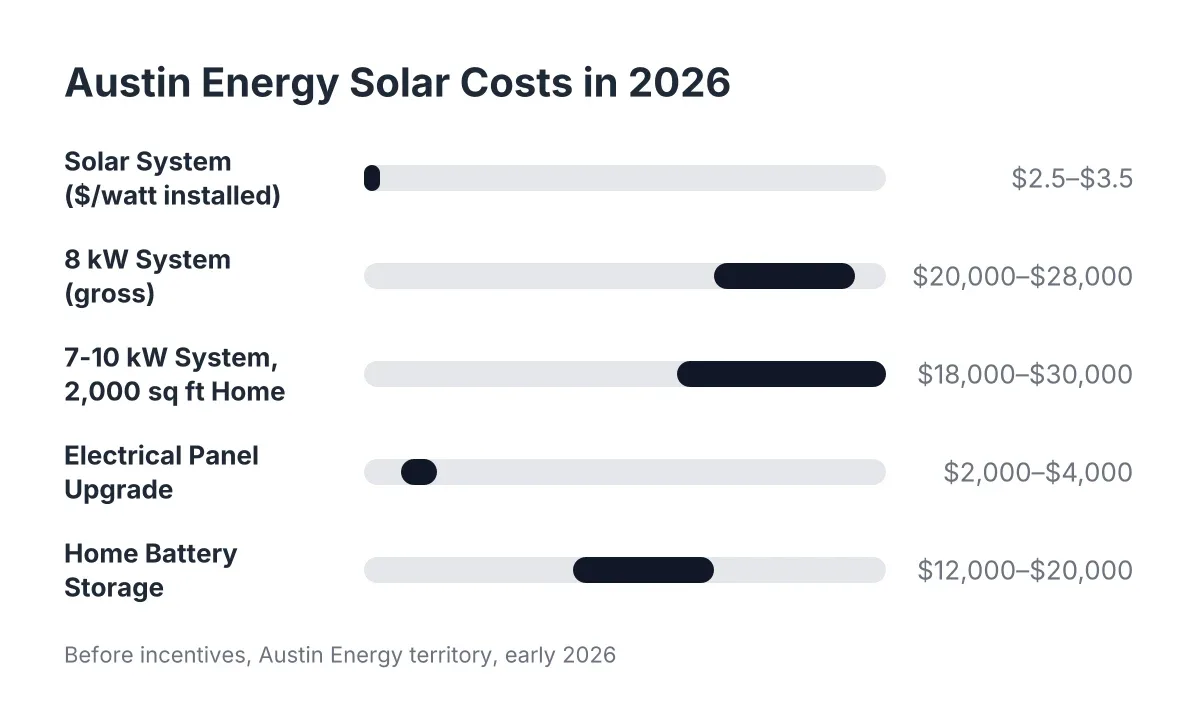
Say a retired homeowner in South Austin uses about 12,000 kilowatt-hours a year, with summer bills that jumped $100 over last year. Suppose a registered contractor quotes a 7 kilowatt system at $21,000 before incentives. These are illustrative numbers, not a quote from anyone; your roof, shading, and usage will produce different figures.
In that scenario, the Austin Energy rebate comes off the top at whatever the current residential amount is when the application is approved. There is no federal purchase credit to subtract in 2026. The system might produce around 10,500 kilowatt-hours a year on a decent roof. At a Value of Solar rate near the published 9.91 cents, that production is worth roughly $85 to $90 a month in bill credits, against retail charges that keep rising. When stacking solar incentives for 2026, payback for a purchased system in that scenario lands in the low-to-mid teens of years, longer than the sub-10-year paybacks quoted when the federal purchase credit existed.
Is that worth it for a retiree? Honestly, sometimes no. If you are 78, plan to move within five years, and would drain savings to pay cash, this is a poor fit and you should say so to the next salesman. If you are 66, staying put, and the alternative is watching the bill climb every summer for twenty years, a purchased system or a flat-payment lease can be a reasonable hedge. Run your own production estimate; tools like a tesla solar calculator give a rough starting point, though utility-specific quotes beat any national calculator. Have your accountant or a trusted family member review any lease or loan before you sign; that second set of eyes is worth more than any rebate.
Where Batteries and Generators Fit the Stack
If outages drove you here rather than the bill, the incentive math changes shape. A home battery, whether a Tesla Powerwall, Enphase, or Generac PWRcell, added to a solar purchase can qualify under whatever battery provisions Austin Energy's program guidelines include that year, and a battery raises the share of your solar production you use yourself instead of exporting at the Value of Solar rate. Under a tariff that pays less than retail for exports, self-consumption through a battery earns retail-rate value on every stored kilowatt-hour.
A whole-house standby generator, by contrast, attracts no Austin Energy solar rebate and no federal energy credit. It is a pure resilience purchase. For a household with medical equipment or a home office that cannot lose power for days, a generator or a generously sized battery is the first purchase and solar is the second, sometimes deferred. That ordering is legitimate; just do not let anyone sell you the generator wrapped inside a solar loan without separating the line items.
One more scope note. Tesla sells an integrated tesla solar roof as an alternative to panels on shingles. Tesla solar roof cost runs well above conventional panels for the same output, and a tesla solar roof installation makes sense mostly when you need a new roof anyway and want the integrated look. The Austin Energy rebate rules about registered contractors and approved equipment still apply, so confirm eligibility before assuming any rebate on a solar roof product.
Questions Austin Energy Customers Ask in 2026
Is the 30% solar tax credit going away in 2026?
For purchased residential systems, the 30% federal purchase credit has already ended; a homeowner buying a system in 2026 should not plan around it. The separate federal lease credit survives for systems owned by leasing companies, which is why lease pricing can look stronger relative to cash purchases than it did in earlier years. Tax situations vary, so confirm your own position with a tax professional before you sign.
Why is my electric bill so high if I have solar?
A high bill with solar under Austin Energy usually traces to the Value of Solar structure: you pay retail for all consumption and earn the tariff rate, 9.91 cents per kilowatt-hour as of the latest published figure according to NuWatt Energy, on production. If summer consumption outruns production, the gap lands on your bill. Undersized systems, new loads like an EV charger, shading from tree growth, and inverter faults are the other usual suspects. Check your production numbers monthly; a dead inverter can sit unnoticed for a full billing cycle.
Can I still use Austin Energy power when my panels are not producing?
Yes. A grid-tied system draws from Austin Energy automatically at night and on cloudy days; you never lose service because production dips. The catch runs the other way: during a grid outage, a standard grid-tied system shuts off for line-worker safety, and only a home battery or generator keeps your house powered.
How long does installation and interconnection take with Austin Energy?
From signed contract to permission to operate, plan on roughly six to twelve weeks in typical conditions: rebate application and design review, city permitting, one to three days of physical installation, inspection, and Austin Energy's interconnection and metering step. Busy rebate periods stretch that timeline. The panels going on the roof is the fast part; the paperwork is the slow part.
The Short Version
Solar with Austin Energy in 2026 means stacking three things: the utility's upfront rebate through a registered contractor, the Value of Solar credit on every kilowatt-hour you produce, and, on the lease path only, federal value passed through the lessor. There is no Texas state credit, no net metering here, and no more federal purchase credit. Verify the current rebate amount and Value of Solar rate on Austin Energy's own pages the week you act, because both move and this article will eventually be the stale one. Every figure above carries its date for that reason, and your numbers will differ.
For help with solar with Austin Energy, Austin Solar FAQ is the place to start.
Prefer to talk it through? Call +15125571906 — a quick call is usually the fastest way to get a straight answer for your situation.