Solar Installation Costs in Austin Energy Territory: Price Per kWh in 2026
If Austin Energy sends your electric bill, the math on solar works differently than it does one county over. Most pages about solar installation costs in Austin quote a single city-wide price and move on. That number hides the thing that actually decides your payback: how Austin Energy pays you for the power your panels make. Understanding the solar payback in Austin energy decisions requires knowing what a system costs in 2026, what the Value of Solar tariff pays per kWh, and how both numbers change if you are adding a home battery because the last multi-day outage is still fresh.
One note before the numbers. I work in this industry and I am not going to pretend otherwise. I am also not an installer, not a directory, and not affiliated with Austin Energy or any government program. Every dollar figure below carries a date, and your numbers will differ.
How Austin Energy Pays for Solar: The Value of Solar Tariff
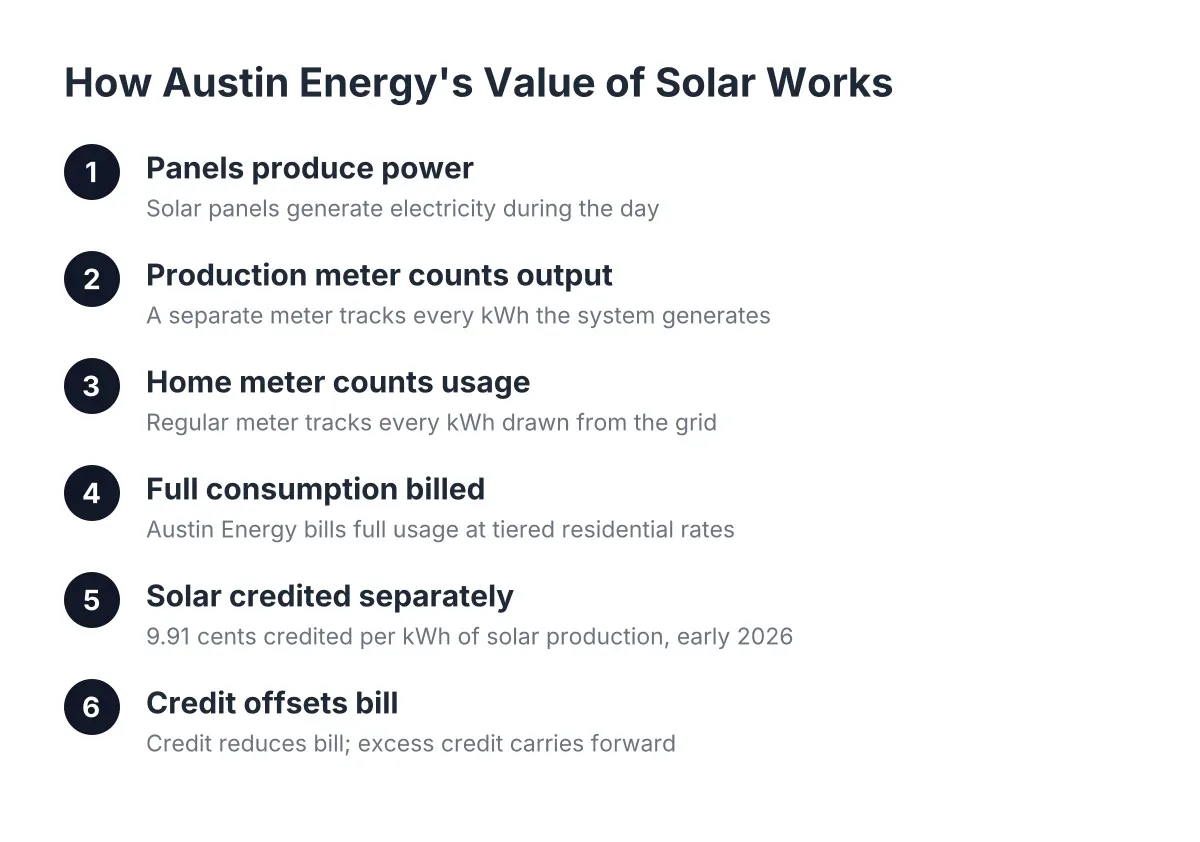
Austin Energy does not offer retail-rate net metering. Instead, it uses a tariff called Value of Solar. Every kilowatt-hour your panels produce gets credited at the Value of Solar rate, while every kilowatt-hour your house draws from the grid gets billed at the normal retail rate. The two rates are not the same, and that gap drives your whole payback calculation.
According to NuWatt Energy, Austin Energy's Value of Solar tariff pays residential solar customers 9.91 cents per kWh for exported electricity, in place of retail-rate net metering. Treat that figure as a snapshot, not a promise. Value of Solar rates get reviewed and adjusted periodically, so verify the current rate with Austin Energy before you sign anything. Your numbers will differ.
Here is why this matters more than the sticker price of the panels. Suppose your system produces 12,000 kWh in a year. Under full retail net metering, every one of those kilowatt-hours would offset grid power at the retail rate. Under Value of Solar, your production earns the tariff rate while your consumption bills at retail. If retail runs higher than 9.91 cents, which it does once you stack base energy charges and riders, each solar kilowatt-hour is worth less to you in Austin than it would be under a true one-for-one program.
For comparison, Pedernales Electric Cooperative, which serves parts of the Austin area including much of Leander and Lakeway, offers retail-rate net metering to its roughly 375,000 customers and credits solar exports at $0.06/kWh, according to SolarSavingsAI. Different utility, different compensation structure, different outcome for the same roof. This is why I organize everything by utility rather than by town. Your address might say Austin, Leander, or Lakeway; your bill decides which rules apply.
Solar Payback and Installation Costs in Austin Energy Territory in 2026
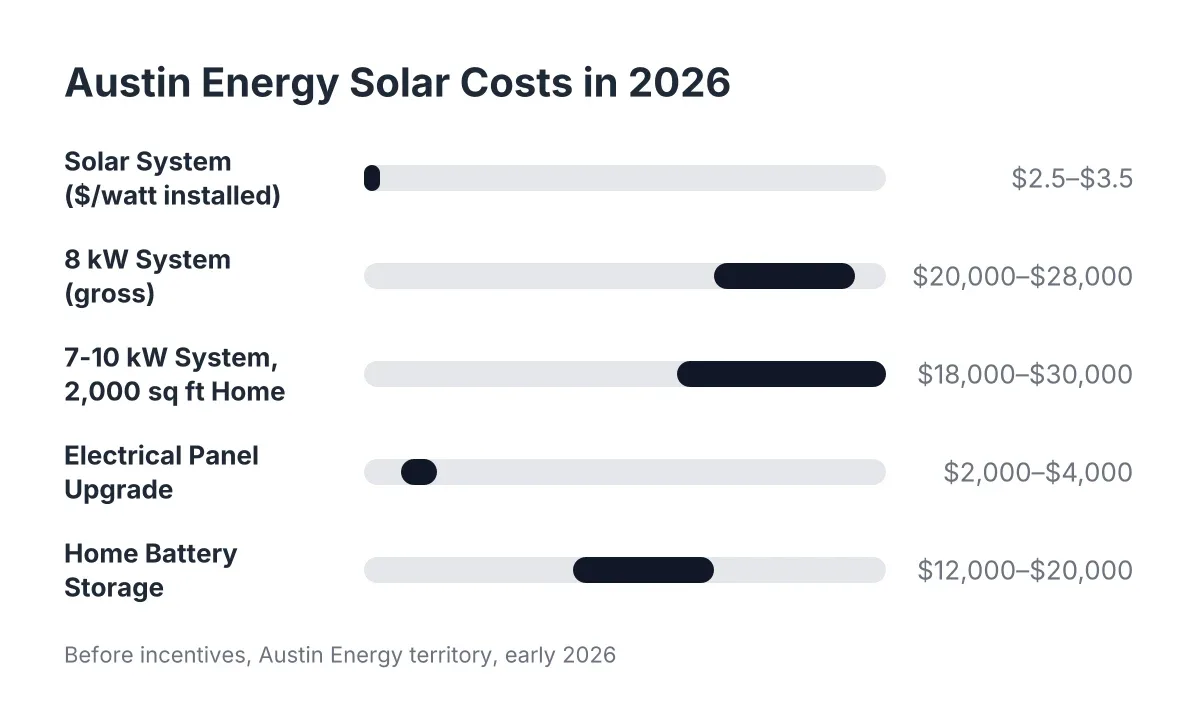
A typical residential solar installation in Austin Energy territory in 2026 runs about $2.50 to $3.50 per watt installed before incentives. That puts a mid-size 8 kW system at roughly $20,000 to $28,000 gross. These are my illustrative estimates based on how the local market is pricing systems, not quotes. Your roof, your equipment choices, and your installer will move the number.
A few things push you toward either end of that range:
- System size. Larger systems cost less per watt. A 12 kW system might land near $2.50 per watt while a 5 kW system sits closer to $3.50, because permitting, design, and crew mobilization cost about the same either way.
- Panel and inverter choices. Equipment is priced by wattage, not by panel count. If your roof has room, more lower-wattage panels can cost less than fewer premium high-wattage ones for the same total output.
- Roof complexity. Steep pitches, multiple small facets, tile or metal roofing, and shade mitigation all add labor hours.
- Electrical upgrades. An older main panel that needs replacement before interconnection can add $2,000 to $4,000.
- Battery storage. A home battery adds $12,000 to $20,000 installed per unit in 2026, depending on brand and whether you want whole-home or partial-home backup. More on this below, because for storm-preppers it is often the real reason for the project.
Texas also exempts solar equipment from sales tax at the point of purchase, which quietly shaves the total compared to taxable home improvements. And there is no shortage of local capacity to do the work; according to the Solar Energy Industries Association (SEIA), Texas installed more solar capacity than any other state in the first quarter of 2025, at 2.7 GWdc, 92 percent more than second-ranked Florida. The installer market here is deep, which keeps labor pricing competitive but also means quote quality varies widely among Austin solar companies.
All figures above are as of early 2026. Your numbers will differ.
Solar Payback Period and Home Energy Systems for 2,000 Square Foot Houses
A 2,000 square foot house in Austin Energy territory typically needs a 7 to 10 kW solar system, which costs about $18,000 to $30,000 before incentives at 2026 prices. The honest answer, though, is that square footage is a weak predictor. Your annual kWh usage, roof orientation, and shading matter far more than floor area.
Pull your last twelve months of Austin Energy bills and total the kilowatt-hours. A house that runs 14,000 kWh a year with two AC units and a pool pump needs a different system than a 9,000 kWh house of the same size. Any installer who prices your system from square footage alone, without looking at usage history, is guessing. Online solar installation cost estimators have the same weakness; use them for a rough range, then let actual usage data set the size.
Working Out Your Real Price Per kWh
The most useful way to evaluate solar installation costs in Austin is to convert the upfront price into a cost per kilowatt-hour over the system's life. It cuts through financing noise and lets you compare solar directly against what Austin Energy charges you today.
Here is the rough method. Take the net system cost after incentives. Divide it by the total kWh the system will produce over 25 years, discounted for the gradual output decline panels experience, about 0.5 percent per year. As an illustrative example, an 8 kW system costing $20,000 net might produce around 270,000 kWh over 25 years in Central Texas sun. That works out to about 7.4 cents per kWh of levelized cost, a calculation that informs the solar payback in Austin energy scenarios.
Now compare that against two numbers, not one. Power you use directly in the house offsets retail rates. Power you export earns the Value of Solar rate, 9.91 cents per kWh as of the NuWatt Energy figure cited above, subject to change. The more of your production you consume on-site, the better your effective return. This is one reason batteries and solar pair well under Austin Energy's structure: a battery lets you store midday production and use it in the evening instead of exporting it.
One misconception to clear up now, because it drives the single most common complaint from existing solar owners: your bill will not be zero. Austin Energy bills you for grid energy drawn, credits your production separately, and nets the two. Fixed charges remain. If you bought solar five or ten years ago expecting a zero bill, the system is not necessarily broken; the billing structure never worked that way.
What Incentives Austin Energy Offers in 2026
Austin Energy has historically run residential solar incentive programs, tracked formally in the DSIRE incentives database maintained by the NC Clean Energy Technology Center alongside its multifamily and commercial solar rebate programs. Program terms, rebate amounts, and eligibility requirements change, sometimes mid-year, and usually require completing an education course and using a participating installer. Check the current program details directly with Austin Energy before building a rebate into your budget. Your numbers will differ.
The federal picture changed more sharply. The 25D purchase credit, the 30 percent federal tax credit that, according to the Internal Revenue Service, historically applied to the total cost of a residential solar installation, has ended for homeowner purchases. If you are buying a system outright in 2026, do not let anyone put a 30 percent federal solar tax credit in your 2026 proposal.
The 48E path survives for leased systems. When a company owns the system on your roof and leases it to you, that company can still claim a lease credit and may pass some value through in your monthly payment. According to the U.S. Environmental Protection Agency (EPA), a solar lease works like an equipment lease, similar to a car lease; you pay a fixed monthly amount regardless of production, and you do not own the system. That trade-off is real. Leasing preserves access to the surviving credit, but you give up ownership, and a lease on the roof complicates a future home sale. Buyers rarely price future electricity costs into an offer, so sellers often cannot capture the system's full value either way.
Is the 30 Percent Solar Tax Credit Going Away in 2026?
For homeowners buying a system, the 30 percent purchase credit is already gone in 2026; it is not a question of going away later. The surviving federal path is the lease credit under 48E, available only when a third party owns the system, as in a solar lease or power purchase agreement.
This changes the buy-versus-lease math from previous years. A cash or loan purchase now stands on its own economics: system cost, Value of Solar compensation, and your retail rate. A lease carries no upfront cost, per the EPA's description of both leases and PPAs, but you never own the equipment. Run both scenarios with current numbers rather than 2022-era assumptions, which still circulate in older suburb guides.
Batteries, Generators, and the Outage Question
If you landed here because you lost a refrigerator full of food during the last grid event, the cost question changes shape. You are not just buying cheap kilowatt-hours; you are buying the ability to keep the lights on when ERCOT issues a conservation alert and the feeder goes down anyway. Solar panels alone do not do that. A standard grid-tied system shuts off during an outage for line-worker safety. You need a home battery or a standby generator for backup.
Here is how the 2026 costs compare, as illustrative estimates:
- Home battery, one unit: about $12,000 to $20,000 installed. Backs up essential circuits, refrigerator, internet, lights, and some plugs, for a day or more depending on usage. Recharges from solar during the outage if paired with panels.
- Home batteries, two or more units: $25,000 to $40,000. Can carry central air conditioning for limited stretches, though a Texas summer outage with the AC running will drain even a large battery bank fast without solar recharging.
- Whole-house standby generator: about $10,000 to $18,000 installed, including the transfer switch and gas line work. Runs indefinitely on natural gas, carries the whole house including AC, but needs fuel supply, maintenance, and permits, and does nothing for your monthly bill.
The honest comparison: a generator wins on raw backup capacity per dollar, especially for whole-house cooling in July. A battery wins on silence, zero fuel dependence, and daily usefulness, because it cycles solar energy every evening and earns its keep even when the grid is fine. During Winter Storm Uri, some natural gas supplies faltered; batteries paired with solar kept recharging as long as the sun came up. Neither option is wrong. The right answer depends on your outage tolerance, your gas service, and your budget.
And to answer a question I see constantly: no, you do not need solar panels to install a home battery. A battery alone can charge from the grid and carry you through an outage. But under Austin Energy's Value of Solar structure, pairing the battery with panels improves the economics of both, since stored solar offsets retail-rate consumption instead of exporting at the tariff rate.
Already Own Solar? The 2026 Re-Evaluation
A lot of readers here bought solar between 2010 and 2020 and are now re-running the math. Maybe the inverter is underperforming, the lease buyout window is approaching, or the bill crept up and the original installer stopped returning calls. The questions are different from a new buyer's, but the per-kWh framing still applies.
Three situations come up repeatedly. First, a battery retrofit: adding storage to an existing system typically runs $12,000 to $20,000 in 2026, my estimate, and compatibility depends on your existing inverter brand and age. Some older string inverters require an AC-coupled battery; some setups justify replacing the inverter entirely. Second, a lease buyout: compare the buyout price against the cost of the remaining payments and the system's realistic remaining production, not against what a new system costs. Third, an aging system: panels degrading on schedule are usually fine, while a dead string or a failed inverter is a repair decision, not a replacement decision.
If your bill is high despite owning solar, check the obvious culprits in order: inverter faults, new loads like an EV or a pool heater, rate changes since you installed, and shading from trees that grew. Pull your Austin Energy bill and read the line items. It separates energy drawn from the grid, energy exported, and the net, which tells you quickly whether the system stopped producing or your usage grew.
The Numbers That Matter Before You Sign
Here is the short version of how to evaluate solar with Austin energy in 2026, whatever the proposal in front of you says. Pull twelve months of bills and get your real annual kWh. Confirm the current Value of Solar rate directly with Austin Energy, since the 9.91 cents per kWh figure cited here carries a date and will change. Confirm current rebate terms the same way. Price the system per watt, then convert to a levelized cost per kWh and compare it against both your retail rate and the export rate. If backup power is the real goal, price the battery and the generator side by side before assuming solar must come first.
Expect the process to take time. Austin Energy requires interconnection review before your system can energize, and utilities commonly require engineering documentation and drawings before approving installation, as Arizona Public Service (APS) describes for its own territory. From contract to permission to operate, two to four months is a realistic 2026 window in my estimate, longer if a panel upgrade or rebate inspection is involved.
One limitation worth stating plainly: solar is a poor fit for some houses in Austin Energy territory. Heavy shade, a roof due for replacement within five years, or low annual usage can push the levelized cost above what you pay the utility today. A structural or electrical question about your specific house belongs with a licensed professional, not an article. The point of understanding solar installation costs in Austin at the per-kWh level is that it gives you a number you can defend, whether the answer turns out to be yes, not yet, or not this roof.
For help with solar with Austin Energy, Austin Solar FAQ is the place to start.
Prefer to talk it through? Call +15125571906 — a quick call is usually the fastest way to get a straight answer for your situation.