Austin Energy Net Metering in 2026: How Value of Solar Buyback Credits Actually Work
If you lost power for two days last winter and started pricing a home battery, you have probably run into the phrase austin energy net metering in a search box. Here is the first thing to know, and it changes the math on everything downstream: Austin Energy does not do net metering. It does something different, called Value of Solar, and the difference decides whether solar pays off for your house, whether a battery changes your bill, and how fast you break even. Understanding the value of solar rate is essential to evaluating whether solar makes financial sense in Austin Energy territory.
I have worked in residential solar in the Austin area for years. I am not an installer, not a directory, and not affiliated with Austin Energy or any government program. This is the plain-English version of how the buyback actually works in 2026, written for someone who is tired of national template articles quoting 2022 rates.
Why Searching for Austin Energy Net Metering Leads You to the Wrong Answer
Austin Energy net metering, as most people picture it, does not exist. True net metering means the utility credits your exported solar at the same rate it charges you for imported power, one to one. Austin Energy replaced that model with its Value of Solar tariff, which pays a fixed rate for every kilowatt-hour your panels produce.
That distinction matters because almost every national solar calculator assumes net metering. Net metering programs, where they exist, let homeowners sell excess solar energy back to their utility and earn credits when the system produces more than the home uses, according to Mass.gov. Texas as a whole never adopted a statewide version of that. In the deregulated parts of Texas, customers choose among multiple solar buyback plans from retail providers, according to Solar United Neighbors. In regulated territory like Austin Energy's, you get the one arrangement the utility offers, and that arrangement is Value of Solar.
So when a payback spreadsheet built for California or Massachusetts tells you an Austin house breaks even in seven years, treat it as fiction until you have rerun the numbers under the actual tariff. The structure of the credit, not just the rate, drives the outcome.
How Austin Energy's Value of Solar Rate Replaces Net Metering
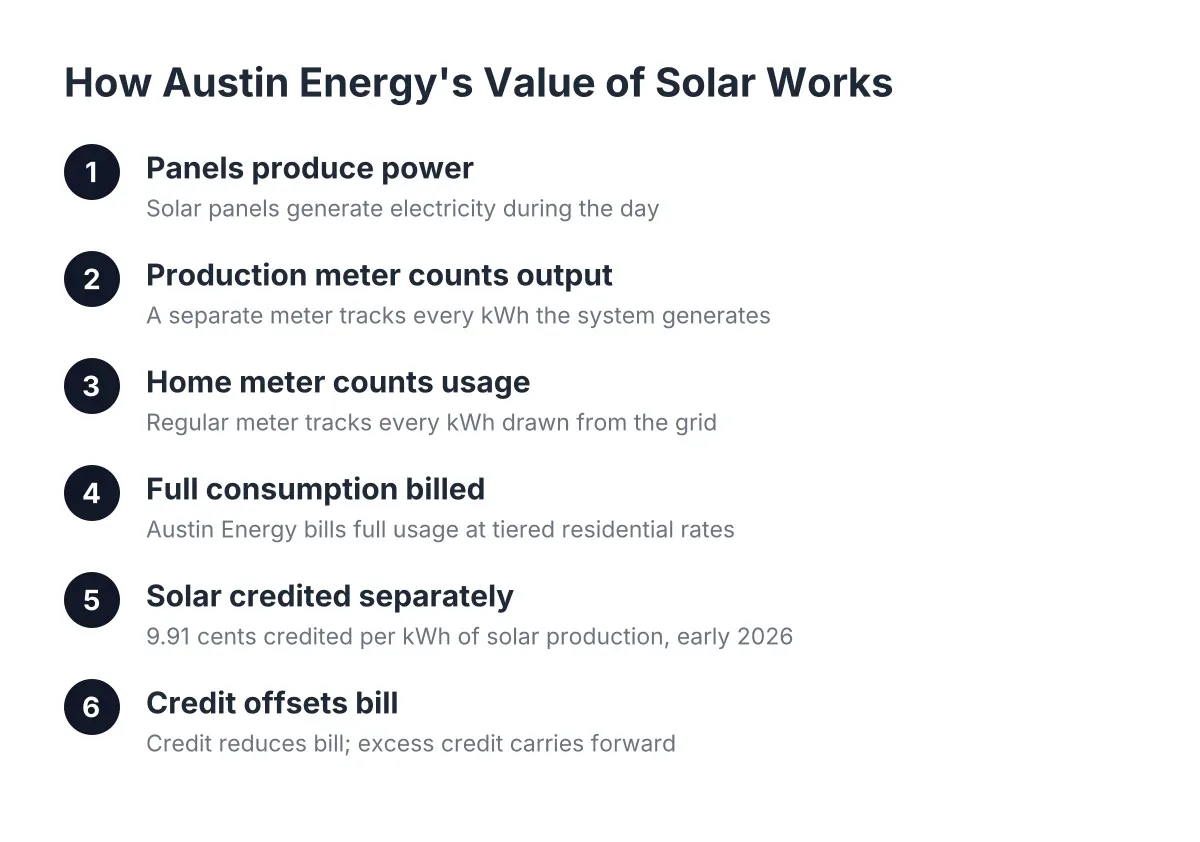
Under Value of Solar, Austin Energy meters two things separately: everything your home pulls from the grid, and everything your solar system produces. You pay retail rates for all consumption. You get credited at the Value of Solar rate for all production, whether your house used that power or not.
As of early 2026, the residential Value of Solar rate pays 9.91 cents per kilowatt-hour for solar production, according to NuWatt Energy. That rate gets reviewed and can change, so confirm the current figure before you sign anything. Your numbers will differ based on your usage, your roof, and the rate in effect when you interconnect.
Here is the mechanical difference from net metering, step by step:
- Your solar panels produce power during the day.
- A production meter counts every kilowatt-hour your system generates.
- Your regular meter counts every kilowatt-hour your home draws from the grid.
- Austin Energy bills you for your full consumption at its tiered residential rates.
- Austin Energy credits you 9.91 cents for each kilowatt-hour of solar production, as of early 2026.
- The credit offsets your bill; excess credit carries forward.
Notice what is missing. There is no moment where your solar directly cancels your usage on the bill. Under net metering, you could run the dishwasher at noon, cover it with your own panels, and the utility never sees either side of that transaction. Under Value of Solar, both sides show up on paper. You buy all your power, and you sell all your production, at two different rates.
A Worked Bill Example Under the 2026 Value of Solar Rate
Suppose a homeowner in Circle C with a 2,400 square foot all-electric house uses 1,400 kilowatt-hours in a July billing cycle. Say their 8-kilowatt system produces 1,100 kilowatt-hours that month. These are illustrative numbers; your numbers will differ.
Their consumption charge might land around $190 to $210 at Austin Energy's tiered summer residential rates, depending on which tiers the usage crosses. Their Value of Solar credit would be 1,100 multiplied by 9.91 cents, about $109. The net bill is the difference, roughly $85 to $100 plus fixed charges.
Compare that with true one-to-one net metering, where the same 1,100 kilowatt-hours would offset usage at the full retail rate, which in the upper tiers exceeds 9.91 cents. In that scenario the net metering bill would be lower. This gap, between what you pay per kilowatt-hour and what you get, is the single most important number in your payback spreadsheet. When the export rate sits below the import rate, the arrangement works like net billing rather than net metering, and the economics tilt toward using more of your own solar directly.
Is the Value of Solar Rate Good or Bad?
Honestly, it is middling, and the answer shifts depending on your usage. For a low-usage house, 9.91 cents credited on every kilowatt-hour produced can cover a large share of a small bill. For a high-usage house with a pool and an EV, your top-tier consumption costs more per kilowatt-hour than the credit pays, so solar offsets your bill at a discount rather than one to one.
For context, Pedernales Electric Cooperative, which serves about 375,000 customers around the Austin area, credits solar exports at 6 cents per kilowatt-hour, according to SolarSavingsAI. So Austin Energy's 9.91 cents, as of early 2026, is better than its nearest regulated neighbor. It is worse than true net metering. It is predictable, though, which fixed-rate buyback arrangements tend to be: a constant per-kilowatt-hour credit you can budget around without needing a battery or any special technology to capture it.
What Happens to Excess Solar on an Austin Energy Bill
Excess solar production on Austin Energy's tariff does not disappear or get given away. Because the Value of Solar credit applies to all production, not just the surplus, there is no cap where extra kilowatt-hours stop counting. If your credit exceeds your charges in a mild April, the balance carries forward to future bills.
However, carrying a credit balance is not the same as getting a check. You cannot cash out, and a system sized far beyond your usage ties up money in credits that only pay back at 9.91 cents while the panels cost you the same per watt to install. This is why experienced designers in Austin Energy territory size systems to annual usage rather than to the roof's maximum. Oversizing made sense under some old net metering regimes. Here it mostly does not.
One practical note: when you interconnect, Austin Energy requires a production meter alongside your billing meter, and your installer submits engineering drawings for utility review before installation is approved. That review step is standard practice; utilities commonly require engineering documentation before approving residential solar interconnection, according to Arizona Public Service. Budget weeks, not days, between a signed contract and permission to operate.
Why Your Bill Can Stay High After Going Solar
A high electric bill after installing solar in Austin Energy territory usually traces back to one of four causes: the system was sized against net metering math instead of Value of Solar math, usage grew after installation, the production meter or inverter has a fault, or the homeowner expected the credit to equal the retail rate. None of these mean solar failed. They mean the model was wrong.
This is the most common complaint I hear over the fence, and it is the reason the Reddit threads calling the buyback unfair keep getting written. The homeowner expected a one-to-one swap. The tariff pays 9.91 cents while summer top-tier consumption costs more than that. The bill shrinks, but less than the national calculator promised.
For example, say a Lakeway-style high-usage household at $350 per month expected solar to erase the bill. Under Value of Solar, a well-sized system might cut that to $120 to $160 in summer. Real savings, and a real gap from the sales pitch. If this describes you, the first fix is a Value of Solar bill model, not more panels. The second fix, for some houses, is shifting usage into daylight hours so your own production covers more of your consumption directly.
If your production has dropped, that is a service call. Inverter faults and failed panel optimizers are the usual suspects, and diagnosing them is a job for a licensed installer, not a weekend project.
Where a Home Battery Fits Under Austin Energy Net Metering Rules
A home battery in Austin Energy territory earns its keep through backup power, not bill arbitrage. Because the Value of Solar credit pays on all production regardless of where the power goes, storing solar in a battery instead of exporting it does not raise your credit. The battery's value here is keeping the fridge cold and the phones charged when the grid fails.
That is a different answer than you would get in deregulated Oncor territory, where some buyback plans reward time-shifted exports. It matters because most battery marketing assumes you are saving money by avoiding peak rates or capturing better export prices. Under Austin Energy's flat tariff, those strategies move little money. Your battery decision should be a resilience decision.
And resilience is a legitimate reason. Texans experienced a 17 percent increase in power outage frequency between 2017 and 2022, a figure Tesla cites as a driver of home battery adoption in the state. If you sat through a multi-day outage during a winter storm, you do not need convincing that the grid has bad weeks.
Battery, Generator, or Both for Outage Backup?
For whole-house backup through a multi-day Austin outage, a standby generator usually wins on raw endurance, a home battery wins on silence and daily usefulness, and pairing a battery with solar wins on indefinite runtime for essential loads. The right answer depends on what you need to keep running and for how long.
A few honest trade-offs, since the national guides tend to skip them:
- A single home battery, around 13 kilowatt-hours usable, will not run central air conditioning through a long August outage. It will run the fridge, lights, internet, fans, and phone charging for a day or more.
- Two or three batteries plus solar can run essential circuits indefinitely, because the panels recharge them each day, even during an outage.
- A whole-house standby generator on natural gas runs everything, including AC, for as long as the gas flows. It needs fuel, maintenance, a permit, and it is loud.
- Solar panels alone, without a battery, shut off during an outage. Grid-tied inverters disconnect for line-worker safety. This surprises people every time.
Do you need solar to get a battery? No. You can install a battery alone. But in Austin Energy territory, the battery-plus-solar pairing is what turns a one-day backup into a week-long one, and the solar side earns Value of Solar credits every normal day in between. The broader economics of panels, batteries, rebates, and interconnection in this territory are covered in my full guide to Solar with Austin Energy.
Rebates and Tax Credits That Change the 2026 Math
Two incentive layers sit on top of the Value of Solar tariff in 2026: Austin Energy's own solar rebate program, and what remains of the federal solar tax credit. Both have changed recently, and stale numbers are everywhere.
Austin Energy has run a residential solar rebate program for years, typically requiring you to complete its solar education course and use a participating installer. Rebate amounts and conditions change; confirm the current offer directly with the utility before counting it in your spreadsheet. Austin Energy's solar rebate programs are formally tracked in the DSIRE incentives database maintained by the NC Clean Energy Technology Center, which is a reasonable place to check current listings. As of early 2026, treat any specific rebate dollar figure you read on a third-party site as unverified until you see it on Austin Energy's own program page. Your numbers will differ.
On the federal side, the picture split in two. The 30 percent federal tax credit historically applied to the total cost of a residential installation, according to the Internal Revenue Service. The purchase credit for homeowner-owned systems ended, which is why "is the 30 percent solar tax credit going away in 2026" keeps trending. Additionally, the lease credit path survives: leased and third-party-owned systems can still carry federal credit value, which the leasing company claims and can pass through as a lower monthly payment. A solar lease works like a car lease, a fixed monthly payment regardless of production, and in neither a lease nor a power purchase agreement does the homeowner own the system, according to the U.S. Environmental Protection Agency.
Therefore the 2026 decision for a cash or loan buyer is different from the 2023 decision. Without the purchase credit, payback periods in Austin Energy territory stretched. For some high-usage households, a lease now pencils out better than it used to relative to buying. For others, especially those who value owning the asset, cash or loan still wins. Run both, and have a tax professional confirm how any credit path applies to your situation before you rely on it.
Running Your Own Payback Numbers Under Value of Solar
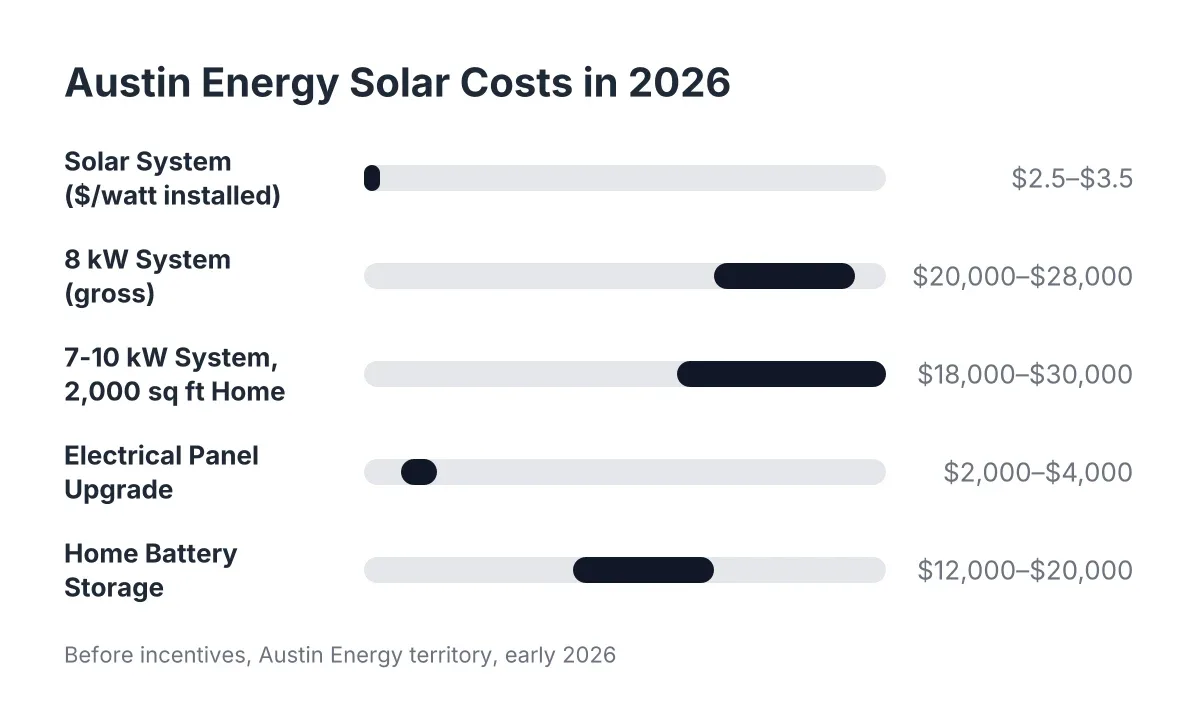
The payback math under Austin Energy's tariff needs five inputs: your twelve months of actual usage, the current tiered consumption rates, the current Value of Solar rate, the installed cost per watt from real local quotes, and any rebate you have confirmed in writing. Everything else is noise.
Here is the order I would work in:
- Pull twelve months of bills and total your kilowatt-hours. One hot summer and one cold snap should be in the window.
- Size a candidate system to produce near your annual usage, not more. In Austin, a rough planning figure is 1,400 to 1,500 kilowatt-hours per year per kilowatt of panels, as an estimate; shade and roof direction move it.
- Multiply annual production by the current Value of Solar rate for your annual credit.
- Compare that credit against your annual consumption cost to get net annual savings.
- Divide net system cost by annual savings for a simple payback in years. Anything under ten starts to look reasonable in this territory; your numbers will differ.
Texas-wide, the context is favorable. The state had 34,907 megawatts of solar installed as of Q2 2024, enough to power an estimated 4 million homes, according to Go Solar Texas. Panels work here. The question was never whether Austin has sun. The question is whether 9.91 cents per exported kilowatt-hour, as of early 2026, plus your confirmed rebates, pays back your installed cost fast enough for you.
On hardware, the brand matters less than the quote math. Whether you are reading a Tesla solar panels review or comparing Enphase against Generac PWRcell for the battery, the Value of Solar tariff pays the same 9.91 cents regardless of whose logo is on the inverter. Compare quotes on installed cost per watt, workmanship warranty, and whether the installer modeled your bill under the actual tariff. An installer who hands you a net metering projection in Austin Energy territory has already told you something about their homework.
The Short Version for the Homeowner Who Just Lost Power
Austin Energy pays 9.91 cents per kilowatt-hour for solar production under its Value of Solar tariff as of early 2026, not one-to-one net metering, and that single fact should anchor every solar and battery decision you make in this territory. Size the system to your usage. Treat the battery as backup, not as a bill trick. Confirm the rebate and the current rate before you sign, because both change, and your numbers will differ.
If the last outage cost you a freezer full of food, you have a real problem worth solving. Just solve it with the actual Austin tariff in the spreadsheet, not the one the national guides assume you have.
For help with solar with Austin Energy, Austin Solar FAQ is the place to start.
Prefer to talk it through? Call +15125571906 — a quick call is usually the fastest way to get a straight answer for your situation.