How Solar Buyback Plans in Texas Work With Oncor Retail Electricity Plans
If Oncor delivers your power, your solar buyback does not come from Oncor. It comes from the retail electricity plan you pick. That single fact confuses more homeowners in the Austin area than anything else about going solar, and it is the reason solar buyback plans in Texas get compared, argued about, and ranked on Reddit threads every month. This article explains how the Oncor side and the retail side fit together, what the common buyback plan structures actually pay, and how to set yourself up so the credits show up on your bill the way you expect.
I write this as someone who works in residential solar around Austin. I am not affiliated with Oncor, any retail provider, or any government program. Rates in this article carry their as-of dates, and your numbers will differ.
Oncor Moves the Power, Your Retail Provider Sets the Price
Oncor is the transmission and distribution utility for the eastern and northern edges of the Austin area, including parts of Round Rock, Pflugerville, Hutto, and a scattering of neighborhoods further west. Oncor owns the poles and wires, reads your meter, and restores power after a storm. When you search oncor power outage by zip code during a grid event, that is the company you are checking on.
However, Oncor does not sell you electricity and does not buy your exports. Because Oncor territory sits in the deregulated part of ERCOT, you buy power from a retail electric provider: TXU, Reliant, Octopus, Rhythm, Green Mountain, and dozens of others. According to Solar United Neighbors, customers in deregulated markets can choose among multiple solar buyback plans that credit surplus energy sent to the grid. That is the opposite of a regulated area, where homeowners typically have one option, take it or leave it.
So the chain works like this:
- Your installer builds the system and submits engineering documentation to Oncor for interconnection review. Utilities commonly require drawings and specs before approving a residential system, according to Arizona Public Service, and Oncor follows the same pattern.
- Oncor approves the interconnection and confirms your meter can measure flow in both directions.
- You enroll in a solar buyback plan with a retail provider. Without that step, your exports can flow to the grid uncompensated.
- The retail provider credits your exports on your monthly bill at whatever rate your plan promises.
Miss step three and you have a working solar system earning nothing for the power it sends out. I have seen that happen, and it is the single most avoidable mistake in Oncor territory.
The Main Types of Solar Buyback Plans in Texas
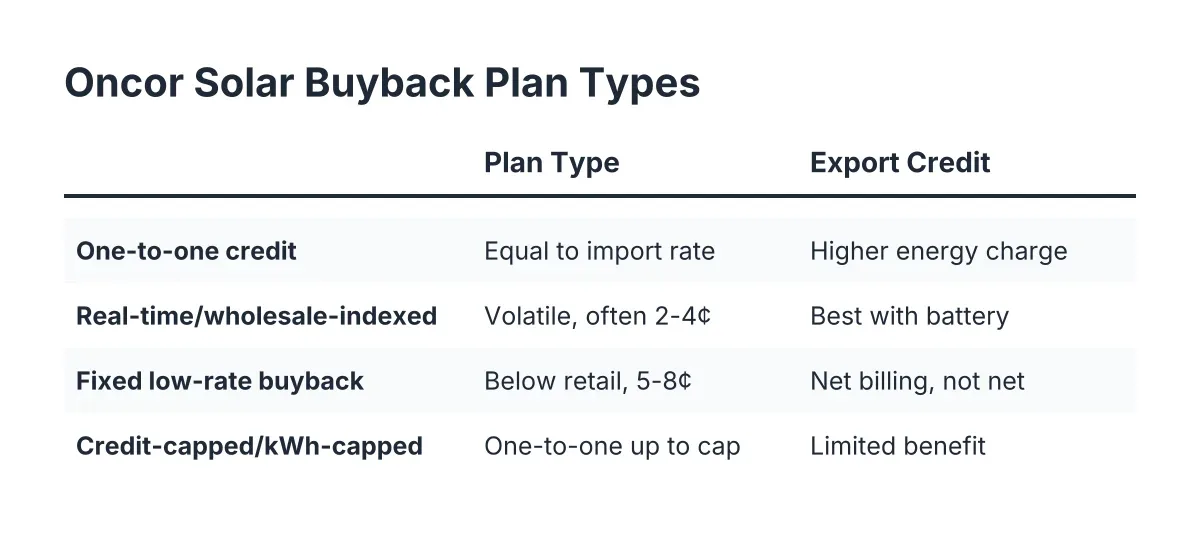
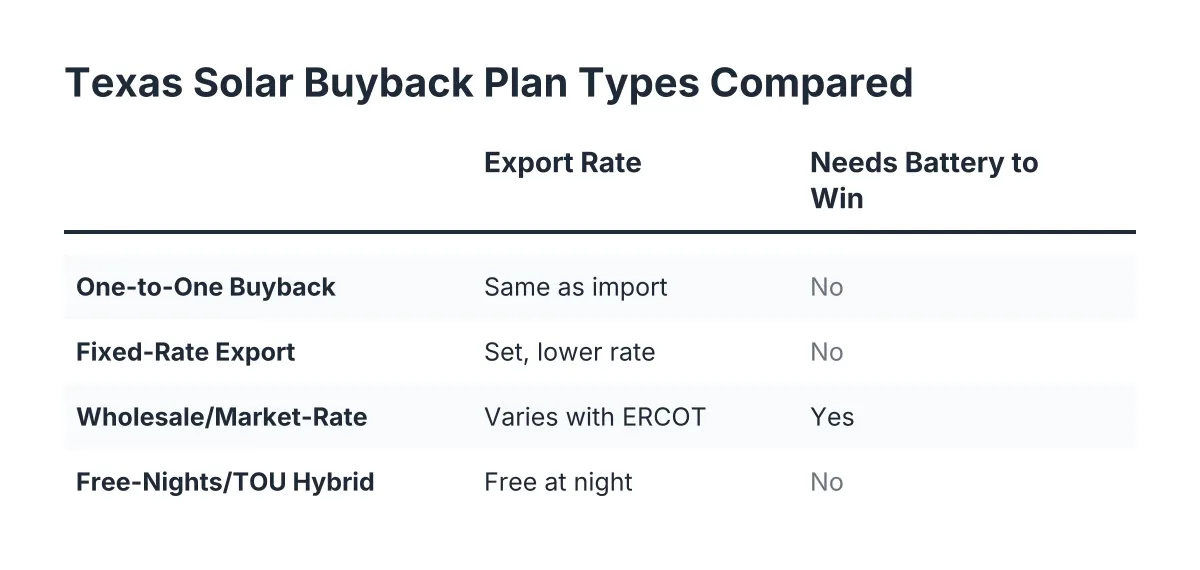
Texas does not have statewide net metering. According to Mass.gov, net metering programs let homeowners sell excess solar energy back to the utility for credits or payments; in Oncor territory, whether you get anything close to that depends entirely on the retail plan you sign. The plans on the market in 2026 fall into four broad structures. Here is how they compare.
One-to-One Buyback Plans
These credit every exported kilowatt-hour at the same rate you pay to import one. If you pay 15 cents per kWh, you earn 15 cents per exported kWh. True one-to-one crediting is the best-case arrangement for a solar owner, and the plans marketed as "1:1" are the ones most worth reading closely.
The trade-off: the base energy rate on these plans often runs 1 to 3 cents higher than a plain fixed-rate plan, and most cap credits so they can offset your bill but never produce a cash payout. Credits that exceed your usage in a month may roll forward, expire at the end of your contract, or vanish when you switch plans. The Electricity Facts Label spells this out, and you should read it before signing anything.
Fixed-Rate Export Plans
These pay a set rate per exported kWh, often lower than your import rate. You might pay 14 cents to import and earn 9 cents to export. This is net billing, not net metering, even when the marketing says "buyback." The upside is predictability; the export rate is locked for the contract term, which makes budgeting simple and requires no battery or special equipment.
Wholesale or Market-Rate Export Plans
These pay whatever the ERCOT real-time market pays at the moment you export. On a mild April afternoon that can be 2 cents. During an August scarcity event it can spike far higher. These plans reward homeowners with a home battery who can hold energy and export during expensive hours. Without a battery, you are exporting most of your power at midday when wholesale prices are usually at their lowest.
Free-Nights and Time-of-Use Hybrids
Some providers pair solar buyback with free-nights pricing. You pay nothing for grid power overnight and a higher rate during the day, while your panels cover daytime usage. For a household that runs the pool pump, EV charger, and laundry after 9 p.m., the math can work. For a typical daytime-heavy household, it usually does not. Model your actual usage before signing one of these.
Comparing Solar Buyback Plans in Texas on the Numbers That Matter
Export rate alone tells you little. A plan paying 16 cents per exported kWh while charging 18 cents to import can cost you more over a year than a plan paying 10 and charging 12. The decision rule that holds up: look for the smallest gap between the import rate and the export rate, then check the fine print.
Work through this checklist for any plan you are considering:
- Import rate at your usage level. EFLs quote averages at 500, 1,000, and 2,000 kWh. A solar home often lands at low grid usage in spring and high usage in August, so check both ends.
- Export rate and whether it is fixed or market-indexed. Fixed rates are predictable; indexed rates swing daily.
- Credit caps and rollover rules. Can credits exceed your bill? Do unused credits roll to the next month, and do they survive a plan change?
- System size limits. Some plans exclude systems above a stated kW size. If you oversized for a battery and backup, confirm you qualify.
- Base charges and minimum usage fees. A $9.95 monthly base charge quietly erodes buyback value on a low-usage solar home.
- Contract length versus rate certainty. A 36-month lock protects your buyback rate; it also locks you out of better plans if the market shifts.
In addition, remember that retail rates and export rates in this market move constantly, sometimes daily. The plan that topped a comparison site in March can be mid-pack by June. Recheck the market near the end of every contract term rather than auto-renewing.
As an illustrative estimate, suppose a homeowner in Pflugerville with an 8 kW system exports 450 kWh in a typical May. On a one-to-one plan at 15 cents, that is about $67 in credits. On a fixed 9-cent export plan, about $40. Additionally, on a wholesale plan averaging 3 cents that month, about $13. Over a year the gap between the best and worst fit can run several hundred dollars. Those are hypothetical numbers for comparison only; your production, usage, and rates will differ.
Why Is My Electric Bill So High If I Have Solar?
A high electric bill with solar panels in Oncor territory usually means one of three things: you never enrolled in a buyback plan, your plan credits exports at a fraction of your import rate, or your overnight and summer usage exceeds what the panels offset. The panels are probably fine; the plan match is the problem.
First, pull your retail bill and find the export credit line. If there is no export line at all, your provider is not crediting you, and switching to an actual buyback plan is the fix. Next, compare the credit rate to your import rate. A 5-cent credit against a 16-cent import rate leaves a wide gap that shows up as a bigger bill than you expected.
Finally, look at when you use power. Air conditioning from 6 p.m. to 10 p.m. in August draws from the grid after your panels have faded for the day. That evening usage is exactly why many Oncor-territory homeowners pair panels with a home battery; the battery soaks up midday surplus and covers the evening peak instead of exporting cheap and importing expensive.
Where Backup Power Fits: Batteries, Buyback, and Outages
If a multi-day outage is what pushed you toward solar, understand this clearly: panels alone shut off during a blackout. Grid-tied inverters disconnect for line-worker safety. You need a home battery, a standby generator, or both to keep the refrigerator cold and phones charged when Oncor's outage map lights up.
A home battery changes the buyback math too. With storage, a wholesale-indexed plan becomes workable because you control when energy leaves the house. Some providers even offer battery-specific plans that pay a premium for exports during grid stress events. Without a battery, stick to one-to-one or fixed-rate export plans and let the panels do simple daytime offsetting.
For a storm-prepper household, a reasonable 2026 sequence looks like this: size the battery for your outage needs first (refrigerator, internet, a bedroom window unit or a soft-start on the central AC), size the solar to recharge it and cover daytime load second, then pick the retail plan that fits the combined system. Shoppers often search for complete solar power kits for homes with battery, and the packaged systems from Tesla, Enphase, and Generac are the professionally installed version of that idea. Whether a battery can run central air through a summer outage depends on your unit's startup draw and the battery's output rating, and that is a question worth putting to a licensed installer rather than answering from a spec sheet.
One honest trade-off: if backup is your only goal and your outage history is severe, a whole-house standby generator still beats batteries on runtime per dollar for multi-day events. The buyback plan question only matters once solar enters the picture.
What the Tax Credit Picture Looks Like in 2026
The federal purchase credit for homeowner-owned systems, the 25D credit, has ended for residential purchases. The Internal Revenue Service confirms the credit historically covered 30% of total installation cost, which is why so much older content still quotes post-credit prices. As of 2026, a system you buy outright does not get that 30% back.
However, the lease credit path under section 48E survives. According to the EPA, a solar lease works like a car lease: you pay a fixed monthly amount for the panels regardless of production, and you do not own the system. The leasing company claims the credit and, in a competitive market, passes some of it through as a lower payment. That changes the lease-versus-loan math compared to 2024, so run both numbers fresh rather than relying on older guides.
Oncor itself does not pay a solar rebate the way Austin Energy does with its Value of Solar tariff, which pays 9.91 cents per kWh for exports according to NuWatt Energy (as of its publication; your rate will differ). If your bill comes from a retail provider, your "incentive" is the buyback plan itself. That is why plan selection carries more weight in Oncor territory than anywhere else around Austin.
How to Choose a Buyback Plan in Oncor Territory
Solar with Oncor and a retail electricity plan works well when you treat the plan as part of the system, not an afterthought. Here is the short version of the decision:
- No battery, steady usage: pick a one-to-one plan if the base rate premium is under about 2 cents per kWh; otherwise a fixed-rate export plan with a narrow import-export gap.
- Battery installed: consider a wholesale-indexed or battery-reward plan, and have your installer configure the system's export settings to match that provider's rules.
- Night-heavy usage with solar: model a free-nights hybrid against a one-to-one plan using 12 months of your actual smart meter data before deciding.
- Every case: read the EFL for credit caps, rollover rules, system size limits, and what happens to banked credits when the contract ends. Switching retail energy providers mid-contract can forfeit accumulated credits, so time any switch to your contract anniversary.
Texas added more solar than any other state in early 2025, 2.7 GWdc in the first quarter according to the Solar Energy Industries Association, so the retail market keeps adjusting its solar offers to compete. Check the current plans within 30 days of your system's interconnection approval, not months before, because the rate you see today will not be the rate available when your meter starts spinning backward.
For help with solar with Oncor and a retail electricity plan, Austin Solar FAQ is the place to start.
Prefer to talk it through? Call +15125571906 — a quick call is usually the fastest way to get a straight answer for your situation.