Comparing Oncor Retail Electricity Plans: Which Pays the Most for Solar Exports
If your home sits in Oncor territory, the panels on your roof are only half the math. The other half is the retail plan you pick, and that is where most of the money hides. Comparing Oncor retail electricity plans for solar is not like comparing gas stations. Two plans with identical advertised rates can produce payback timelines that differ by three or four years, because the thing that matters—how the export credit works in your solar export credit comparison—is buried on page two of the fact sheet. I have watched homeowners spend weeks comparing installer quotes and ten minutes picking the plan, when the plan deserved equal time.
This piece is for the person with two or three solar quotes in their inbox and a recent bill over $200. The installers will not pick your retail plan for you. Here is how the pieces fit, and how to compare the plans that actually pay for exports.
What Oncor Does and Does Not Do for Your Solar
Oncor is the wires company. It owns the poles, the transformers, and the meter on your wall. It delivers power, reads your meter, and approves your solar interconnection. What Oncor does not do is sell you electricity or buy your exports. That job belongs to the retail electric provider you choose, and in Oncor territory you must choose one.
This confuses people coming from Austin Energy or Pedernales Electric territory, where the utility sends the bill and sets the export rate in one place. In deregulated electricity markets, customers choose among multiple solar buyback plans that credit surplus energy sent to the grid, according to Solar United Neighbors. In regulated areas, by contrast, homeowners typically get only one or a few buyback options. Oncor territory is the deregulated case. The selection is wide, and the quality varies more than the marketing suggests.
One cost is fixed no matter which retailer you pick. Oncor electric delivery charges, the per-kWh and monthly fees for using the wires, pass through on every plan. As of early 2026, these run on the order of $20 to $30 a month for a typical home before you use a single kilowatt-hour of grid power. Your numbers will differ, and these charges change twice a year, so check the current schedule. Texas does not use standard net metering; you must actively select a buyback plan, and those delivery charges are non-bypassable. That is why a zero-dollar bill is close to impossible here even with a large system.
Why the Export Credit Decides Your Payback, Not the Panel Price
Say a homeowner in Round Rock or Lakeway installs an 8 kW system. On a typical April day, the house uses 30 kWh but the panels make 45 kWh, and most of the production lands between 10 a.m. and 4 p.m. when nobody is home. In that hypothetical scenario, roughly half the solar production exports to the grid. If the export credit is 12 cents per kWh, that exported energy is worth real money. If it is 3 cents, the same panels on the same roof earn a quarter as much for every exported unit.
Run that gap across a year and it compounds. Suppose the system exports 5,000 kWh annually. At 12 cents, exports return about $600 a year. At 3 cents, about $150. On a $25,000 system, that single difference can move your break-even point by several years. These are illustrative estimates, not quotes; your production, your usage pattern, and your plan will differ. But the direction holds: when comparing Oncor retail electricity plans, the export rate matters more than a half-cent difference in the energy charge.
The decision rule the industry uses internally is simple. Look for plans where the import rate and the export rate are about equal. A plan that charges you 15 cents and credits you 14 to 15 cents for exports is strong. A plan that charges 12 cents and credits wholesale, often 2 to 4 cents, is weak for a solar home even though its headline rate looks better.
How Solar Export Credits and Comparison Factors Shape Plan Selection
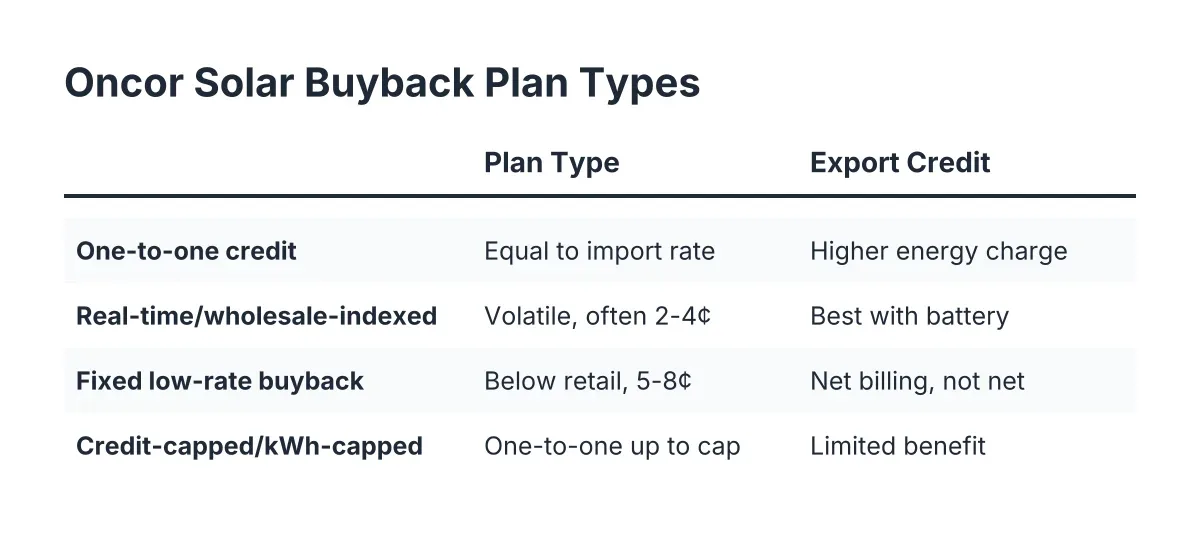
Retail providers in Oncor territory structure solar buyback four ways. The names change by company; the structures do not. Here is the side-by-side.
One-to-one credit plans
These plans credit exports at the same rate you pay for imports. They are the closest Texas gets to net metering. The trade-off is nearly always a higher energy charge, sometimes 2 to 4 cents above the cheapest plan in your zip code, plus a higher base fee. For a home that exports heavily, a south-facing roof with daytime vacancy, the math usually still favors these plans. For a home that self-consumes most of its production, the premium rate can cost more than the generous credit returns.
Real-time or wholesale-indexed buyback
These plans pay you the live wholesale market price for exports. Some summer afternoons that price spikes and you earn well. Most hours it sits low, often 2 to 4 cents. The appeal is a cheap import rate. The risk is volatility in both directions, and the export earnings are unpredictable. These suit spreadsheet-minded homeowners with a home battery who can hold energy and export during price spikes; understanding the solar, export, credit, and comparison dynamics of these plans requires careful analysis. Without storage, the averages tend to disappoint.
Fixed low-rate buyback
The most common structure. The plan credits exports at a fixed rate below retail, say 5 to 8 cents against a 13 to 15 cent import rate. This is net billing, not net metering, and the difference matters. Under net billing, excess production is credited at a rate below what you pay, which shrinks the value of overproduction. These plans are not automatically bad. If the import rate is competitive and your system is sized to self-consume, the modest export credit may be fine.
Credit-capped or kWh-capped plans
Some plans credit exports one-to-one but only up to the amount you import in that billing cycle. Export more than you use, and the surplus earns nothing. Read for this clause specifically. An oversized system on a capped plan donates energy to the grid every spring and fall. If an installer quote assumes uncapped credits and your plan caps them, the production estimate in that quote is quietly wrong.
How to Read the Fine Print Before You Sign
The electricity facts label does not always show the export rate. You often have to pull the terms of service or a separate solar rider document. When you compare, pull these five numbers for every candidate plan:
- The import energy charge per kWh, at your actual usage level, not the advertised 1,000 kWh tier
- The export credit per kWh, and whether it is fixed, indexed, or capped
- The base monthly fee the retailer charges on top of Oncor electric delivery charges
- The contract term and the early termination fee
- Whether unused export credits roll over month to month, and what happens to them if you switch plans
That last one trips people. With most retailers, accumulated credits are a feature of that plan. Switch providers or let the contract lapse onto a default rate, and banked credits can vanish. If you carry a large credit balance into fall, time any plan change for when the balance is low.
In addition, rates and buyback terms in this market change often, sometimes daily. Checking electricity rates by zip code once and filing the number away does not work here. The plan that paid best in March may be middle of the pack by September. Recheck when your contract renewal approaches, and recheck before your panels are commissioned, because the best plan for a non-solar home is rarely the best plan once exports start.
Why Is My Electric Bill So High If I Have Solar?
A high bill with solar in Oncor territory usually comes from one of three causes: a retail plan that pays little or nothing for exports, Oncor delivery charges that apply regardless of generation, or evening and nighttime usage that the panels cannot offset. The panels may be working fine. The plan underneath them is often the problem.
For example, a homeowner who kept their pre-solar plan after installation is a common case. That plan was chosen for a cheap import rate and pays nothing for exports. Every midday kilowatt-hour flows to the grid unpaid, then the house buys power back at full price at 8 p.m. The fix is not more panels. The fix is comparing Oncor retail electricity plans again, this time with export value as the first filter, or adding a home battery to shift midday production into the evening.
This is also where the whole-territory picture helps. Solar with Oncor and a retail electricity plan is a two-contract arrangement: one contract with your installer for the hardware, one with your retailer for the rates. Homeowners audit the first contract line by line and sign the second one in an afternoon. Both deserve the spreadsheet.
How the Oncor Side of the Process Actually Works
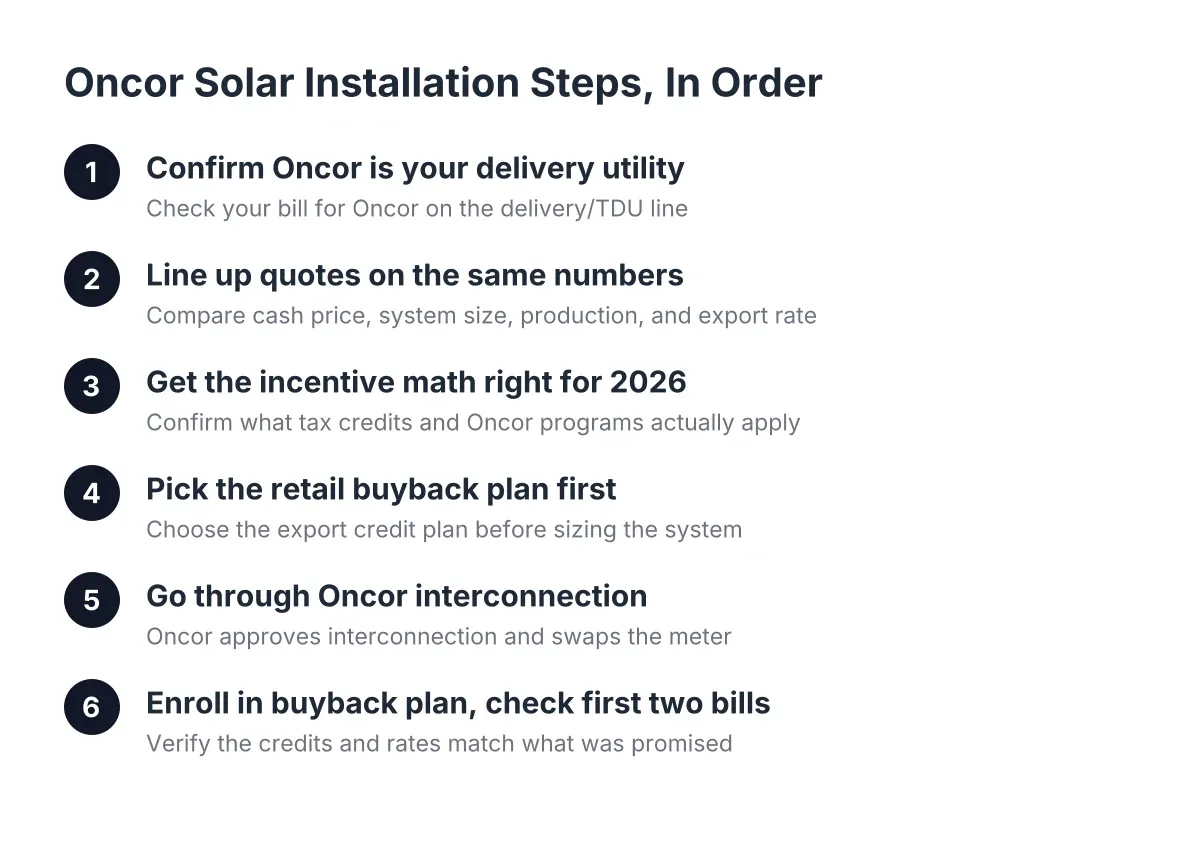
Your installer handles the interconnection paperwork with Oncor, but you should know the shape of it. Utilities that support residential solar commonly require engineering documentation and drawings for review before installation is approved, according to Arizona Public Service, and Oncor follows the same pattern. After the city inspection, Oncor swaps or reprograms your meter to measure flow in both directions. Until that meter work is done, your exports earn nothing, so do not switch to a buyback plan weeks before commissioning.
Timeline-wise, the Oncor approval and meter steps typically add two to six weeks after the physical install, though your schedule will differ by city and season. Your retail plan choice is separate from all of this. You can switch retailers before, during, or after installation without touching the interconnection. The sequencing that works: install and interconnect first, confirm the system exports, then move to the buyback plan that fits your actual export pattern after a month or two of real data.
Where the 2026 Incentive Picture Fits
Two things changed the math recently, and any quote comparison should reflect both. First, the purchase credit, the federal 25D credit that historically returned 30% of a residential system's cost according to the Internal Revenue Service, has ended for homeowner-purchased systems. Second, the lease credit under the 48E path survives, which is why leasing offers have multiplied in 2026. A solar lease works like an equipment lease; you pay a fixed monthly amount regardless of production, and you do not own the system, according to the U.S. Environmental Protection Agency. Leases are not automatically bad, but compare the 25-year total cost against a loan, not just the first monthly payment.
Texas remains a huge solar market; the state installed 2.7 GWdc in the first quarter of 2025, 92% more than second-ranked Florida, according to the Solar Energy Industries Association. Scale has kept hardware pricing competitive even after the purchase credit ended. But it also means more sales pressure, and more plans designed to look solar-friendly without paying much for exports.
How to Choose
There is no single best buyback plan in Texas, only the best fit for your export profile. Here is the order of operations that holds up:
- Estimate your export share. Pull a year of smart meter data, compare it to your quote's hourly production estimate, and figure out what fraction of solar production leaves the house.
- If you export heavily, over about a third of production, shortlist one-to-one and high fixed-credit plans and accept the higher import rate.
- If you self-consume most production, pool, EV charging timed to midday, someone home during the day, a cheap import rate with a modest export credit may beat the premium plans.
- If you are adding a home battery, wholesale-indexed buyback becomes worth modeling; without one, treat those plans with caution.
- Reprice annually. Plans in this market move, and loyalty is not rewarded.
One honest caveat. If your bill runs under $100 a month, or your roof faces north and east under oak shade, solar in Oncor territory may not pencil regardless of which plan you pick, and a competent installer should say so. And if your situation involves a complex load, a large battery, or a standby generator interlock, have a licensed electrician or your installer's engineer review the design rather than relying on plan math alone.
The panels are a 25-year decision. The plan is a 12-month decision you get to remake every year. Get the first one right once, and the second one right repeatedly, and the payback math takes care of itself.
For help with solar with Oncor and a retail electricity plan, Austin Solar FAQ is the place to start.
Prefer to talk it through? Call +15125571906 — a quick call is usually the fastest way to get a straight answer for your situation.