Solar With Oncor and a Retail Electricity Plan Terms Explained: A Plain-English Glossary
If Oncor delivers your power and a retail provider sends your bill, solar comes with its own vocabulary, and most of it never appears in a quote until it starts costing you money. This solar with oncor and a retail electricity plan glossary defines the terms you will meet while reading quotes, comparing buyback plans, and talking to installers in the Austin area. Each entry is a plain-English definition you can read in under thirty seconds. Use it to understand your paperwork, ask sharper questions, and catch problems before you sign anything.
- Oncor: the wires company, not your billing company
- Retail Electric Provider (REP): the company that actually bills you
- Deregulated Market (Retail Choice): why you pick your own provider
- Solar Buyback Plan: a retail plan that pays for your exports
- Export Credit: the money or credit you get per exported kWh
- Net Metering: the full-price buyback most Texans do not have
- Interconnection Agreement: Oncor's permission to connect your system
- Permission to Operate (PTO): the green light to switch on
- Bidirectional Meter: the meter that counts power both ways
- Kilowatt-Hour (kWh): the unit everything is priced in
- Inverter: the box that makes solar power usable
- Home Battery: stored solar for nighttime and outages
- TDU Delivery Charges: Oncor's fee on every kWh you pull in
- Buyback Rate: the price per kWh your plan pays for exports
- Credit Rollover: whether unused export credits carry forward
- Purchase Credit vs. Lease Credit: the two federal tax paths, one ended
- Production Estimate: the installer's forecast of annual output
- Offset: how much of your usage the system is sized to cover
Solar, Oncor, and Retail Electricity Plan Terminology: Who Does What
Solar with Oncor and a retail electricity plan involves two separate companies, and confusing them is the single most common mistake I see homeowners make. These are the terms that sort out who does what.
Oncor
Oncor is the transmission and distribution utility that owns the poles, wires, and meters across a large part of Texas, including towns like Hutto northeast of Austin. Oncor delivers electricity but does not sell it to you, and it does not set your solar buyback rate. Additionally, oncor approves your system's connection to the grid and swaps your meter. If an installer tells you "Oncor pays you for solar," that is wrong, and it is a sign they do not know this market.
Retail Electric Provider (REP)
A Retail Electric Provider is the company that sells you electricity and sends your monthly bill in Oncor territory. Your REP, not Oncor, decides what your exported solar power is worth. This is why two identical houses with identical panels can have different payback timelines; one picked a better plan. Comparing REPs is the step that national solar guides usually skip, and I walk through it in comparing Oncor retail plans for solar exports.
Deregulated Market (Retail Choice)
A deregulated market means homeowners choose their electricity provider instead of being assigned one by the local utility. Oncor territory is deregulated; Austin Energy and Pedernales Electric Co-op territory are not. For you, this cuts both ways. You get to shop for a strong buyback plan, but you also carry the job of re-shopping it when the contract ends, because buyback terms change between contract cycles.
Solar Buyback Plan
A solar buyback plan is a retail electricity plan that pays you, in bill credits or sometimes cash value, for the solar power your home exports to the grid. Not every retail plan offers one, and the terms vary widely between providers. Picking the plan is as important as picking the panels, which is the core argument of my guide to how solar buyback plans work with Oncor retail plans. Ask any installer which buyback plans their production estimate assumes; if they cannot answer, the estimate is a guess.
Solar and Retail Electricity Plan Money Terms: How Exports Turn Into Credits
This section covers the terms that decide what your exported power is worth when you have solar with Oncor and a retail electricity plan glossary.
Export Credit
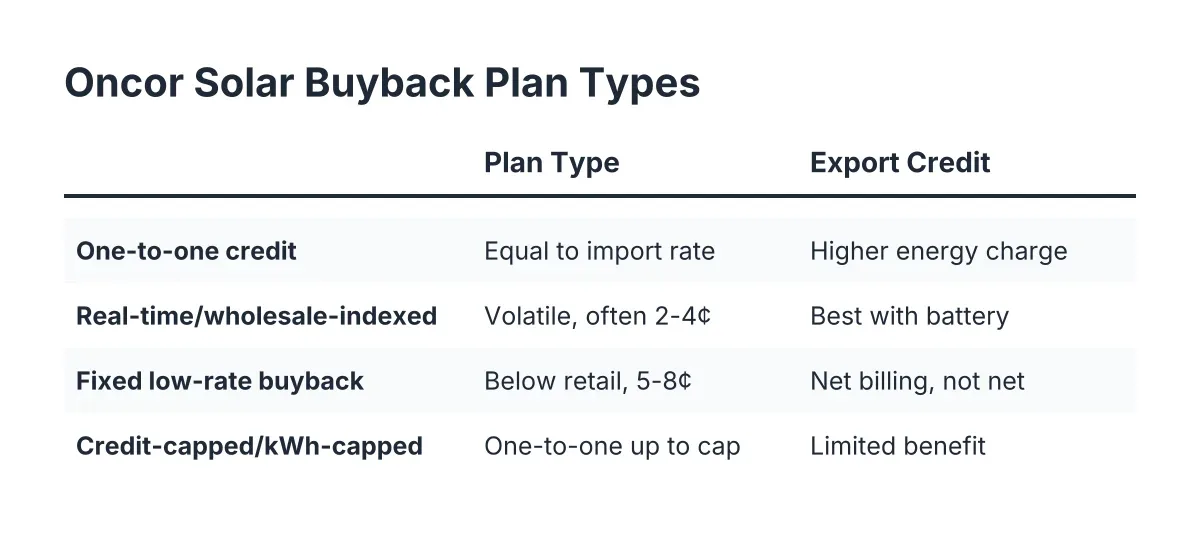
An export credit is the value your retail provider gives you for each kilowatt-hour your solar system sends to the grid. In Oncor territory the credit comes from your retail plan, not from Oncor and not from any government program. Some plans credit at the full retail rate, some at a lower wholesale-linked rate, and some pay nothing. Any rate you see quoted needs an as-of date, because these plans change; your numbers will differ from anyone else's.
Net Metering
Net metering means the utility credits your exports at the same price you pay for imports, effectively running your meter backward. True net metering is rare in Texas, and no law requires it. In Oncor territory you get whatever your retail plan offers, which may resemble net metering or may not. Treat "we have net metering here" in a sales pitch as a claim to verify against the actual plan documents.
Buyback Rate
A buyback rate is the price per kilowatt-hour that your retail plan pays for exported solar power. It can be fixed, tied to your import rate, or tied to wholesale market prices that swing by the hour. A high headline buyback rate paired with a high import rate can still lose to a boring plan with modest rates on both sides. Run the math on your own usage pattern, with current rates and their as-of dates, before you commit.
Credit Rollover
Credit rollover means unused export credits carry forward to future bills instead of expiring. Plans differ: some roll credits month to month, some expire them at the end of a contract term, and some cash them out. This matters most in spring and fall, when your panels overproduce and you bank credits for summer air conditioning. Read the plan's fine print for the expiration rule before counting banked credits in your payback math.
TDU Delivery Charges
TDU delivery charges are the fees Oncor adds to every kilowatt-hour you pull from the grid, passed through on your retail bill. Solar reduces how many kilowatt-hours you import, so it reduces these charges too, but exports do not usually earn delivery charges back. This is one reason exported power is often worth less than power you use yourself. It is also why a home battery can change the economics, since stored solar avoids both the energy charge and the delivery charge.
Purchase Credit vs. Lease Credit
The purchase credit was the federal tax credit for homeowners who bought their solar systems outright, under section 25D, and that path has ended. The lease credit, under section 48E, survives for systems owned by a third party, which is why leasing offers now lean on it. If a quote assumes a federal credit, ask which one and who actually claims it. A lease credit goes to the leasing company, not to you, though it can lower your lease payment.
Hardware Terms: What Actually Goes on Your House
Kilowatt-Hour (kWh)
A kilowatt-hour is the unit of electrical energy that your bill, your buyback rate, and your production estimate are all priced in. One kilowatt-hour runs a 1,000-watt appliance for one hour. Everything in this market, import prices, export credits, and battery capacity, trades in this unit. Get comfortable with it and every quote becomes easier to read.
Inverter
An inverter is the device that converts the direct current your panels produce into the alternating current your home and the grid use. Quotes usually offer either one central string inverter or microinverters mounted under each panel. The choice affects cost, shade tolerance, and how failures show up later. A quote that does not name the inverter type and warranty length is incomplete.
Bidirectional Meter
A bidirectional meter is a meter that records electricity flowing in both directions, into your home and out to the grid. Oncor installs or reprograms yours as part of the interconnection process. Without it, your exports are invisible and earn nothing. If your system is on but your buyback credits are zero, the meter swap is the first thing to check.
Home Battery
A home battery stores solar power for use at night, during expensive hours, or during an outage. In Oncor territory a battery changes the money question, because self-used power avoids both energy and delivery charges while exported power often earns less. Batteries add meaningful cost, so whether one pays off depends on your plan and your outage tolerance, not on a universal rule. For deep backup needs, a whole-house standby generator is sometimes the more honest answer, and a decent installer will say so.
Process Terms: Paperwork Between Quote and Switch-On
Interconnection Agreement
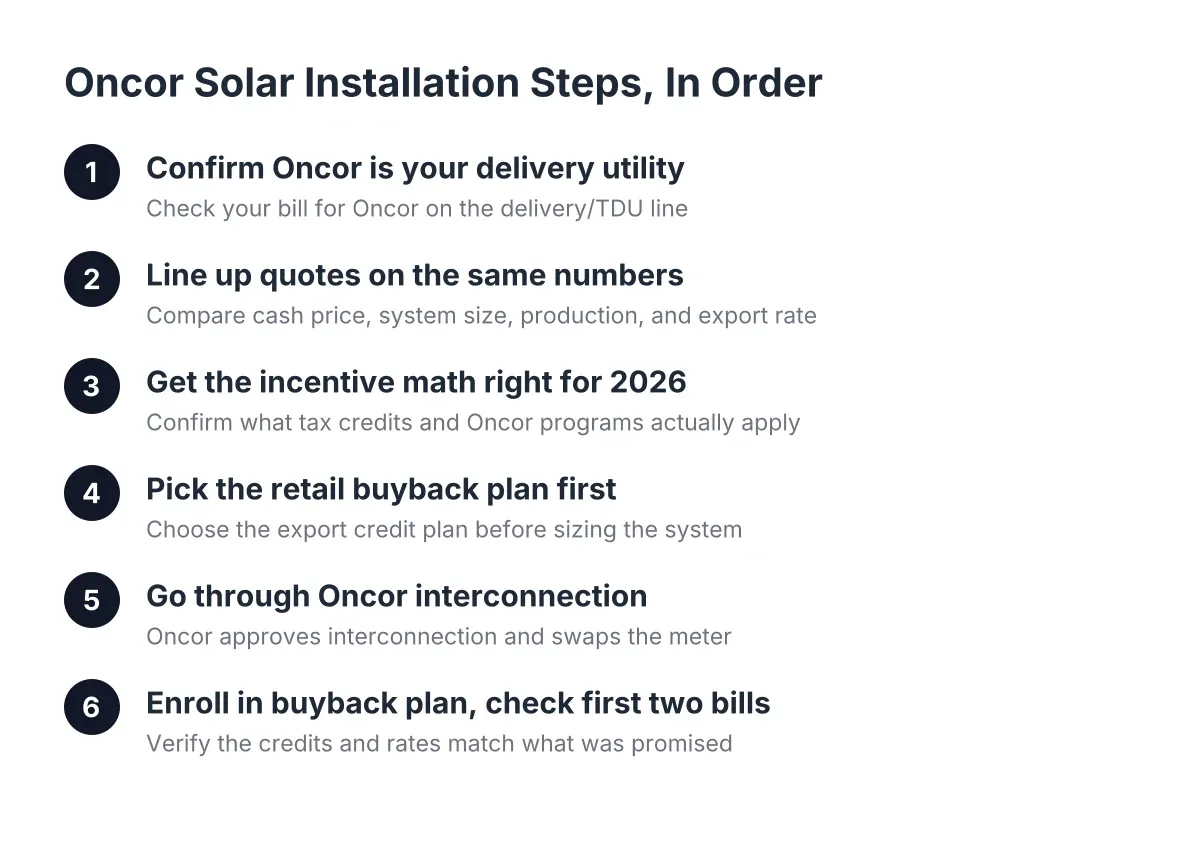
An interconnection agreement is the contract between you, your installer, and Oncor that authorizes your solar system to connect to the grid. Oncor reviews the system design for safety before approving it. Your installer typically files it, but you sign it, so read what you are signing. The full sequence, from signed quote to approved connection, is laid out in my walkthrough of the Oncor interconnection steps in order.
Permission to Operate (PTO)
Permission to operate is the formal approval, after inspection and meter work, that lets you legally switch your system on. Until PTO arrives, your panels sit idle on the roof, sometimes for weeks after installation day. Ask every installer for their current average time from install to PTO in Oncor territory. The honest ones track it; the others will change the subject.
Production Estimate
A production estimate is the installer's forecast of how many kilowatt-hours your system will generate per year. It depends on your roof's direction, tilt, and shade, and good estimates come from modeling software, not a rule of thumb. The estimate drives every payback claim in the quote, so an inflated one makes a bad deal look good. Compare the estimates across quotes for the same roof; large gaps mean someone is guessing or stretching.
Offset
Offset means the share of your annual electricity use that your solar system is sized to produce, often quoted as a percentage. A 100 percent offset does not mean a zero bill, because you still import at night and export at midday, and those two flows are priced differently. In Oncor territory your buyback plan decides how much a high offset is worth. Sizing past 100 percent only makes sense when the export economics support it, which they often do not.
Using These Terms
You can now read an Oncor-territory solar quote line by line and know which company controls each number on it. That is what this solar with oncor and a retail electricity plan glossary is for: separating what Oncor does, what your retail provider does, and what the installer is promising. When a term on your paperwork is not here, ask the person who wrote it to define it in plain English, and keep asking until they do.
For help with solar with Oncor and a retail electricity plan, Austin Solar FAQ is the place to start.
Prefer to talk it through? Call +15125571906 — a quick call is usually the fastest way to get a straight answer for your situation.