Oncor Solar Installation Steps: From Quote to Buyback Plan, in Order
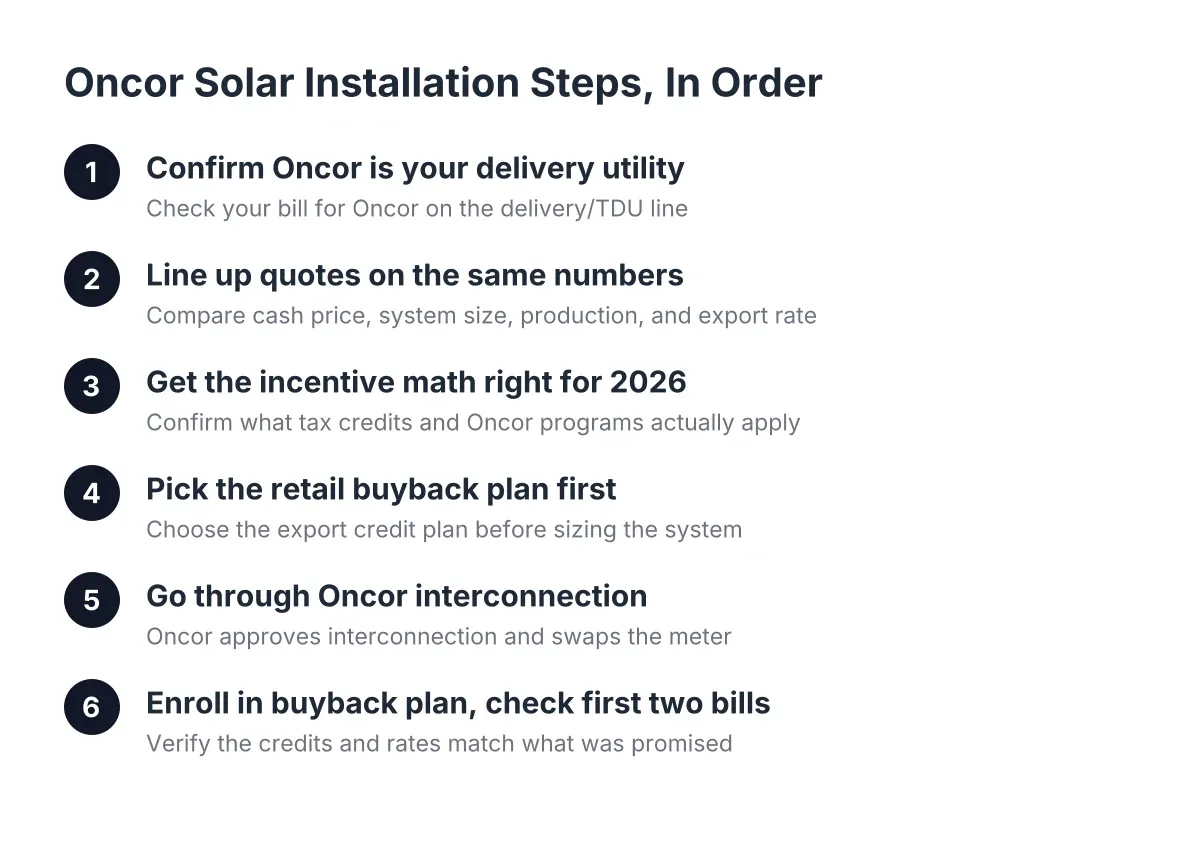
If your bill says Oncor on the delivery line and a retail provider on the supply line, the path to solar has more moving parts than it does in Austin Energy or PEC territory. This guide walks through each Oncor solar installation step in order, from reading your quotes to picking the buyback plan that actually pays you. I work in residential solar in the Austin area. The sequence below is the one that keeps homeowners from signing a contract based on savings math their retail plan will never deliver. Understanding the Oncor interconnection process is essential to getting this right.
One thing up front. Oncor does not sell you electricity and does not buy your exports. Oncor owns the wires, approves the interconnection, and swaps the meter. Your retail electric provider sets the rate you pay and the export credit you earn. If a sales rep blurs that line, that tells you something about the rest of the pitch.
Step 1: Confirm Oncor Is Your Delivery Utility
Look at a recent bill before you compare anything. You will see a retail provider's logo at the top and a line for TDU or delivery charges lower down. If that delivery line says Oncor, this guide applies. If it says Austin Energy, Pedernales Electric, or Bluebonnet, the rules are different and the quotes in your inbox should be modeled differently too.
This matters because retail electric providers in Texas compete for your business, and in deregulated markets you choose among multiple solar buyback plans that credit surplus energy sent to the grid, according to Solar United Neighbors. In regulated territory, by contrast, homeowners typically get one or a few buyback options. Austin Energy, for example, pays its Value of Solar tariff at 9.91 cents per kWh for exported solar, according to NuWatt Energy, as of the date that figure was verified; your numbers will differ. In Oncor territory there is no single rate like that. The export credit comes from whichever retail plan you sign.
Step 2: Line Up Your Quotes on the Same Numbers
You likely have two or three quotes already, and they probably use different system sizes, different production estimates, and different savings assumptions. Before you can judge any of them, force them onto common ground.
For each quote, pull out four numbers:
- Total cash price before any incentives, not the monthly payment
- System size in watts DC, so you can compute price per watt
- Year-one production estimate in kWh, and ask what shading tool produced it
- The export rate the savings projection assumes, in cents per kWh, with the plan named
That fourth number is where most quotes fall apart. Texas does not have a statewide net metering mandate. Net metering, where it exists, lets a homeowner sell excess solar back to the utility for credits, according to Mass.gov, but in Oncor territory that arrangement only exists if your retail plan offers it. A savings projection that assumes one-to-one credit without naming the plan behind it is a projection built on air. Suppose a homeowner in Lakeway gets a quote showing $2,100 in annual savings. If $900 of that comes from exports credited at the full retail rate, and the plan they actually sign credits exports at wholesale, the real number lands closer to $1,500. That is an illustrative estimate, not a prediction; your numbers will differ.
As of early 2026, cash prices for residential solar panels in the Austin area commonly land between $2.40 and $3.20 per watt before incentives, in my experience reading quotes. Treat that as a rough band, not a rule, and expect financed prices to run higher because dealer fees get baked into the loan.
Step 3: Get the Incentive Math Right for 2026
Is there still a 30% solar tax credit in 2026?
The 30 percent federal purchase credit for homeowner-owned systems, the 25D credit, has ended for residential purchases; it historically applied to the full cost of a residential installation, according to the Internal Revenue Service. What survives in 2026 is the lease credit path under 48E, which flows to the company that owns a leased or PPA system, not to you directly. A lessor may pass some of that value through in a lower monthly payment, or may not.
This changes the lease versus loan comparison from past years. With a lease, you pay a fixed monthly amount for the panels regardless of production, and you do not own the system, according to the U.S. Environmental Protection Agency. Both leases and PPAs put solar on the roof with no upfront cost, but ownership stays with the company in either case, per the EPA. If a quote still shows a 30 percent credit flowing to you on a cash or loan purchase, ask the rep to put that in writing. Most will quietly revise the proposal instead. Tax situations vary, so confirm your own eligibility for anything claimed with a tax professional before you sign.
Oncor has historically run incentive programs for solar that pay through participating installers rather than directly to homeowners. These programs change year to year and run out of budget, so verify current availability before you count the money. Any dollar figure a rep quotes should carry a date.
Step 4: Pick the Retail Buyback Plan Before You Sign Anything
This is the Oncor solar installation step most homeowners do in the wrong order. The buyback plan determines what your exports are worth, and what your exports are worth should shape how big a system you buy. Compare electric supplier rates and export credits together, because a plan with a generous buyback often charges a higher import rate, and the net effect depends on your usage pattern.
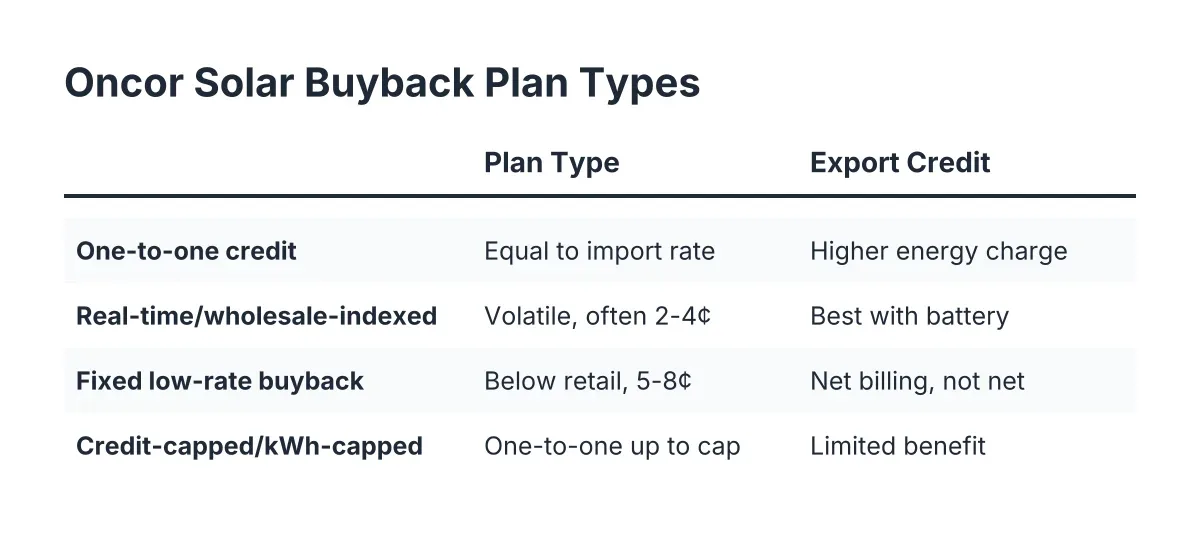
Plans in Oncor territory generally fall into three buckets:
- One-to-one credit plans, where exports offset imports at the same rate, usually with a higher base energy charge
- Wholesale or real-time export plans, where exports earn a fluctuating market rate that can be high on summer afternoons and low otherwise
- Fixed low buyback plans, where exports earn a set rate well below retail
There is no single best solar plan in Texas; the right plan depends on how much you export. A household home all day exports little, so a cheap import rate beats a rich buyback. A household that is empty from 8 to 6 exports heavily and should weight the export rate. Going solar with Oncor and a retail electricity plan works best when the system size, the plan choice, and your usage are solved together rather than in sequence.
Two cautions. First, buyback plans have contract terms; when the term ends or you switch providers, the export credit changes, and unused bill credits may not transfer. Read the plan's terms for what happens to accrued credits at renewal. Second, a knowledgeable installer should configure the system around the plan's rules, since the provider's buyback policy can determine the right system settings and size.
Step 5: The Oncor Interconnection Process and Your Solar Installation
Once you sign, your installer submits an interconnection application to Oncor before the system can operate. The Oncor interconnection process requires utilities that support residential solar to obtain engineering documentation and drawings for review before approving an installation, according to Arizona Public Service, and Oncor follows the same pattern with its project requirements. Expect the package to include a one-line electrical diagram, equipment spec sheets, and proof of your installer's credentials.
The sequence usually runs: permit from your city or county, physical installation, local inspection, then Oncor's review and meter work. Oncor replaces or reprograms your meter so it can measure energy flowing both directions; a standard meter cannot record exports. From contract signature to permission to operate, plan on six to twelve weeks in the Austin suburbs as of 2026, longer if the application package has errors. Ask each installer who on their staff handles Oncor interconnection paperwork. A vague answer predicts a slow project.
Do not run the system before Oncor grants permission to operate. Doing so can delay approval and will not earn export credits anyway.
Step 6: Enroll in the Buyback Plan and Check the First Two Bills
After permission to operate, confirm your enrollment in the buyback plan you chose in Step 4. Some plans require proof of interconnection before the export credit activates. If you energize the system while still on a plan with no buyback, your exports flow to the grid for nothing.
Then audit the first two bills line by line. Check that exported kWh appears, that the credit rate matches the plan you signed, and that your imported kWh dropped roughly in line with the production estimate.
Why is my electric bill so high if I have solar?
A high bill after solar in Oncor territory usually traces to one of three causes: Oncor delivery charges that solar cannot erase, an export credit lower than the sales projection assumed, or a system producing less than quoted. The delivery charges are non-bypassable; every kWh you pull from the grid carries them, so a zero-dollar bill is rare even with heavy overproduction.
If the bill is high because production is short, pull your monitoring data and compare actual kWh against the quote's year-one estimate before calling the installer. If it is high because the export credit is thin, the fix is a plan switch at your next contract window, not a service call. Owners of older systems hit this too; a plan that paid well in 2019 may credit exports at a fraction of that today, and re-running the math sometimes points toward a home battery to store exports instead of selling them cheap. Battery retrofits depend on your existing inverter, so have a licensed installer assess compatibility before budgeting.
What a Fair Process Looks Like, Summarized
Texas installed 2.7 GWdc of solar in the first quarter of 2025, more than any other state and 92 percent ahead of second-ranked Florida, according to the Solar Energy Industries Association. A big market attracts good installers and bad ones in similar proportion. The homeowners who do well in Oncor territory follow each Oncor solar installation step in this order: confirm the utility, normalize the quotes, verify 2026 incentives, choose the buyback plan, let the installer run interconnection cleanly, and audit the first bills.
The quote that survives all six steps with named plans, dated figures, and a written production estimate is usually the one worth signing. The quote that only survives as a monthly payment is usually the one worth declining.
For help with solar with Oncor and a retail electricity plan, Austin Solar FAQ is the place to start.
Prefer to talk it through? Call +15125571906 — a quick call is usually the fastest way to get a straight answer for your situation.