Best Solar With Oncor and a Retail Electricity Plan in Austin, TX: How to Choose
If part of the Austin area delivers your power through Oncor, finding the best solar with Oncor and a retail electricity plan in Austin, TX is mostly about knowing what to look for before anyone sets foot on your roof. Oncor homes work differently from Austin Energy homes: Oncor delivers the power, but your export credit comes from whichever retail electricity plan you choose, and that choice can swing your payback by years. This guide covers what separates a solid installer from a mediocre one in Oncor territory, what actually drives the price of a system here, the questions worth asking, and the warning signs that should end a conversation. By the end, you will know exactly how to judge the quotes and the buyback plans in front of you.
What the Best Solar with Oncor and a Retail Electricity Plan Companies in Austin, TX Have in Common
The companies that do right by homeowners searching for the best solar with Oncor and a retail electricity plan in Austin, TX share a handful of checkable traits. None of them require you to trust a sales pitch.
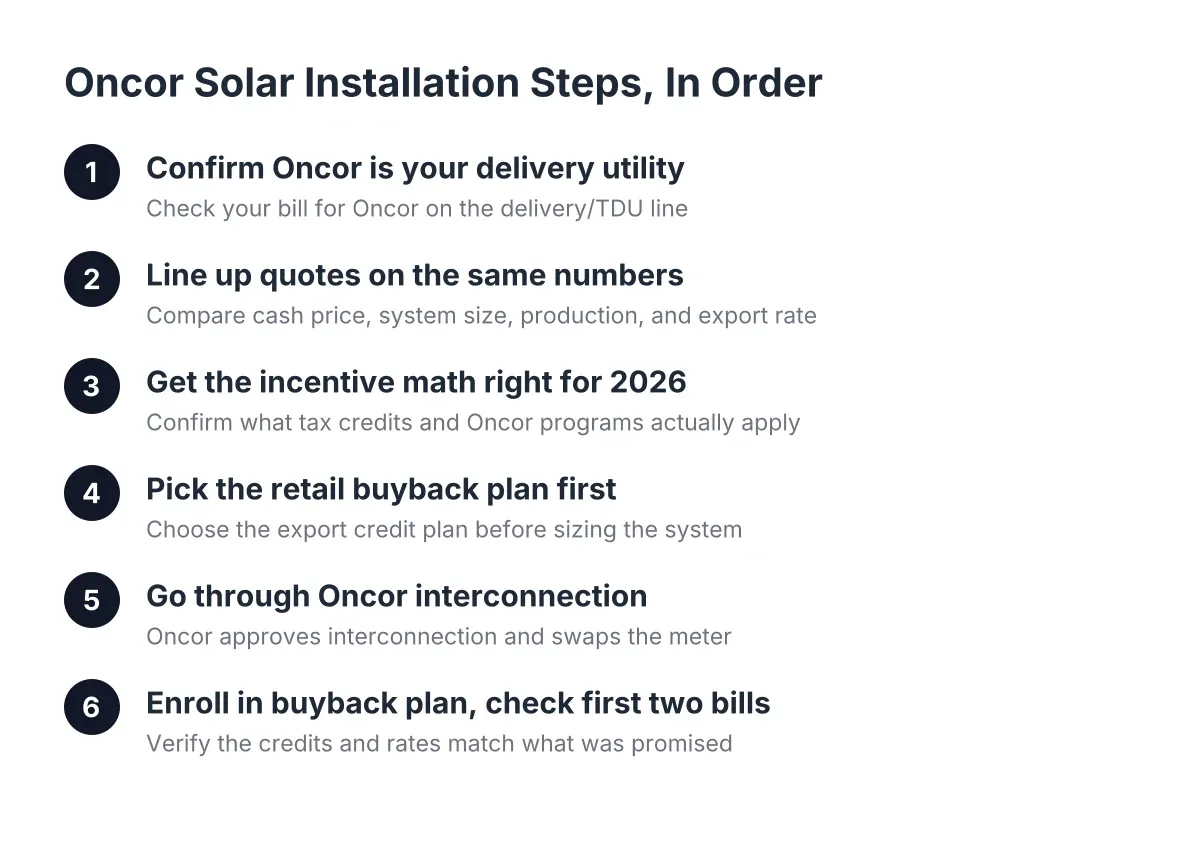
- They know Oncor is the wires company, not the biller. A good installer explains up front that Oncor handles interconnection and the meter swap, while your export credit comes from the retail plan you pick. If a salesperson says "Oncor pays you for your solar," they either do not understand the market or hope you do not.
- They model your savings against a named retail buyback plan. The honest quote shows production against a specific plan's import rate and export credit, with the as-of date on both. A quote that assumes full net metering in Oncor territory is fiction.
- They carry a Texas Electrical Contractor License and insurance, and show both on request. Licensing and general liability coverage are table stakes. A real company produces documents the same day you ask.
- They put everything in writing. System size in kW, panel and inverter models, home battery capacity if included, production estimate, warranty terms, and total price. Verbal promises about buyback rates do not survive the first bill.
- They offer real warranty terms, not slogans. Look for the workmanship warranty length in years, who services the inverter claim, and what happens if the company closes. The equipment warranty matters less than who answers the phone in year six.
- They are willing to say no. The typical Austin home was built around 1994, per U.S. Census Bureau ACS estimates, which means plenty of roofs in the area are on their second or third shingle layer. A trustworthy installer tells you to replace the roof first, or tells you a shaded lot is a poor candidate, even when that costs them the sale.
How to Find the Best Solar, Retail Electricity Plan, and Oncor Interconnection Strategy in Austin, TX
I will not quote you a price per watt here, because any number without your roof, your usage, and a date attached is a guess dressed up as a fact. What I can tell you is what moves the price and how to compare bids so the cheapest one does not become the expensive one.
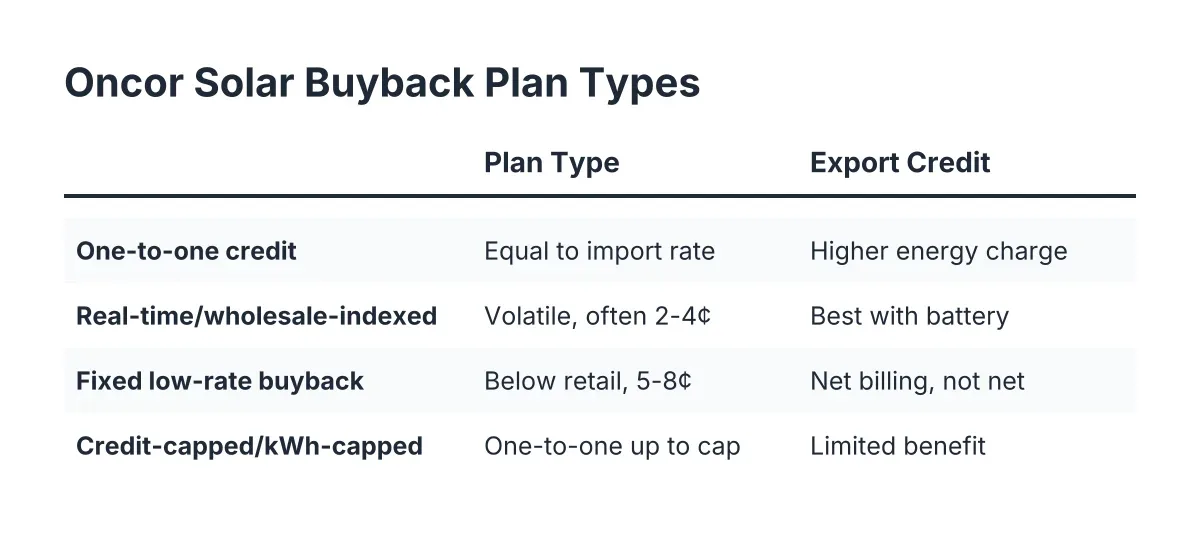
Price drivers run in both directions. System size is the biggest lever; larger systems cost more in total but less per watt. Roof complexity adds labor: multiple planes, steep pitch, tile instead of shingle, or a panel upgrade to the main electrical service. A home battery can add a large share of the total, and in Oncor territory a battery changes the math because some retail plans credit exports differently than others. Financing matters too: a solar loan or solar lease shifts cost into interest or escalator clauses that never appear on the headline price.
On incentives, be careful with dates. The federal purchase credit (the 25D path) ended, while the lease credit (the 48E path) survives for third-party-owned systems. Any installer still promising "30% back from the IRS" on a cash purchase in 2026 is quoting a dead program. Your numbers will differ from any example you read, including on this site, so anchor every figure in a quote to its as-of date.
To compare estimates apples-to-apples: divide total price by system size in watts, confirm both quotes use the same panel and inverter tier, confirm both model the same retail buyback plan, and read the production estimate's assumptions. A quote that models a generous export credit against a competitor's conservative one is not a better system. It is a better spreadsheet. The guide to how solar buyback plans work with Oncor retail electricity plans walks through the mechanics.
Questions to Ask Before You Hire
- Which retail electricity plan did you model my savings against, and what is its export credit today? A good answer names the plan, states the credit rate with its date, and admits the rate can change at renewal.
- Who files the Oncor interconnection paperwork, and how long does the meter swap usually take? The right answer is "we do, start to finish," with a realistic timeline, not "that happens automatically."
- What is your workmanship warranty, and who honors it if you close? Listen for a specific term in years and a clear answer on roof penetrations, which cause most post-install problems.
- Will my roof outlast this system? A good installer inspects the roof before quoting and will say "replace it first" when that is the truth.
- How does a home battery change my numbers on this plan? The honest answer depends on the plan's export credit; some plans make a battery nearly pointless, others make it the whole point. The export credit comparison across Oncor retail plans shows why.
- What happens to my savings estimate if the buyback plan changes at my next contract renewal? A good answer acknowledges the risk and shows a conservative scenario, not just the best case.
- Can I see the full contract before I sign anything? Any hesitation here is your answer.
Red Flags That Should End the Conversation
- "Oncor will pay you for your extra power." Oncor does not buy your exports. Your retail plan does. An installer who gets this wrong will get your payback math wrong too.
- A savings estimate with no named retail plan behind it. If the quote does not say which plan's rates it used and as of what date, the savings number is decoration.
- A 2026 cash quote that still includes the 30% purchase credit. The 25D purchase credit ended. Quoting it on a cash deal is either ignorance or deception, and neither improves with a signature.
- Door-to-door urgency. "This rate expires tonight" and "your neighborhood was selected" are sales scripts, not programs. No legitimate incentive in Oncor territory requires a same-day signature.
- No written estimate, or a one-page estimate with no equipment models. You cannot compare what is not written down.
- No license or insurance documents on request. A company that cannot produce its Texas Electrical Contractor License the day you ask does not deserve day two.
Solar with Oncor and a Retail Electricity Plan Questions Austin, TX Homeowners Ask
Are solar panels worth it in Austin, Texas?
It depends on your utility more than your address. In Oncor territory with a well-chosen buyback plan, a correctly sized system on a sound, unshaded roof can pencil out. On a shaded lot, an aging roof, or with a poorly chosen retail plan, the same system can be a bad buy. Your numbers will differ from anyone else's, so judge your own roof and your own plan, not an average.
Is there still a 30% solar tax credit in 2026?
Not for cash and loan purchases. The federal purchase credit (25D) ended, while the lease credit (48E) survives for systems owned by a third party, as with a solar lease. If a quote dated 2026 includes a 30% purchase credit on a system you would own, send it back.
Why is my electric bill so high if I have solar?
In Oncor territory, the usual culprits are a retail plan with a weak export credit, a buyback rate that dropped at contract renewal, a system sized for last year's usage, or delivery charges that solar never offsets. Pull your plan's Electricity Facts Label and compare the import rate against the export credit. Often the system is fine and the plan is the problem.
What is the 33% rule in solar panels?
It is a rough sizing guideline some salespeople cite, suggesting panels should cover about a third of available roof area or that bills should drop by a set fraction. Treat it as a conversation starter, not a design rule. Proper sizing comes from your actual kWh usage, your roof's orientation and shading, and your retail plan's export credit, not a one-size ratio.
Get a Quote You Can Judge
You now know what the best solar with Oncor and a retail electricity plan in Austin, TX actually looks like on paper: a named buyback plan with dated rates, listed equipment, written warranties, and a license you can verify. This guide also covers homeowners in Round Rock, Cedar Park, Georgetown, Pflugerville, Leander, Kyle, Buda, San Marcos, Hutto, Dripping Springs, Lakeway, Bee Cave, and Bastrop, where the utility on your bill, not your town, decides your outcome. Contact us with your questions, or take this checklist into your next installer conversation and make them earn the job.
For help with solar with Oncor and a retail electricity plan, Austin Solar FAQ is the place to start.
Related guide: Solar with Oncor and a retail electricity plan — Complete Guide
Prefer to talk it through? Call +15125571906 — a quick call is usually the fastest way to get a straight answer for your situation.