Solar Installer Warranties in Austin: What a Contractor Actually Covers
You signed the contract, or you are about to. The system is sized, the loan is approved, and the panel brand is picked. Now the part most homeowners skip: making sure your solar panel installation contractor actually stands behind the work after the crew drives away. Warranties on solar systems look generous on paper, 25 years here, 10 years there. What they actually cover varies more than any other part of the deal. This guide walks you through verifying coverage, step by step, written for someone in the Austin area in 2026 who has already decided to go solar and wants the paperwork to hold up.
If you just closed on a new build in Georgetown or Hutto and the builder stubbed solar conduit into the attic, this matters double. A brand-new roof is the best possible surface for solar, and the worst possible place to find out your installer's roof penetration warranty is three lines of vague language.
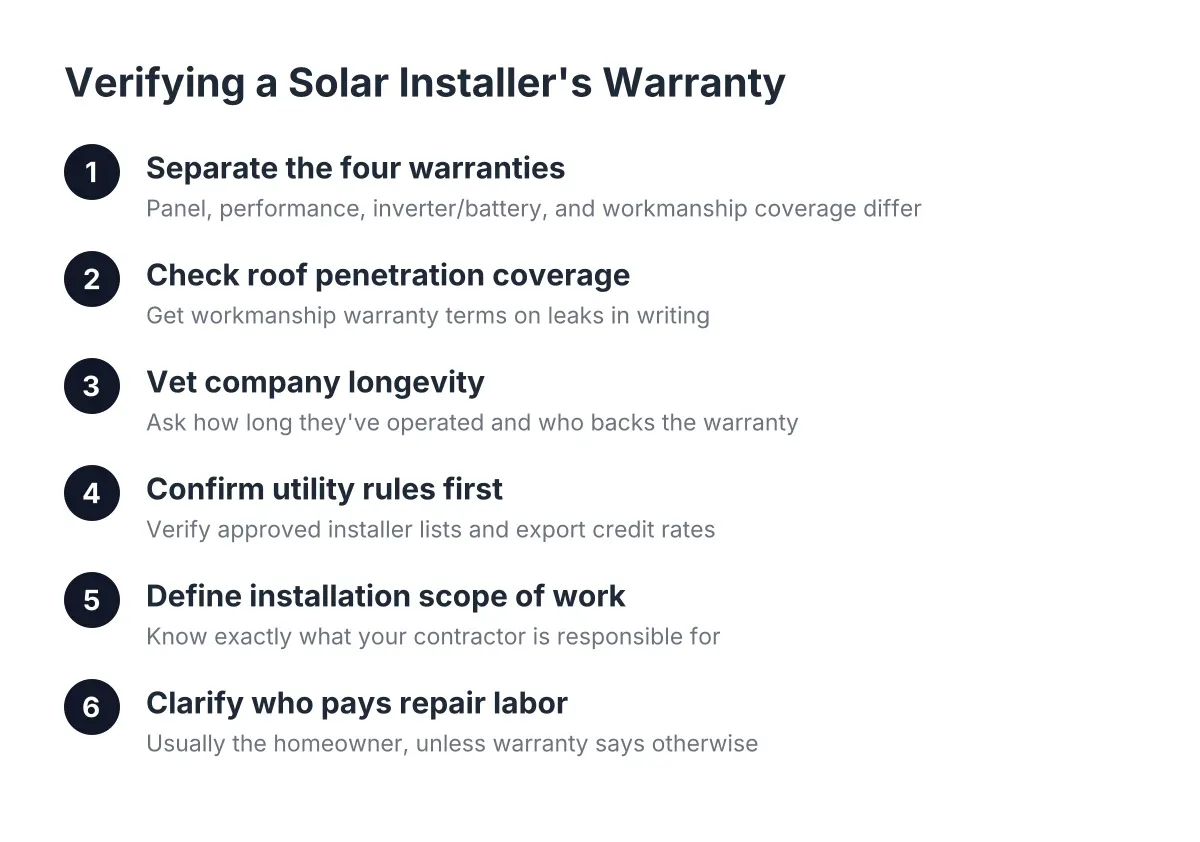
Step 1: Separate the Four Warranties Before You Compare Anything
A residential solar system comes with up to four distinct warranties, and homeowners routinely confuse them. Before you evaluate any solar panel installation contractor, write these four down and demand the term and the backer for each one:
- Panel product warranty. Covers manufacturing defects in the panel itself. Commonly 12 to 25 years depending on brand. Backed by the manufacturer, not the installer.
- Panel performance warranty. Guarantees the panel still produces a stated percentage of rated output after 25 years. Also backed by the manufacturer.
- Inverter or battery warranty. Typically 10 to 12 years for string inverters, longer for many microinverters, and around 10 years for most home batteries. Manufacturer-backed.
- Workmanship warranty. Covers the installation labor itself: the racking, the wiring, the roof penetrations, the conduit runs. This one is backed by the installer alone, and it is the one that fails most often.
The first three survive even if your installer disappears. The fourth does not. That asymmetry should drive everything you check in the following steps.
Step 2: Roof Penetrations and Solar Panel Installation Contractor Workmanship Coverage
Ask for the workmanship warranty in writing before you sign, and read the roof language word by word. A strong warranty says the installer will repair any roof leak caused by their penetrations, at their cost, including the labor, for a stated term of ten years or more. A weak one says they will "address defects in workmanship" without mentioning the roof at all.
For a new-construction buyer this step carries an extra wrinkle. Your builder's roof warranty may contain language voiding coverage if a third party penetrates the roof. Call your builder's warranty department before the install date, not after, and get their answer in writing. Some builders are fine with it; some require the solar panel installation contractor to carry specific insurance or follow specific flashing methods. If your home came "solar ready" with conduit already run, penetrations are fewer but not zero, so the question still applies.
One trade-off worth naming honestly: a longer workmanship warranty from a shaky company is worth less than a five-year warranty from a company likely to exist in year five. The next step deals with that directly.
Step 3: Check Whether the Company Will Exist When You Need It
A warranty is a promise, and a promise is only as good as the company making it. Solar installation companies fail at a high rate, and when they do, the workmanship warranty usually dies with them. If you financed a purchased system and the installer folds in year four, you still owe the loan, and you now pay out of pocket for any labor the workmanship warranty would have covered.
So vet longevity, not just reviews. Ask these three questions of any solar installer company you are considering:
- How many years have you operated under this exact legal name in Texas? Name changes after bad reviews or liability events are common in this industry.
- Who holds the electrical license, and is that person an employee or a rented license? A master electrician on staff signals a real operation.
- If you close, what happens to my workmanship warranty? Some installers carry third-party-backed warranties where an outside entity guarantees labor and replacement service even if the original installer goes out of business. That structure protects you from installer bankruptcy. Ask whether it exists and who the backer is.
In addition, prefer established, bankable equipment manufacturers for the same reason. A 25-year panel warranty from a manufacturer that exits the market in year six is paper.
Step 4: Confirm Your Utility's Rules Before the Contract Locks You In
Your utility, not your town, decides most of your solar outcome in the Austin area, and it also shapes your warranty exposure. Utility-run rebate programs commonly require you to use contractors registered or approved by the utility, and hiring an unregistered installer can forfeit the rebate entirely. Check the approved list before you sign, not after.
The utility also sets what your exported power earns, which affects how much a production shortfall costs you. Austin Energy pays residential solar customers through its Value of Solar tariff rather than retail-rate net metering; according to Austin Energy, that rate is 12.89 cents per kWh for systems under 1 MW-AC, effective October 1, 2026, credited on all the solar a home produces. Pedernales Electric Cooperative credits surplus solar sent to the co-op at 7.1921 cents per kWh under its regular interconnect rate, applies that credit only toward the Base Power Charge, and expires unused credits at the end of each calendar year, according to PEC. Those figures are as published for 2025 reporting; rates change, and your numbers will differ.
If you are in Georgetown Utility Systems or Bluebonnet territory in a new subdivision, call the utility and ask two things: what the current export credit is, and whether interconnection for a new-construction home requires anything extra. Utilities commonly require engineering documentation and drawings for review before approving an installation, a practice Arizona Public Service describes for its own interconnection process, and your installer should handle that submission. If a company that installs solar panels tells you they "don't deal with the utility paperwork," walk away. Interconnection is part of the job.
Step 5: Define the Installation Scope of Work from Your Solar Panel Installation Contractor
A complete solar panels installation service in this market should include, in writing: system design, engineering drawings, permit filing, utility interconnection application, the physical install, inspection scheduling, and commissioning. Items that are often extra include main panel upgrades, trenching for ground mounts, roof repairs discovered during install, and tree work.
Here is where a quality quote earns its keep. It should list the exact model numbers of both the panels and the inverter in writing. Without model numbers you cannot verify equipment warranty terms, and you cannot confirm the equipment qualifies under your utility's rebate program if one exists. A quote that says "Tier 1 panels, 25-year warranty" and nothing else is not a quote; it is a placeholder.
Timelines run longer than most buyers expect. The physical install is often one to three days for a typical roof system, but permitting, utility review, and inspection can stretch the full project across several weeks to a few months depending on the utility and the permitting office. Any installer promising a specific energization date before the utility has reviewed the application is guessing.
Step 6: Understand Who Pays for Repair Labor, Because Usually You Do
This is the single most misunderstood point in solar warranties. Manufacturer warranties typically cover the replacement part, not the labor to diagnose the fault, remove the failed unit, ship it, and install the replacement. Unless your contract or a separate labor warranty says otherwise, you pay a technician for that work, even on a panel that is fully under warranty.
Suppose a homeowner in a new Bluebonnet-territory subdivision has an inverter fail in year eight. The manufacturer ships a replacement under warranty at no charge. The original installer closed two years earlier. In that scenario the homeowner pays a new company for a service call, diagnosis, and swap labor, plausibly several hundred to over a thousand dollars as an illustrative range. Nothing went wrong with the warranty; the warranty simply never covered labor.
Leased systems work differently. With a solar lease you pay a fixed monthly amount for the equipment regardless of production, and you do not own the system, as the U.S. Environmental Protection Agency describes for both leases and power purchase agreements. Maintenance terms vary by provider, but coverage typically runs while the leasing entity owns the system. For an outage-motivated buyer adding a home battery, apply the same labor question to the battery warranty specifically, since battery service calls are not cheap.
Step 7: Match the Warranty Decision to Your Actual Priority
Finally, weigh all of this against why you are buying. Texas installed 2.7 GWdc of solar in the first quarter of 2025, more than any other state and 92% ahead of second-ranked Florida, according to the Solar Energy Industries Association. The market is big, which means plenty of strong solar panel installers operate here, and plenty of weak ones do too. Volume does not vet anyone for you.
If backup power is your real motivation, prioritize the battery and inverter warranties and the installer's service response commitment over panel specs. If you are a new-construction buyer stretched thin from closing costs, a legitimate option is to wait a year, use the solar-ready conduit later, and spend the waiting time confirming your HOA's rules and your utility's current export credit. Texas law limits how far an HOA can restrict solar, but architectural review requirements still apply in most new subdivisions, so get their process in writing early.
One honest limitation: no article can read your specific contract. For roof warranty conflicts on a new build, or any dispute over whether damage falls under workmanship or manufacturer coverage, a licensed professional or an attorney who has seen solar contracts is worth the fee.
The Short Checklist Before You Sign
Run through this list with any solar panel installation contractor before signing:
- All four warranties in writing, with term length and the name of the entity backing each.
- Roof penetration coverage stated explicitly, and your builder's warranty department consulted first on a new build.
- Proof the company is on your utility's approved contractor list if a rebate program requires it.
- Exact panel and inverter model numbers on the quote.
- A direct answer to "who pays repair labor in year eight," in writing.
- Whether a third-party-backed warranty survives the installer's bankruptcy.
Ten minutes of reading warranty language now beats a leak dispute in year six. The companies confident in their work answer these questions without flinching. The ones that dodge them just told you everything you need to know.
For help with solar with Austin Energy, Austin Solar FAQ is the place to start.
Prefer to talk it through? Call +15125571906 — a quick call is usually the fastest way to get a straight answer for your situation.