Residential Solar Installation Timeline in Austin: How Long Each Step Really Takes
If you signed a solar contract today in the Austin area, panels would probably go live on your roof in two to four months. That is the honest answer on the residential solar installation timeline in Austin, and the range is wide for a reason: your utility, not your installer, controls the longest waits. Austin Energy, Pedernales Electric Cooperative (PEC), Oncor, Georgetown Utility Systems, and Bluebonnet each review paperwork at their own pace. This guide walks through every step in order, with realistic durations for each, so you can plan around the parts you control and stop worrying about the parts you cannot.
One note before the steps. If your real goal is backup power before the next grid event, the timeline matters twice. A home battery added to a solar project rides the same schedule as the panels. A battery or standby generator installed on its own usually moves faster because the utility review is simpler. I will flag those differences where they come up.
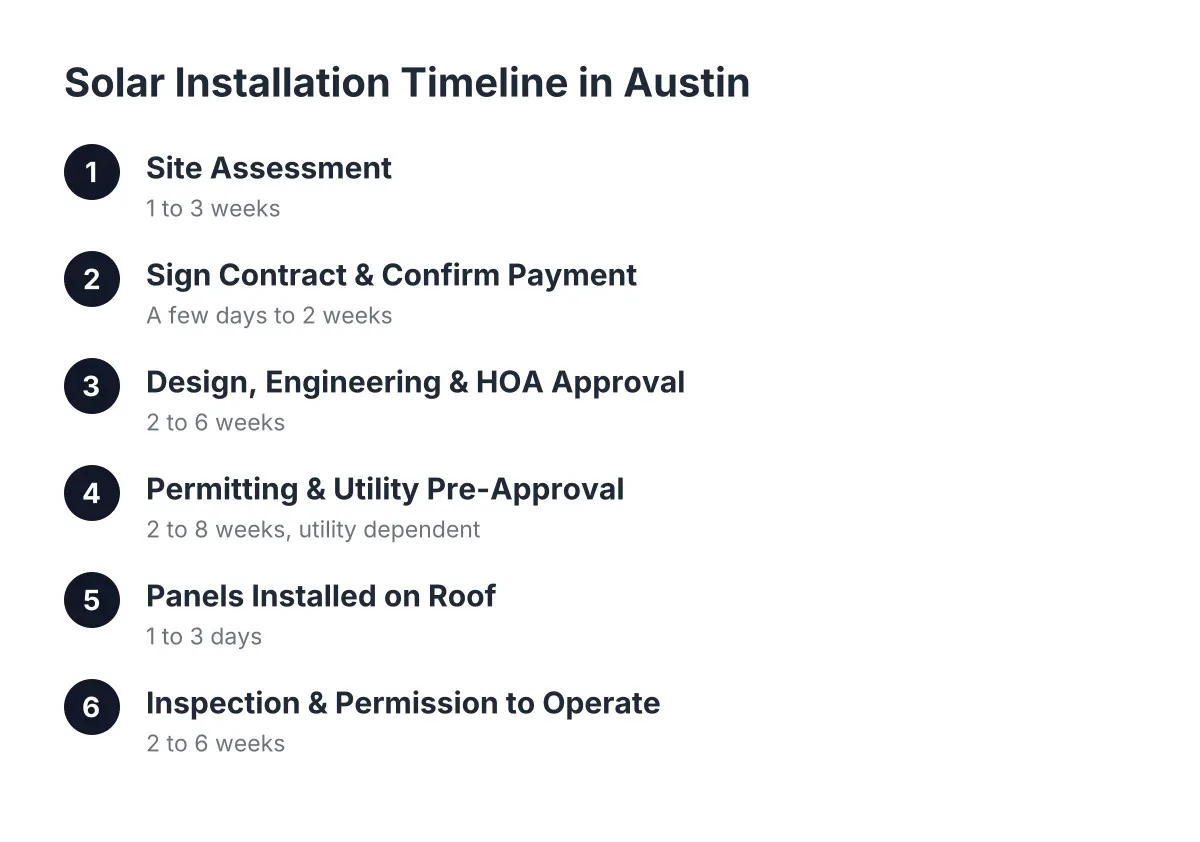
Step 1: Site Assessment and Solar Installation Timeline in Austin (1 to 3 Weeks)
Start with the site visit, or at least a remote assessment from satellite imagery and your last twelve months of bills. A competent installer checks roof age, shading, panel placement, and the condition of your electrical panel. An old 100-amp panel can add a main panel upgrade to the project, which adds cost and one to three weeks of time.
Collect two or three quotes and compare them on the same terms: system size in kilowatts, equipment brands, and total cash price. This stage takes as long as you let it. Two weeks is typical if you respond to installers promptly; it stretches to months if quotes sit in your inbox.
If you lost food during the last multi-day outage and a battery is part of your plan, say so in the first conversation. Battery sizing changes the electrical design, and a design change after permitting restarts the clock. Deciding between a home battery and a whole-house standby generator is its own question, but either one belongs in the plan from day one, not bolted on at Step 5.
Step 2: Sign the Contract and Confirm How You Will Pay (A Few Days to 2 Weeks)
Signing is fast. Financing can be slow. A cash purchase adds no time. A solar loan adds a few days to two weeks for credit approval and underwriting.
Leases deserve a careful read in 2026. A solar lease works like an equipment lease, similar to a car lease; you pay a fixed monthly amount regardless of production, and you do not own the system, according to the U.S. Environmental Protection Agency. The federal purchase credit for homeowner-owned systems, historically 30% of total cost according to the Internal Revenue Service, has ended for residential purchases; the lease credit path survives and flows to the leasing company, not to you. How much of that credit shows up in your monthly lease payment varies by company. Every dollar figure in this article is as of early 2026, and your numbers will differ.
Step 3: Design, Engineering, and HOA Approval for Solar Installation in Austin (2 to 6 Weeks)
After signing, the installer produces engineering drawings: panel layout, structural attachment details, and electrical one-line diagrams. Utilities that support residential solar interconnection commonly require this documentation before approving an installation, according to Arizona Public Service, and the Austin-area utilities are no different. Expect two to four weeks for design work alone.
HOA approval runs in parallel, but do not treat it as a formality. Texas law limits what an HOA can refuse, yet architectural review committees often meet monthly. Miss one meeting and you lose thirty days. Submit the HOA packet the same week you sign.
This is also the step where homeowners racing a deadline get burned. HOA review, permitting, and inspections together can take weeks to months, so if you are trying to finish before a credit deadline or before storm season, start the project with that buffer built in. A contract signed in October does not reliably produce a working system by late December.
Step 4: Permitting and Utility Pre-Approval—Solar Installation Timeline Austin (2 to 8 Weeks, Utility Dependent)
Here is where the solar installation timeline in Austin splits by territory. Two things happen, often in parallel: your city or county issues a building and electrical permit, and your utility reviews the interconnection application.
Rough planning figures, as of early 2026, with the usual caveat that your numbers will differ:
- Austin Energy: Interconnection review plus the City of Austin permit, usually 2 to 4 weeks combined. Austin Energy also runs its own rebate paperwork, which can add time if your installer is not on the participating list. The utility credits all solar production under its Value of Solar tariff rather than traditional net metering.
- PEC: Interconnection review is typically 2 to 4 weeks. PEC credits surplus solar sent to the co-op at 7.1921 cents per kilowatt-hour, only toward the Base Power Charge, according to PEC; confirm the current rate before you size your system.
- Oncor territory (retail choice): Oncor handles the physical interconnection, usually 2 to 6 weeks, but your buyback comes from whichever retail electric provider you choose. In deregulated markets, customers can pick among multiple solar buyback plans, according to Solar United Neighbors; plan shopping can run alongside the build so it adds no calendar time if you start early.
- Georgetown Utility Systems and Bluebonnet: Smaller review queues, typically 2 to 5 weeks, but staffing is thin and a single incomplete form can add a month. In regulated utility areas like these, you typically have only one or a few buyback options, per Solar United Neighbors, so there is nothing to shop; the wait is the wait.
You cannot speed this step up by calling the utility. You can avoid delays by picking an installer who files complete applications the first time. Most rejections are paperwork errors, not engineering problems.
Step 5: Get the Panels on the Roof (1 to 3 Days)
The part everyone pictures is the shortest part. A typical crew installs a standard roof-mounted home solar energy system in one to three days: racking and panels on day one, then electrical work, which includes running the wiring from the roof through protective conduit down to your electrical panel. A home battery adds half a day to a full day. Additionally, a main panel upgrade adds another day and sometimes a coordinated shutoff with the utility.
Workmanship here matters more than speed. Rushed rooftop wiring is the failure mode you cannot see; a fault in the roof space can smolder out of sight long before anything is visible from the ground. This is one reason to weight installer reputation over a one-week schedule difference, and why electrical work on a project like this is never a do-it-yourself job.
Step 6: Pass Inspection and Wait for Permission to Operate (2 to 6 Weeks)
After installation, the city or county inspector signs off, usually within one to two weeks of the crew finishing. Then the application goes back to the utility for final approval and, in some territories, a meter swap. This final wait is called permission to operate, or PTO. Until PTO arrives, your system sits on the roof doing nothing. Budget two to six weeks and treat anything faster as a bonus.
For example, suppose a homeowner in Cedar Park on PEC signs a contract on March 1. In that scenario, understanding the solar installation timeline for Austin and PEC, a realistic schedule looks like design and HOA through early April, PEC interconnection approval and county permit by late April, a two-day install the first week of May, inspection mid-May, and PTO in early June. That is about fourteen weeks start to finish with no setbacks, which is a normal outcome, not a slow one.
What Stretches a Solar Installation Timeline Past Four Months
A residential solar panel installation slips past the four-month mark for predictable reasons, and most of them show up early enough to manage:
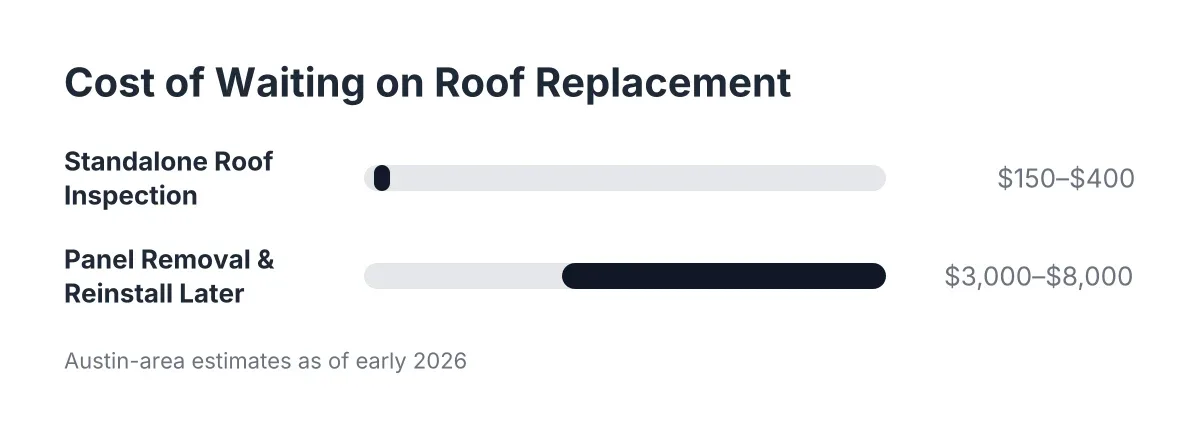
- A roof that needs replacement first, which adds four to eight weeks before solar work can start.
- A main electrical panel upgrade discovered late instead of at the site assessment.
- An HOA packet submitted weeks after contract signing instead of the same week.
- Incomplete interconnection paperwork that bounces back from the utility.
- Equipment substitutions mid-project, which can force a revised plan review.
- Battery additions after permitting, which restart the electrical design.
Demand is the quiet variable. Texas installed 2.7 gigawatts of solar capacity in the first quarter of 2025 alone, 92% more than second-ranked Florida, according to the Solar Energy Industries Association. Busy installers and busy utility review desks both stretch queues, especially in the weeks after a major grid event when everyone on your street starts calling at once.
How the Timeline Changes for Batteries, Generators, and Existing Systems
If backup power is the goal, the equipment you choose changes the schedule. Texans experienced a 17% increase in power outage frequency between 2017 and 2022, according to Tesla, so you are not imagining the trend, and you are not the only one planning for it.
A home battery added to a new solar project adds little calendar time; it rides the same permits and the same interconnection review. A battery retrofit on an existing system is often faster than a full new install, roughly four to eight weeks, because the solar interconnection already exists, though compatibility with your current inverter can complicate the design. Furthermore, a whole-house standby generator skips utility interconnection entirely; its schedule is driven by gas line work, a concrete pad, and equipment availability, often four to ten weeks as of early 2026. Your numbers will differ with equipment supply.
For homeowners who already own panels, timing questions look different. If your utility moved you from net metering to a lower export credit, a battery retrofit lets you store midday home solar power generation for evening use instead of exporting it cheaply. The decision math there depends on your specific tariff and your inverter, and it is worth an hour with a licensed electrician or a design-literate installer before you sign anything.
The Short Version
Plan on two to four months from signed contract to permission to operate for home solar installations in the Austin area, with the install itself taking only one to three days. The utility review and the final PTO wait are the steps you cannot compress, so start before you need the power, not after the next outage reminds you why you wanted it. Solar is also not the right answer for every house; a heavily shaded roof or a roof due for replacement changes the math, and a battery or generator alone may serve a storm-prepper better than panels ever would. Knowing the timeline is how you make that call calmly instead of under a conservation alert.
For help with solar with Austin Energy, Austin Solar FAQ is the place to start.
Prefer to talk it through? Call +15125571906 — a quick call is usually the fastest way to get a straight answer for your situation.