Does Your Roof Need Replacing Before Solar Panels Go On? An Austin Checklist
Before you sign anything with a solar company, answer one question: does your roof need replacing in the next ten years? If the answer is yes, you should complete roof replacement before solar installation. Taking panels off a roof, redoing the shingles, and putting the panels back typically runs several thousand dollars, and nobody mentions that at the kitchen table during the sales pitch. I have watched more Austin-area homeowners regret the roof decision than the panel decision.
This matters whether Austin Energy, Pedernales Electric Co-op, Bluebonnet, Oncor, or Georgetown Utility Systems sends your bill. The utility decides your export credit. Your roof decides whether the install holds up for 25 years. Here are eight checks to run before an installer sets foot on your shingles in 2026.
1. Determine Roof Age Before You Date the Panels
Find out exactly how old your roof is before any solar conversation goes further. Panels last 25 to 30 years. A standard three-tab asphalt shingle roof in Central Texas often lasts 15 to 20, and our hail and heat shorten that. If the two lifespans do not line up, you are planning a future removal and reinstall, which is why roof replacement before solar makes financial sense.
Pull your records. The age might be on your home insurance declarations page, in closing documents, or on a permit you can look up with the City of Austin or your county. If you bought the house used and cannot find a date, a roofer can estimate age from granule loss and shingle condition in a 20-minute visit.
My rule of thumb: if the roof is past year 12 of a 20-year shingle, replace it before the panels go up. If it is under 8 years old and undamaged, proceed. Between those marks, get a roofer's written opinion, not the solar salesman's verbal one.
2. Know When Roof Replacement Before Solar Is Required, Not Just Repair
A roof needs replacement, not repair, when the problems are spread across the whole surface rather than confined to one spot. One lifted shingle after a windstorm is a repair. Curling edges on every south-facing course, bald patches where granules have washed into the gutters, and daylight visible in the attic are replacement signs.
Walk your attic on a sunny morning with a flashlight off. Pinpoints of light through the decking mean the roof is failing. Then check the gutters; a layer of shingle granules that looks like coarse coffee grounds means the shingles are near the end.
In addition, look for sagging. A roof must carry the panels, the racking, and the crew installing them. A healthy roof can support a person walking on it without flex or soft spots underfoot. If a roofer reports spongy decking or sagging rafters, that is structural work before solar, full stop.
3. Get the Roof Inspected by a Roofer, Not Only the Solar Company
Pay a roofing contractor for a standalone inspection before you compare solar quotes. A solar company has an incentive to call your roof fine, because roof replacement before solar can delay or kill their sale. Most are honest. The inspection removes the need to guess which ones.
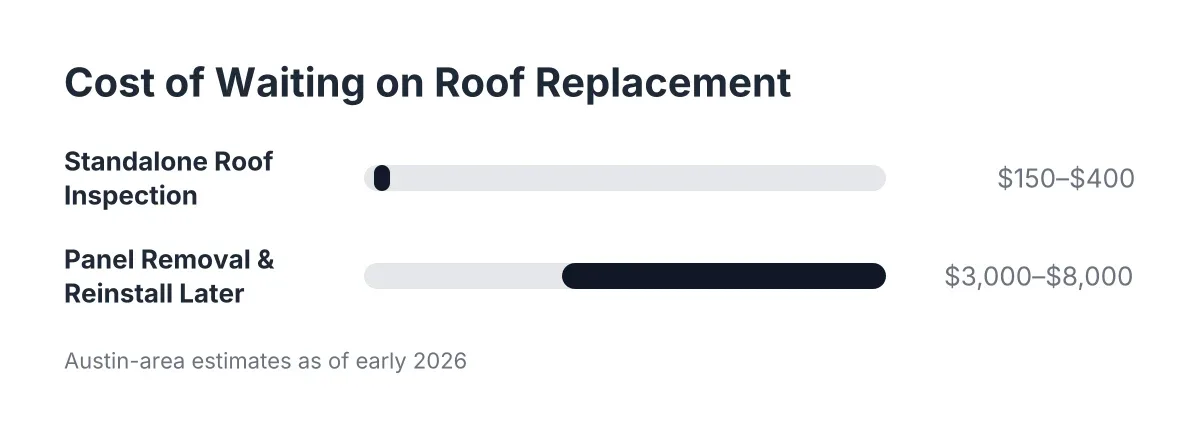
Expect to pay roughly $150 to $400 for a documented inspection in the Austin area as of early 2026; some roofers waive it hoping for the replacement job. Your numbers will differ. Ask for the finding in writing with photos, including remaining expected life in years.
This document earns its cost twice. First, it settles the replace-or-wait question. Second, if a solar crew damages shingles during residential solar panel installation, you have dated proof of the roof's prior condition for the warranty claim.
4. Check What Your Roof Needs Structurally: Decking, Rafters, and Attachment Points
Your roof needs solid decking and sound rafters at every point where a mounting foot will land. Solar racking attaches with lag bolts driven through the shingles into the rafters below. Rotted decking or cracked rafters at those points mean leaks later, or worse, pull-out in a windstorm.
Utilities and permitting offices take this seriously. Utilities that support residential solar interconnection commonly require engineering documentation and drawings submitted for review before installation is approved, according to Arizona Public Service (APS), and the same pattern holds here. A structural sign-off is not red tape; it is the thing standing between you and a roof penetration problem you cannot see.
Ventilation belongs on this list too. A roof needs to breathe; blocked soffit or ridge vents trap heat and moisture under the decking and age it from below. Panels shade the shingles, which helps, but they do not fix an attic that cooks at 140 degrees every July afternoon.
5. If You Replace, Pick the Roof for the Next 30 Years
Choose roofing material with the solar system's full life in mind, because whatever you install will live under those panels until the 2050s. Architectural shingles rated for 30 years cost more than three-tab but match the panel lifespan. A standing-seam metal roof costs more again, yet panels can clamp to the seams with zero penetrations.
For a Bill-Shock Retiree on a fixed income, this is the one place I suggest spending up if you can. You are buying your way out of a $3,000 to $8,000 panel removal and reinstall 15 years from now; those figures are my estimate as of 2026, and your numbers will differ. A reflective or light-colored roof also cuts attic heat, which trims the summer bill before a single panel generates anything.
Suppose a homeowner in Georgetown Utility Systems territory has a 14-year-old shingle roof and a $280 August bill. In that scenario, the smart sequence is roof now, efficiency fixes next, and a right-sized solar array in spring. Shrinking the bill first means buying fewer panels later, and the roof never forces a mid-life teardown.
6. Clear the Shade Before You Price the System
Walk outside at 10 a.m., noon, and 3 p.m. and note what shadows cross your south- and west-facing roof planes. A live oak shading the best roof face can cut production enough to break the math, whatever your utility pays. Installers routinely recommend trimming or removing trees that shade proposed panel locations before installation, and that cost belongs in your budget, not as a surprise.
Sometimes the honest answer is that the house is a poor fit. A heavily shaded roof, a low bill, or a weak export credit can mean solar does not pencil, and insulation plus attic sealing beats panels on return. A solar panel on a house only earns its cost when sun actually reaches it. I would rather tell you that over the fence than have you learn it on your first full-year bill.
7. Match the Roof Timeline to Your Utility's Money
Run the payback math against what your specific utility pays before the roof-plus-solar spending starts. The town on your address does not decide this; the name on the bill does. As of early 2026, and your numbers will differ:
- Austin Energy credits every kilowatt-hour a home's panels produce at its Value of Solar rate, 12.89 cents per kWh for systems under 1 MW-AC effective October 1, 2026, and bills the home for all the electricity it uses, according to Austin Energy. That is a buyback rate, not retail net metering.
- Pedernales Electric Co-op credits surplus solar sent to the co-op at 7.1921 cents per kWh, only toward the Base Power Charge, with unused credits expiring each calendar year-end, according to PEC.
- Oncor territory means retail choice; in deregulated markets you can pick among multiple solar buyback plans that credit surplus energy sent to the grid, according to Solar United Neighbors. In regulated and municipal areas you get one option, or a few.
Therefore, a roof replacement that delays your install by three months costs you three months of credits. Weigh that against the removal-and-reinstall bill a dying roof guarantees. The roof wins that comparison in almost every case I have seen.
8. Protect Yourself on Ownership, Leases, and Warranties
Own the roof decision even if you do not own the panels. A solar lease works like an equipment lease, similar to a car lease; you pay a fixed monthly amount regardless of production, and you do not own the system, according to the U.S. Environmental Protection Agency (EPA). If that leased roof later fails, removing the system is labor intensive, and the lease contract dictates who pays and when. Read that clause before signing, not after.
For buyers, the 30% federal tax credit has historically applied to the total cost of a residential system, according to the Internal Revenue Service; the purchase credit path ended for homeowners, while the lease credit path under 48E survives through third-party owners. Ask any home solar system installers you interview to put the credit treatment in writing with a date on it.
One more quiet risk: solar contractors go out of business at a high rate. If your installer folds, roof penetration warranties can fold with them, and you bear the repair cost. However you search for home solar installation near me, favor companies with ten-plus years in business and a roofer's workmanship warranty that is separate from the installer's.
The Short Version
Does your roof need to come first? Usually, yes. Here is the sequence that protects a fixed income and a backup-power budget alike:
- Date the roof and get a paid, written roofing inspection.
- Fix structure, decking, and ventilation before any racking goes on.
- Replace a roof past year 12 of its life; pick a 30-year material.
- Clear shade, then do cheap efficiency fixes to shrink the system you need.
- Run the math on your actual utility's buyback or Value of Solar rate.
- Only then compare installers and contracts.
For structural questions, sagging, or anything involving decking, bring in a licensed roofer or structural engineer; this article cannot see your attic. The roof is the foundation of the whole project. Get it right once, and the panels on top become the boring, reliable part for the next 25 years.
For help with solar with Austin Energy, Austin Solar FAQ is the place to start.
Prefer to talk it through? Call +15125571906 — a quick call is usually the fastest way to get a straight answer for your situation.