Residential Solar Panel Installation Terms Explained: A Plain-English Glossary
This residential solar panel installation glossary is for homeowners in the Austin area who keep hitting jargon in quotes, utility documents, and online threads. Every entry here defines a term in one plain sentence, then tells you why it matters when you read a quote or talk to an installer. Use it to decode the paperwork, ask sharper questions, and spot the places where a sales pitch glosses over a real cost. No selling here, just the words explained.
- Kilowatt (kW): how big your system is
- Kilowatt-hour (kWh): how much energy it makes or you use
- Solar Panel (Module): the thing on the roof
- Inverter: turns panel power into house power
- Microinverter: a small inverter behind each panel
- String Inverter: one inverter for a row of panels
- Home Battery: stores solar power for later
- Racking: the hardware that holds panels to the roof
- Interconnection: the utility's permission to connect
- Permission to Operate (PTO): the final switch-on approval
- Site Survey: the measure-twice visit before design
- Export Credit (Buyback): what you get for extra power
- Value of Solar: Austin Energy's way of crediting solar
- Net Metering: the credit system people assume exists
- Price Per Watt: how quotes get compared
- Solar Lease: paying monthly for someone else's panels
- Solar Loan: borrowing to own the system
- Offset: how much of your bill solar covers
- Production Estimate: the installer's output prediction
Equipment Terms
These are the physical parts of a residential solar panel installation, the pieces that show up as line items on a quote.
Kilowatt (kW)
A kilowatt is a unit of power, and it measures how big your solar system is at any single moment. Quotes describe system size in kilowatts, so a 7 kW system has more panel capacity than a 5 kW system. Size drives cost, roof space needed, and how much energy the system can make. When two quotes differ in price, check the kW first; a cheaper quote is sometimes just a smaller system.
Kilowatt-hour (kWh)
A kilowatt-hour is a unit of energy, and it measures how much electricity you use or your panels produce over time. Your utility bill charges you per kWh, and your installer's production estimate predicts kWh per year. Keep the two units straight: kW is the size of the engine, kWh is the miles driven. Comparing your annual kWh use to the system's estimated kWh output tells you how much of your bill solar might cover.
Solar Panel (Module)
A solar panel, also called a module, is the flat unit on your roof that converts sunlight into electricity. Panels differ in wattage, so a system's size depends on both the count and the rating of each panel. A quote listing "20 panels" without wattage tells you less than one listing total kW. Ask for the panel model and wattage in writing so you can compare quotes fairly.
Inverter
An inverter is the device that converts the direct current (DC) electricity your panels make into the alternating current (AC) electricity your house uses. Every system needs one, and it is the component most likely to need replacement during the system's life. Quotes should name the inverter type and its warranty length. If a quote skips the inverter entirely, ask why.
Microinverter
A microinverter is a small inverter mounted behind each individual panel, so every panel converts its own power independently. The upside is that shade on one panel does not drag down the others, and you can see each panel's output separately. The tradeoff is more hardware on the roof. Austin-area roofs with trees or dormers often lean this way, but there is no single right answer for every house.
String Inverter
A string inverter is one central inverter that handles a whole group, or string, of panels together. It is the simpler, often cheaper setup, and it works well on open, unshaded roofs. The weakness is that one shaded or dirty panel can pull down the whole string. If your roof is clean and south-facing, a string inverter is not a corner cut; it can be the sensible choice.
Home Battery
A home battery is a unit that stores electricity from your panels so you can use it after sunset or during an outage. In the Austin area, batteries matter more where the utility's export credit is weak, because stored power you use yourself can be worth more than power you sell back. A battery adds real cost, so the case for one depends on your utility and your outage tolerance. Ask the installer to show the math for your utility, not a national average.
Racking
Racking is the mounting hardware that attaches solar panels to your roof. It matters because every racking attachment penetrates the roof, and bad flashing around those penetrations causes leaks years later. Ask what racking system the installer uses and how penetrations get sealed. A quote that itemizes racking and roof work is a good sign the installer has thought about your specific roof.
Process and Paperwork Terms
Interconnection
Interconnection is the formal agreement between you and your utility that allows your solar system to connect to the grid. In the Austin area the process and the paperwork differ by utility; Austin Energy, Pedernales Electric Co-op, Oncor-area retail providers, Georgetown Utility Systems, and Bluebonnet each run their own version. Your installer usually files this for you, but you sign it and you are bound by it. Read it before you sign, because it sets the rules for how your exported power gets credited.
Permission to Operate (PTO)
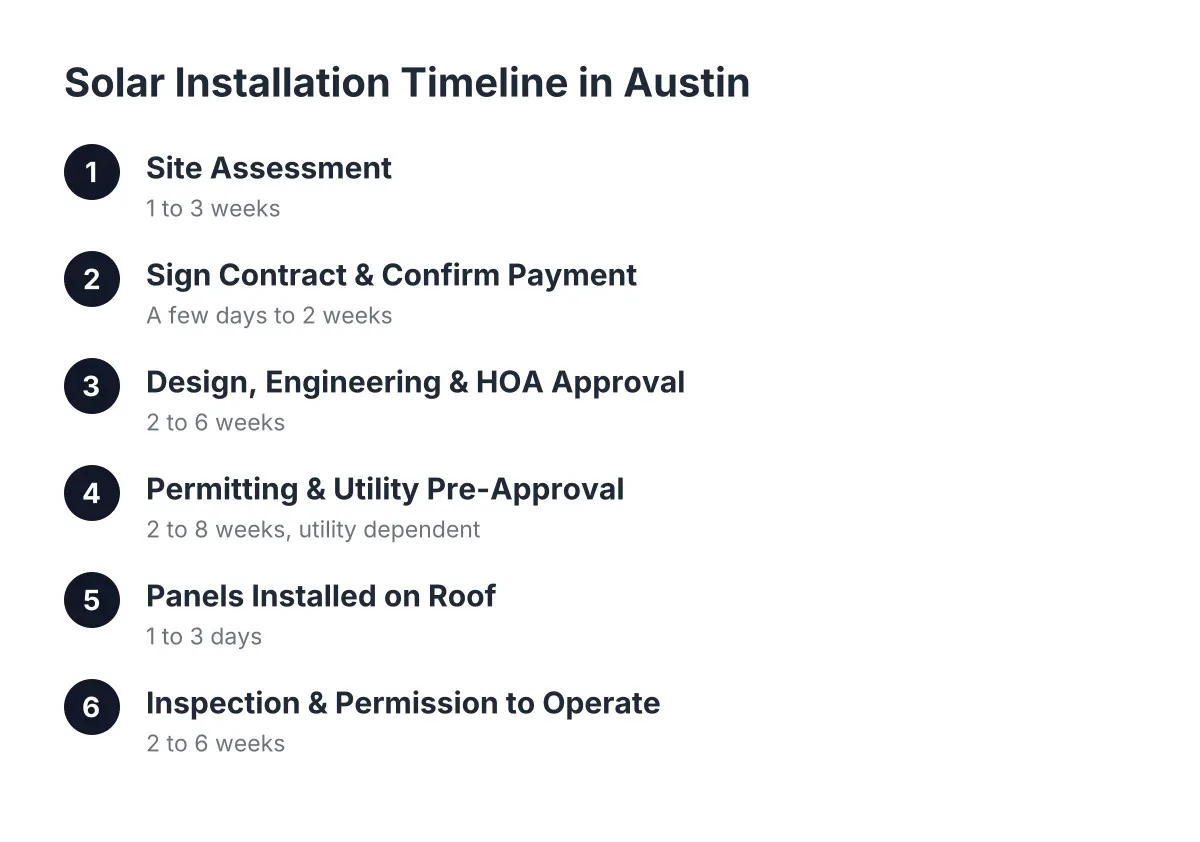
Permission to Operate, or PTO, is the utility's final written approval to switch your system on. Panels can sit installed on your roof for weeks while you wait for PTO, and until it arrives the system produces nothing you can legally use. Ask every installer for their typical install-to-PTO timeline with your specific utility. A company that quotes one timeline for every utility territory has not done this here often enough.
Site Survey
A site survey is the visit, in person or by drone and software, where the installer measures your roof, checks shading, and inspects your electrical panel. The survey turns a rough sales estimate into a real design, and designs often change after it. If the panel count or price shifts after the survey, that is normal; a company that never adjusts after surveying is the odd one. Keep the before-and-after numbers and ask about any change.
Production Estimate
A production estimate is the installer's prediction of how many kilowatt-hours your system will make per year. It comes from modeling software that accounts for your roof's direction, tilt, and shading. Estimates are honest guesses, not guarantees, and your numbers will differ with weather and panel soiling. Ask whether the quote includes a production guarantee and what happens if the system underperforms.
Residential Solar Panel Installation Glossary: Money, Credits, and Contracts
Export Credit (Buyback)
An export credit, sometimes called buyback, is what your utility pays or credits you for solar power you send to the grid instead of using. This single number changes the economics of solar more than panel brand ever will, and it differs by utility across the Austin area. Do not assume full retail credit exists; many territories pay less for exported power than they charge for delivered power. Ask your installer to state your utility's current export rate in writing, with a date on it.
Value of Solar
Value of Solar is Austin Energy's tariff for crediting solar customers, and it works differently from traditional net metering. Under it, Austin Energy credits all the power your panels make at a set rate while billing your usage normally, rather than simply netting one against the other. The rate can change, so any savings projection built on it carries an as-of date, and your numbers will differ. If you are an Austin Energy customer, make sure your quote models Value of Solar specifically, not a generic net metering assumption.
Net Metering
Net metering means the utility credits your exported solar power at the same rate it charges you, so the meter effectively runs both ways. It is the arrangement national solar websites assume everyone has, and in much of the Austin area it does not exist in that pure form. Your actual deal is whatever export credit or buyback your specific utility offers. Treat any quote that says "net metering" without naming your utility as a yellow flag.
Price Per Watt
Price per watt is the system's total cost divided by its size in watts, and it is the standard way to compare quotes of different sizes. It strips out system size so a 6 kW quote and a 9 kW quote can be judged on the same scale. Check whether the figure uses the cash price or a loan price with financing fees baked in, because those are not the same number. For what goes into that total, see the full breakdown of residential solar panel installation cost.
Solar Lease
A solar lease is a contract where a company owns the panels on your roof and you pay a monthly fee to use the power they make. You avoid the upfront cost, but you do not own the system, and the lease can complicate selling your house. The surviving federal lease credit under section 48E goes to the system owner, the leasing company, not to you, though it can shape the monthly price you are offered. Read the escalator clause, the yearly payment increase, before anything else.
Solar Loan
A solar loan is financing that lets you own the system while paying it off over time. Ownership matters because credits and long-term savings flow to the owner, but loan fees and interest raise the true cost above the cash price. Ask for the cash price and the financed price side by side, because the gap between them is the cost of the loan. The ended federal purchase credit under section 25D no longer applies to new purchases, so be wary of any pitch that still leans on it.
Offset
Offset is the percentage of your annual electricity use that your solar system's production is expected to cover. A 100 percent offset sounds ideal but is not automatically the right target, because your utility's export credit decides whether overproduction pays off. In a territory with weak buyback, a smaller system sized to your daytime use can beat a bigger one on payback. Ask the installer to justify the offset they chose for your utility, not just your roof.
Using These Terms in a Residential Solar Panel Installation Glossary
What this residential solar panel installation glossary gives you is the vocabulary to read a quote line by line instead of trusting the summary page. You can now ask what the export credit is in your utility territory, what the price per watt covers, and when PTO typically lands. Those three questions alone will tell you more about an installer than any review score.
Prefer to talk it through? Call +15125571906 — a quick call is usually the fastest way to get a straight answer for your situation.