IRS Solar Tax Credit and Form 5695: How Austin, TX Homeowners Claim It in 2026
If you have two or three solar quotes sitting in your inbox and every sales rep has told you something different about the IRS solar tax credit, this is the part where the confusion usually starts. One quote shows a "net price after tax credit." Another shows the gross price and a footnote. A third shows a monthly payment that quietly assumes you will hand the credit back to the lender. Before you can compare any of those numbers, you need to know what the credit actually is in 2026, who can still claim it, and how IRS Form 5695 fits in. I work in this industry in the Austin area, and I will walk you through it the way I would over a fence, not from a sales script.
One thing up front. I am not a tax professional, this site is not affiliated with the IRS or any utility, and the right move before you file anything is to run your situation past a CPA. What follows is the plain-English map so that conversation is a short one.
What the IRS Solar Tax Credit Was, and What Changed for 2026
The IRS solar tax credit, formally the Residential Clean Energy Credit under Section 25D, historically let homeowners claim 30% of the total cost of a residential solar installation against their federal income taxes, according to the Internal Revenue Service. On a $25,000 system, that was $7,500 off your tax bill. I call this the purchase credit, because it applied when you bought and owned the system yourself.
Here is the part your sales reps may be describing three different ways. Federal legislation passed in 2025, the one most people searched as the "big beautiful bill solar tax credit" change, ended the purchase credit for residential systems placed in service after December 31, 2025. So if a rep in 2026 tells you that you will personally claim 30% on a system you buy this year, that claim deserves a hard follow-up question.
That does not mean the paperwork is irrelevant now. Two groups still care about Form 5695 and the surviving credit paths in 2026:
- Homeowners who completed a cash or loan purchase in 2025 and are filing their 2025 return in early 2026. You claim the purchase credit on Form 5695 with that return.
- Homeowners signing in 2026 who go through a lease or similar third-party ownership arrangement, where a commercial entity owns the system and claims a separate credit under Section 48E. I call that the lease credit, and you never file Form 5695 for it.
Eligibility hinges on when the work was completed and the system placed in service, not when you signed the contract. A contract signed in November 2025 for a system energized in March 2026 does not qualify for the purchase credit. If a salesperson tells you otherwise, ask them to put it in writing and then ask your CPA.
How to Claim the IRS Solar Tax Credit on Form 5695
Form 5695, Residential Energy Credits, is the form homeowners file with their federal return to claim the purchase credit for a system placed in service during the tax year. For most Austin-area homeowners reading this in 2026, that means claiming a 2025 installation on the 2025 return you file by April 2026.
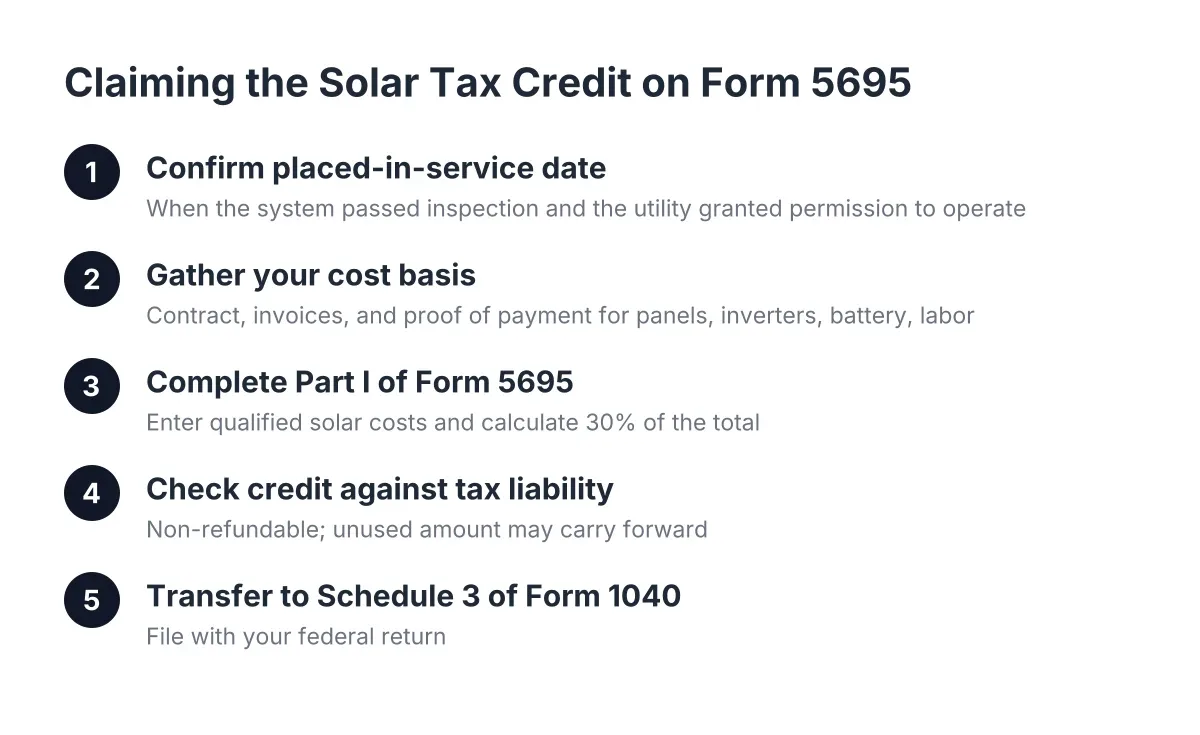
The process is shorter than the sales pitch made it sound:
- Confirm your placed-in-service date. This is when the system passed inspection and your utility granted permission to operate, not your contract date. Austin Energy, Pedernales Electric Cooperative, and the other area utilities all issue this in writing.
- Gather your cost basis. Your installation contract, final invoices, and proof of payment. Include panels, inverters, a home battery if installed with the system, racking, wiring, permitting, and labor. Keep every piece of this paperwork in one folder; the credit is claimed on your say-so, but you carry the burden if the IRS asks.
- Complete Part I of Form 5695. Enter qualified solar electric property costs, and battery storage costs if applicable, then calculate 30% of the total.
- Check the credit against your tax liability. The credit is non-refundable. It offsets taxes you owe; it cannot generate a refund beyond that. If your 2025 federal tax liability was $5,000 and your credit is $7,500, you use $5,000 now and carry the remainder forward.
- Transfer the figure to Schedule 3 of Form 1040 and file.
A note on the carryforward, because it matters for retirees and anyone with modest tax liability. The purchase credit historically carried unused amounts to future years. How carryforward interacts with the credit's expiration for post-2025 years is exactly the kind of question that belongs with a CPA, not a sales rep, and not me. If a large chunk of your credit depends on future-year carryforward, get professional advice before you count that money.
One more common question: there is no solar tax credit 2025 income limit. The purchase credit never phased out by income the way some energy tax credits do. What limits it is your actual tax liability, which is a different thing, and people confuse the two constantly.
What Paperwork the IRS Solar Tax Credit Requires You to Keep
The IRS solar tax credit does not require you to attach receipts to your return, but you must be able to substantiate every dollar of the claimed cost basis if asked. Keep the signed contract, change orders, final paid invoices, your utility's permission-to-operate letter, and inspection records. Store them with the tax year's records, not in a kitchen drawer.
In addition, watch what the installer includes in the "cost" on their paperwork. Roof repairs, a main panel upgrade done for unrelated reasons, or a standby generator bundled into the same contract raise genuine questions about what counts as qualified solar property. A whole-house generator is not solar equipment. If your contract mixes these, ask the installer for a line-item breakdown before year end, and let your tax professional sort the eligible from the ineligible.
The Lease Credit: The 48E Path That Survives in 2026
For systems going in during 2026, the surviving federal path runs through commercial ownership. Under Section 48E, a business that owns a solar system can claim a federal credit. When a leasing company or similar commercial entity owns the system on your roof, that company claims the credit, not you. You never touch Form 5695. The benefit reaches you, in theory, as a lower monthly payment.
This is why nearly every 2026 quote in your inbox from a national company is structured as a lease or similar third-party arrangement. A solar lease works like an equipment lease, similar to a car lease; you pay a fixed monthly amount for the use of the panels regardless of how much energy they produce, according to the U.S. Environmental Protection Agency. The EPA also notes that in neither a lease nor a power purchase agreement does the building owner actually own the system, even though both get it installed with no upfront cost.
For the quote comparer, three questions cut through lease pitches fast:
- How much of the 48E credit value is reflected in my payment, in dollars? If the rep cannot show the math, the answer is probably "less than the pitch implies."
- What is the annual payment escalator? A 2.9% annual escalator compounds into a meaningfully larger payment by year 15.
- What happens when I sell the house? Lease transfers are a known friction point in Austin-area real estate transactions, and the terms vary widely by company.
A loan-financed purchase in 2026 gets no federal credit, but you own the system and the math is transparent. A lease passes through some of a commercial credit on terms you cannot fully see. Neither is automatically the right answer; the honest comparison is total cost over 20 to 25 years under each structure, on paper, side by side.
Where Local Money Fits: Solar Rebates and Incentives in Austin, TX
The federal credit is only one layer, and in this area the utility that sends your bill decides most of the rest. Solar rebates and incentives in Austin depend on your utility territory far more than your town name, which is why a homeowner in Kyle on one utility sees a different deal than a neighbor three streets over on another.
A few anchors, each with its as-of date, and your numbers will differ:
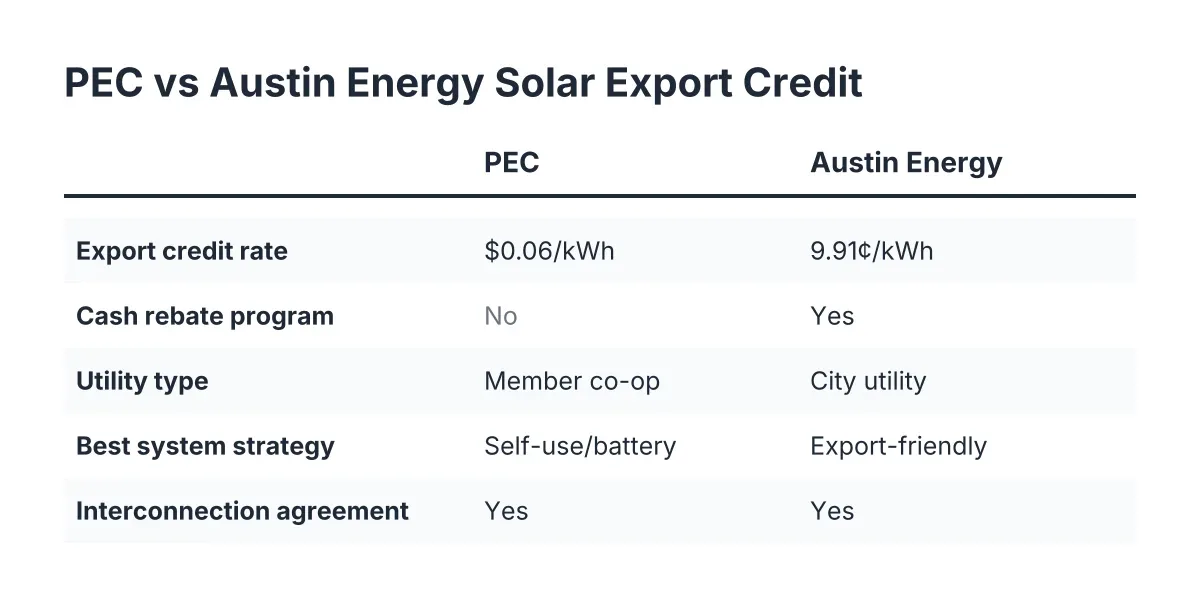
- Austin Energy credits all solar production under its Value of Solar tariff rather than retail net metering. According to Austin Energy, the Value of Solar rate for systems under 1 MW-AC is 12.89 cents per kWh, effective October 1, 2026, credited on all the solar a home produces. Confirm the current rate directly with Austin Energy before you model savings; this tariff gets revised.
- Pedernales Electric Cooperative credits surplus solar sent to the co-op at 7.1921 cents per kWh under its regular interconnect rate, applies that credit only toward the Base Power Charge, and expires unused credits at the end of each calendar year, according to PEC. PEC territory covers much of Dripping Springs and the western hills.
- Texas adds two quiet incentives regardless of utility. Solar equipment carries a sales tax exemption at purchase, and residential solar installations are exempt from property tax increases, so the added home value does not raise your tax bill.
These local layers stack with whatever federal path applies to you. The purchase credit, where it still applies to 2025 installations, calculated against your net cost; utility rebates where they exist typically require approved contractors and approved equipment, and sometimes a short educational course, so DIY installations generally forfeit them. Utilities also require engineering documentation for interconnection review before approving a system, a practice Arizona Public Service describes for its own territory and that holds across this area too.
For broader context, Texas is not a small solar market. According to the Solar Energy Industries Association, Texas installed 2.7 GWdc of solar in the first quarter of 2025, 92% more than second-ranked Florida. The market is mature here. The pricing should be too, which is useful leverage when a quote looks inflated.
A Worked Example: Reading a 2026 Quote Against the Tax Credit Claims
Suppose a homeowner in Dripping Springs, on PEC, got three quotes in January 2026 after a multi-day outage pushed backup power to the top of the list. These numbers are illustrative estimates, not quotes, and your numbers will differ.
Quote one: a $31,000 cash price for solar plus a home battery, with a line reading "net cost after 30% federal credit: $21,700." That line is the red flag. A system placed in service in 2026 does not qualify for the residential purchase credit. The installer is either working from a stale 2025 template or hoping the homeowner does not know the law changed. Either way, ask them to restate the quote without the credit and see how the conversation goes.
Quote two: a lease at $185 per month with a 2.9% annual escalator, pitched as "we pass the tax credit savings to you." That is the lease credit path, and it can be legitimate. The homework is the escalated 25-year total, which in this illustration lands near $68,000, against the $31,000 cash price plus PEC's 7.1921-cent export credit on the production model.
Quote three: battery-first, a two-battery backup setup around $24,000 with solar deferred. For an outage-driven buyer on a co-op line, that can be the honest answer, especially since PEC's export rate makes the solar payback slower than Austin Energy's Value of Solar rate would. In that scenario, no federal residential credit applies to a 2026 purchase, and the installer who says so plainly is the one earning trust.
The pattern to notice: the quote that handles the tax credit honestly is usually the quote that handles everything else honestly.
Red Flags When a Sales Rep Talks About Tax Credits
After enough kitchen-table pitches, the same moves repeat. Watch for these in 2026:
- A 30% "federal credit" line item on a purchase quote for a system that will be placed in service in 2026. The residential purchase credit ended for those systems.
- "Sign before the rebate expires" pressure tied to a federal credit. Deadline pressure built on a credit that already expired is a sales tactic, not a deadline.
- A monthly payment that assumes you will apply a tax credit as a loan paydown by month 18. If the credit does not exist for your install date, that payment balloons.
- Tax advice from the rep. Credit eligibility, carryforward, and what counts in your cost basis are CPA questions. A rep who says "my customers always get the full credit" is making a promise they cannot keep and will not be in the room when the IRS asks.
- Vagueness about who owns the system. If the answer to "do I own this?" takes more than one sentence, you are looking at third-party ownership, and the 48E lease credit belongs to the owner, not you.
None of this means every installer is playing games. Plenty of local crews quote clean numbers. The point is that the tax credit line is where sloppy or stale quotes reveal themselves first, so check it first.
What To Do Next, Depending on Your Situation
If your system was placed in service in 2025: file Form 5695 with your 2025 return, claim the 30% purchase credit against your documented costs, and keep the paper trail. Confirm carryforward treatment with a tax professional if your credit exceeds your 2025 liability.
If you are buying in 2026 with cash or a loan: model the economics without a federal credit. The Texas sales tax exemption, the property tax exemption, and your utility's export credit still apply. On Austin Energy, the Value of Solar rate does real work in the math; on PEC or Bluebonnet, the lower export rate means you should size the system to your own consumption, not to exports.
If you are considering a lease in 2026: the 48E lease credit is real, but it belongs to the system owner. Demand the escalated lifetime total in writing and compare it to the cash price before you decide whether enough of that credit is reaching you.
If backup power is the actual goal: run the battery and generator numbers on their own merits first. The IRS solar tax credit was never the reason to buy backup power, and in 2026 it is not available to prop up a purchase decision that should stand on resilience alone.
The quotes in your inbox will not agree with each other. They never do. But once you know which federal path applies to your install date and ownership structure, the tax credit line stops being a trust exercise and becomes a simple yes-or-no check. Start there, then take the survivors to your CPA.
For help with solar with Austin Energy in Austin, TX, Austin Solar FAQ is the place to start.
Prefer to talk it through? Call +15125571906 — a quick call is usually the fastest way to get a straight answer for your situation.