Georgetown Utility Systems Solar Incentives: Local Rebates and Federal Credit Stacking in 2026
If Georgetown Utility Systems sends your electric bill, the solar math on your house works differently than it does twenty minutes south in Austin. This guide covers Georgetown Utility Systems solar incentives as they stand in 2026: what the city-owned utility offers, what survived at the federal level, how the two stack, and where the numbers stop working. I work in residential solar in the Austin area, where solar incentive stacking in Georgetown differs significantly from neighboring utilities. I am not affiliated with Georgetown Utility Systems, Austin Energy, or any government program, and nothing here is a sales pitch. It is the explanation I give neighbors over the fence.
One note before the numbers. Every dollar figure and rate in this article carries an as-of date because these programs change, sometimes mid-year. Your numbers will differ. Verify anything that matters against your own bill and the utility's current published tariff before you sign anything.
Why Your Utility, Not Your Town, Decides the Outcome
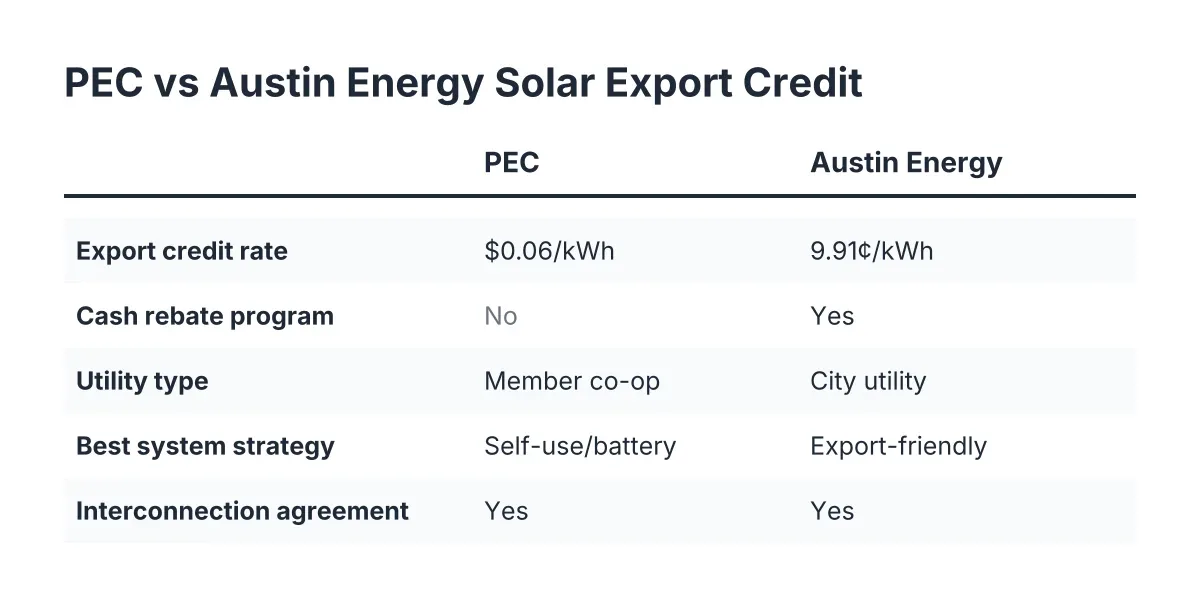
The single biggest mistake I see homeowners make is reading a solar guide written for Austin Energy customers and assuming it applies in Georgetown. It does not. Austin Energy credits every kilowatt-hour a home's panels produce under its Value of Solar tariff, 12.89 cents per kWh for systems under 1 MW-AC effective October 1, 2026, and bills the home for all the electricity it uses, according to Austin Energy. Pedernales Electric Cooperative credits surplus solar sent to the co-op at 7.1921 cents per kWh under its regular interconnect rate, applies that credit only toward the Base Power Charge, and expires unused credits at the end of each calendar year, according to PEC. Georgetown Utility Systems has its own rules, its own rate, and its own paperwork.
Georgetown is also not in the deregulated part of Texas. In deregulated markets, customers can shop among multiple solar buyback plans that credit surplus energy sent to the grid, according to Solar United Neighbors. In regulated territory like Georgetown's, the same source notes, you typically get one option or a few. You take the export credit the utility publishes or you do not go solar. There is no shopping around for a better buyback plan, which makes understanding the one plan you have the whole game.
Therefore, if your bill says Georgetown Utility Systems at the top, every projection a salesperson shows you should be built on Georgetown's current export credit and Georgetown's interconnection rules. If their proposal mentions "net metering" without naming your utility and a rate with a date on it, send them home.
What Georgetown Utility Systems Offers Solar Customers in 2026
Georgetown Utility Systems solar customers deal with two things from the utility: an interconnection process that lets you legally connect panels to the grid, and an export credit that determines what the utility pays for electricity you send back. Georgetown has historically run its program conservatively. The utility buys 100 percent renewable power at the wholesale level, a fact it is known for nationally, but that corporate purchasing decision does not translate into generous rooftop solar payments for you.
Here is the practical shape of it as of early 2026. Georgetown requires an interconnection application before installation, approved equipment, and an inspection before they grant permission to operate. Exports are credited at a rate the utility sets, and that rate has run below the full retail rate in recent years. That gap matters. When exports earn less than retail, every kWh you use yourself the moment the panels make it is worth more than a kWh you send to the grid.
As a result, the design advice in Georgetown differs from the advice in PEC territory. Oversizing a system to bank large export credits works poorly when the export rate is low. A system sized close to your daytime self-consumption, or paired with a home battery that stores afternoon production for evening use, usually pencils better. Your numbers will differ; a load profile from your own meter history is the only honest starting point.
Does Georgetown Utility Systems pay a solar rebate?
Georgetown Utility Systems does not currently run a standing cash rebate for residential solar the way Austin Energy does, as of early 2026. The city's value to a solar owner comes through the interconnection program and the export credit, not an upfront check. Any installer quoting you a "Georgetown rebate" should show you the program page and its date.
Utility rebate programs around Texas come and go, and they share common fine print worth knowing in case Georgetown introduces one. Utility-run rebates typically require you to use contractors registered with the utility, install approved equipment, and sometimes complete a short education course first. They also frequently exclude leased systems and power purchase agreements, paying only homeowners who own the system outright. If a rebate appears in Georgetown and you are mid-project with a non-registered installer, you can forfeit it entirely. Check the utility's published program list the same week you sign, not the month before.
For contrast, Austin Energy's solar programs, including a $500 flat rebate under one tracked program and multifamily and commercial offerings, are formally listed in the DSIRE incentives database maintained by the NC Clean Energy Technology Center. DSIRE is also the right place to check Georgetown's current listings yourself. It is free, and it is the same database the industry uses.
Federal and State Incentives: How They Stack with Georgetown Solar Programs
This is where 2026 differs sharply from every stale guide still ranking on Google. The federal residential purchase credit, the 25D credit that historically returned 30 percent of a system's total cost to homeowners who bought their systems, according to the Internal Revenue Service, has ended for purchased residential systems. If a door-knocker in Georgetown tells you in 2026 that you will "get 30 percent back from the IRS" on a cash or loan purchase, that claim is out of date.
What survives is the lease credit, the 48E path. A business that owns a solar system on your roof, which is what happens under a lease or power purchase agreement, can still claim a federal credit on it. The leasing company captures that credit, and competitive lease pricing passes some of the value through to you in the monthly payment. How much passes through depends entirely on the contract in front of you.
Understand what a lease actually is before you weigh that trade. Both solar leases and PPAs let you get a system installed with no upfront cost, but in neither arrangement do you own the system, according to the U.S. Environmental Protection Agency. The EPA also notes a lease works like an equipment lease, similar to a car lease: you pay a fixed monthly amount for use of the panels regardless of how much energy they produce.
Is there still a 30% solar tax credit in 2026?
No, not for homeowners buying a system. The 30 percent federal purchase credit for residential solar ended, and in 2026 a Georgetown homeowner paying cash or financing with a loan cannot claim it. The surviving 30 percent path is the lease credit, claimed by the company that owns a leased system, not by you.
That answer changes the stacking math for everyone, and it changes it most for retirees. Under the old rules, a $24,000 purchased system came back to roughly $16,800 after the purchase credit. In 2026 that same purchase costs the full $24,000 unless a utility or local program contributes, and in Georgetown there is currently no standing utility rebate to contribute. The lease route carries a federal subsidy but costs you ownership, and ownership is usually what protects a person on a fixed income.
How Solar Incentive Stacking in Georgetown Works, and What Is Left to Stack
Solar incentives at the federal, state, and local level are generally designed to stack. A homeowner can combine a federal credit, a state program, and a utility rebate on the same system, each reducing the net cost. The catch in Georgetown in 2026 is that two of the usual three layers are thin. Texas has no state income tax and no statewide solar cash rebate, and Georgetown Utility Systems offers no standing residential rebate. The stack, for a purchased system, is short.
Here is what a Georgetown homeowner can still combine as of early 2026:
- The Texas property tax exemption for solar. Texas exempts the added home value from a solar installation from property tax assessment. You file the exemption form with your county appraisal district, in Williamson County for most Georgetown addresses. This is not a check, but it prevents a tax increase that would otherwise eat into savings every year.
- Georgetown's export credit. Not a rebate, but it is the recurring incentive that drives your monthly savings. Confirm the current rate directly with the utility before believing any projection.
- The federal lease credit, indirectly. If you lease, the owner claims the 48E credit, and a well-negotiated lease reflects some of it in your rate.
- Efficiency rebates on other equipment. Utility and local programs for thermostats, heat pumps, water heaters, and insulation are separate from federal solar law and unaffected by the federal changes. Shrinking your load first often beats adding panels.
In addition, keep the layers straight when comparing quotes. This is the practical difference between federal credits and local rebates: a federal credit reduces a tax bill after the fact, a utility rebate cuts the invoice or arrives as a check, and an export credit pays out slowly on every monthly bill for decades. Most of the pages ranking for Solar rebates and incentives in Austin blur those three together, which is how a 2022-era projection ends up in a 2026 sales pitch.
Running the Numbers on a Georgetown House: A Worked Example
Say a retired couple in the Sun City area opens a July bill $110 higher than last July and wants a straight answer. Suppose their house uses about 14,000 kWh per year, with a west-facing roof section clear of shade. An installer proposes an 8 kW system at an illustrative $22,000 purchased, or a lease near $140 per month. These are estimates for illustration; your roof, usage, and quotes will differ.
On the purchase, with no federal purchase credit in 2026 and no Georgetown rebate, $22,000 is the real number. If the system offsets most daytime use and exports earn a below-retail credit, the realistic bill reduction might land in the $120 to $170 per month range across the year, heavier in summer. Taken at the midpoint, that is a payback in the range of 11 to 13 years. For a 68-year-old, that is a serious question, not an automatic yes. Solar can still make sense as a hedge against rate increases and as home value, but anyone who tells you it is always worth it is selling something.
On the lease, the monthly payment starts below the expected savings, which is the pitch. However, read for three things before signing: an annual escalator that raises the payment every year, the term length against your realistic time in the home, and the buyout and transfer terms if you sell. The EPA's plain description bears repeating: you pay the fixed amount whether or not the panels produce. A lease that outlives your budget flexibility is the specific trap a fixed-income homeowner needs to avoid, and it is the one I would weigh hardest in that scenario.
One more honest caveat. The payback estimate above swings with Georgetown's export rate, your tax situation, and your roof. Before committing $20,000 or signing a 25-year contract, have a licensed installer run production modeling on your actual roof and, for a lease, have someone qualified read the contract. The hour of professional review is cheap insurance.
Batteries, West-Facing Roofs, and Solar Incentive Stacking Design Choices in Georgetown
Because Georgetown's export credit runs below retail, system design matters more here than in full net-metering territory. Two choices move the needle.
First, orientation. Some utility programs across the country pay a higher incentive tier for west-facing systems because they produce in the late afternoon, when the grid is most stressed. Even without a tiered rebate in Georgetown, the same physics works for you: a west-facing array produces more power during the expensive, air-conditioning-heavy hours when your own consumption is highest. Self-consumed power is worth retail; exported power is worth less. West or southwest roofs in Georgetown often beat the textbook due-south answer on real savings.
Second, storage. A home battery, whether a Tesla Powerwall, an Enphase system, or a Generac PWRcell, stores midday surplus and discharges it in the evening instead of exporting at the lower credit. Some utility incentive programs also pay more for solar paired with storage than for solar alone, so watch Georgetown's program listings for that pattern. Batteries add real cost, commonly $10,000 to $18,000 installed as an illustrative range in early 2026, so they only pencil when the export gap is wide or backup power during outages has genuine value to you. For a household with medical equipment, the backup value alone sometimes settles it. A whole-house standby generator is the other way to buy outage protection, and for backup alone it is usually cheaper.
This is also where existing solar owners re-enter the picture. If you installed panels in Georgetown years ago under better export terms and the credit has since dropped, a battery retrofit converts low-value exports back into retail-value self-consumption. Check your inverter's compatibility first; older string inverters sometimes force an AC-coupled battery or an inverter replacement, which changes the budget by thousands.
Steps to Claim Georgetown Utility Systems Solar Incentives
The process for capturing solar incentives through Georgetown Utility Systems is short because the incentive list is short, but each step has a failure mode. The order matters.
- Pull 12 months of usage from your Georgetown account. Size against real data, not a salesperson's estimate.
- Confirm the current export credit with the utility, in writing or from the published tariff, with its date. Every projection you review should use that number.
- Submit the interconnection application before installation begins. Installing first and applying later risks a system you cannot legally energize.
- Verify your installer and equipment meet Georgetown's requirements. If any rebate program exists when you sign, confirm your installer is registered with it; a non-registered installer can cost you the entire rebate.
- Pass the utility inspection and receive permission to operate. No credits accrue until this letter arrives.
- File the Texas property tax exemption with the Williamson County appraisal district after installation, so the added value does not raise your property taxes.
- If you leased, keep the contract and credit terms on file. The lease credit belongs to the system owner, but the payment schedule it shaped belongs to you for the full term.
One timing note for anyone planning to move. If you sell the house mid-stream, utility rebates generally pay the account holder who completed the program, export credits stay with the meter, and a lease must be transferred to the buyer or bought out. Sort that out before listing, not at closing.
Is Solar Worth It in Georgetown in 2026?
Solar is worth it for some Georgetown homes in 2026 and a poor fit for others, and the honest dividing lines are specific. It tends to work when you have an unshaded west or south roof, high summer usage you can self-consume, cash or cheap financing, and a 10-year-plus horizon in the home. It tends to fail when the roof is shaded or old, usage is low, or a lease escalator outruns the savings.
The broader market backdrop is real. Texas installed more solar than any other state in the first quarter of 2025, 2.7 GWdc, 92 percent more than second-ranked Florida, according to the Solar Energy Industries Association. As of Q2 2024, the state had 34,907 MW installed, enough to power an estimated 4 million homes, according to Go Solar Texas. Scale has pushed equipment prices down for years. But statewide momentum does not make your roof a good roof, and the end of the federal purchase credit lengthened paybacks for buyers everywhere, Georgetown included.
So here is the over-the-fence summary. In Georgetown Utility Systems territory in 2026, the incentive stack for a purchased system is the property tax exemption plus the export credit, nothing more. The federal lease credit subsidizes leases, which carry their own risks for anyone on a fixed income. Size for self-consumption, consider west-facing panels, weigh a battery against the export gap, and demand dated numbers on every page of every quote. If the dated numbers do not show a payback you will live to enjoy, walking away is a perfectly good answer, and nobody who works in this industry honestly will tell you otherwise.
For help with solar with Austin Energy, Austin Solar FAQ is the place to start.
Prefer to talk it through? Call +15125571906 — a quick call is usually the fastest way to get a straight answer for your situation.