Bluebonnet and San Marcos Solar Incentives 2026: Rebates, Tax Credits, and What Actually Applies
If your new house gets its power from Bluebonnet Electric Cooperative or the City of San Marcos utility, the solar math works differently than it does ten miles away in Austin Energy territory. Most of what you will read online about solar incentives in these territories in 2026 is either written for Austin Energy customers or quotes programs that ended years ago. This guide covers what a homeowner in these two territories can actually claim this year: which rebates exist, which do not, how the federal tax credit changed, and how to get through interconnection on a brand-new home without retrofitting mistakes. We'll focus specifically on Bluebonnet electric solar incentives and San Marcos programs available to you right now.
I work in residential solar in the Austin area. I am not an installer pitching you, and this site is not affiliated with Bluebonnet, the City of San Marcos, or any government program. The point here is to give you the current, local answer so you can make a one-time decision correctly.
Why Your Utility Decides Everything, Not Your Town
Your mailing address might say Kyle, Buda, Lockhart, or San Marcos. None of that determines your solar outcome. The utility that sends your bill does. Bluebonnet Electric Cooperative serves a wide stretch east and south of Austin, including parts of Bastrop, Caldwell, and Hays counties. The City of San Marcos runs its own municipal electric utility inside city limits, while homes just outside the line often land on Bluebonnet or Pedernales Electric Cooperative.
This matters because the three big levers of solar value differ by utility:
- Upfront rebates. Some utilities pay you to install. Most in this region do not.
- Export credits or buyback. What you get paid for power your panels send to the grid. Texas does not have statewide net metering, so each utility sets its own terms.
- Interconnection process. The paperwork, inspection, and meter swap that lets your system legally operate.
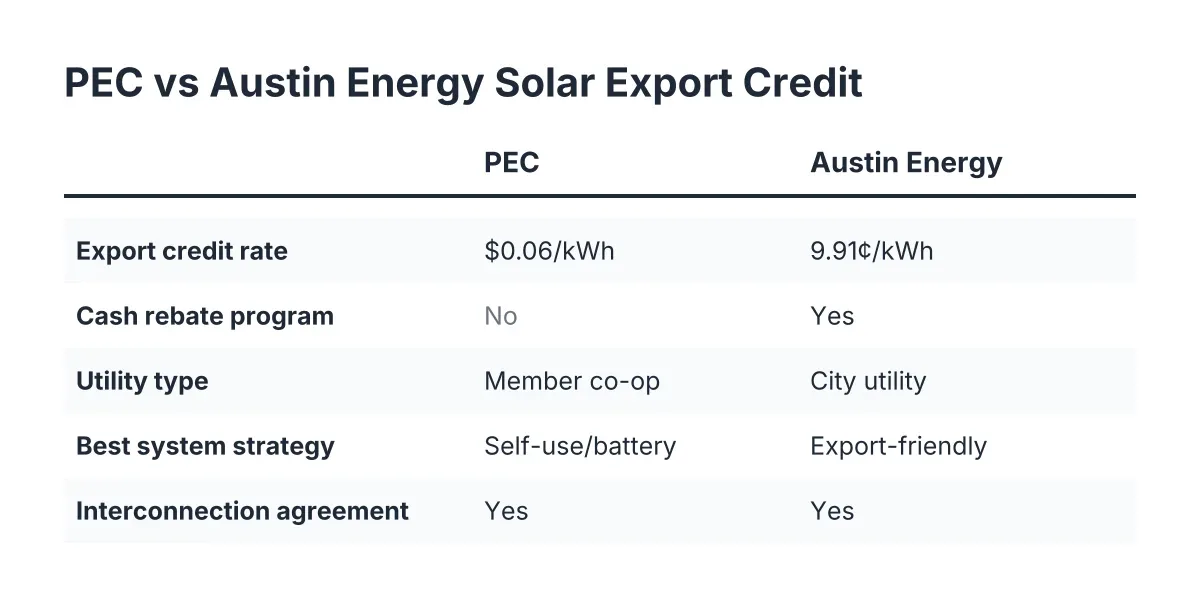
For contrast, Austin Energy credits every kilowatt-hour a home's panels produce at its Value of Solar rate, 12.89 cents per kWh for systems under 1 MW-AC effective October 1, 2026, and bills the home for all the electricity it uses, according to Austin Energy. Pedernales Electric Cooperative credits surplus solar sent to the co-op at 7.1921 cents per kWh under its regular interconnect rate, applies that credit only toward the Base Power Charge, and expires unused credits at the end of each calendar year, according to PEC. Those numbers change, and your numbers will differ, but the point stands: two houses in the same school district can see payback periods years apart because of which utility serves them.
So the first step, before you read a single quote, is to pull out an electric bill and confirm the name at the top. Everything below assumes it says Bluebonnet Electric Cooperative or City of San Marcos.
Bluebonnet Electric Solar Incentives and San Marcos Rebates in 2026: What Exists and What Does Not
Here is the honest answer most sales mailers skip. As of early 2026, neither Bluebonnet Electric Cooperative nor the City of San Marcos electric utility offers a standing cash rebate for residential solar panels the way Austin Energy does. If a door-knocker in your new subdivision tells you there is a "utility rebate" waiting for you in either territory, ask them to show you the program page with a current date on it. Programs come and go, and co-ops sometimes run limited pilots, so it is worth checking the utility's own site the week you sign anything. But do not build your budget around a rebate that is not published.
What Bluebonnet does offer is a defined interconnection process and an export arrangement for member-owned solar. The co-op requires an interconnection application, an agreement, and approval before your system energizes. Your installer should handle the filing, but you sign it, and you should read it. The export credit rate for surplus power is set by the co-op and can change with board decisions, which is exactly why I will not print a number here without a date; call Bluebonnet member services or check the current rate schedule before you size your system. Evaluating Bluebonnet electric solar incentives means understanding both the interconnection pathway and the export credit structure your co-op applies.
San Marcos Electric Utility similarly handles distributed generation through its own interconnection requirements inside city limits. The city has promoted energy efficiency programs over the years, and those are worth checking for things like smart thermostats or insulation. For solar specifically, treat the city the same way: confirm the current interconnection rules and the current treatment of exported energy before you commit.
What this means for your payback math
Without an upfront utility rebate, the value of solar in Bluebonnet and San Marcos territory comes from three places: the electricity you avoid buying, whatever the utility credits for exports, and the federal tax side, which changed significantly going into 2026. The avoided-purchase piece is the big one. A system sized so most of its production gets used inside the house, rather than exported, protects you from whatever the export credit happens to be.
That sizing logic is different from Austin Energy territory, where the Value of Solar tariff pays for every kWh produced. In co-op and municipal territory, self-consumption is king. This is also where a home battery earns its keep beyond backup, because it soaks up midday surplus and discharges it in the evening instead of exporting it at a modest credit rate.
Federal Tax Picture for Bluebonnet Electric Solar Incentives in 2026: Purchase Credit Gone, Lease Credit Alive
A federal tax credit of 30% historically applied to the total cost of a residential solar installation, according to the Internal Revenue Service. That purchase credit, the 25D Residential Clean Energy Credit, ended for homeowner-purchased systems after 2025. If you are reading this in 2026 and planning to buy a system with cash or a solar loan, you should not count on claiming 30% back on your federal return the way your neighbors did in 2024.
However, the 48E path survived. That is the lease credit: when a third-party company owns the system on your roof under a lease or power purchase agreement, the company can claim the commercial-side credit and, in a competitive market, passes some of that value through as a lower monthly payment. Both solar PPAs and solar leases let a homeowner get a system installed with no upfront cost, but in neither arrangement does the homeowner own the system, according to the U.S. Environmental Protection Agency. A solar lease works like a car lease; you pay a fixed monthly amount for use of the panels regardless of production, per the same EPA guidance.
For a new-construction buyer who just drained savings on closing costs, the lease path is tempting and sometimes sensible. Be clear-eyed about the trade-offs:
- You do not own the asset. The escalator clause, the buyout schedule, and what happens when you sell the house all live in the contract. Read all three before signing.
- The lease credit belongs to the leasing company. You benefit only if the pricing reflects it. Compare the lease's total 25-year cost against a straight loan purchase with no federal credit at all; in 2026 that comparison is closer than it used to be.
- Home sale friction is real. A leased system must be assumed by your buyer or bought out at sale. On a new build you might sell in five to seven years, so model that scenario, not just year 25.
Texas adds one quiet benefit either way: solar equipment is exempt from state sales tax at purchase, and Texas offers a property tax exemption so the added home value from solar does not raise your appraisal for tax purposes. Confirm the property tax exemption filing with your county appraisal district; it is usually a one-page form.
Adding Solar to a New Build in Bluebonnet or San Marcos Territory
This section is for the reader who just closed in a new subdivision near Kyle, Lockhart, Martindale, or east of Bastrop and found solar conduit stubbed into the attic. "Solar-ready" from a builder usually means some combination of: a conduit run from the attic to the electrical panel area, a panel with physical space for a solar breaker, and sometimes a roof framed to carry the load. It rarely means the panel's busbar rating supports a large system, and it never means the interconnection paperwork is done.
Here is the sequence that avoids retrofitting mistakes:
- Confirm your utility in writing. New subdivisions sit on territory edges. Your bill, not your ZIP code, is the authority.
- Photograph your main panel label. Note the busbar rating and main breaker size. A 150-amp panel with a 150-amp main limits how much solar you can backfeed without a derate or upgrade. This single detail changes quotes by thousands of dollars.
- Check your HOA documents, then relax. Texas Property Code protects homeowners' right to install solar; HOAs can regulate placement for aesthetics but generally cannot prohibit panels outright. Submit the architectural review form early because review cycles can add four to eight weeks.
- File interconnection before equipment goes on the roof. Bluebonnet requires application and approval; San Marcos has its own process. A system installed before approval sits idle, and in co-op territory an unapproved backfeeding system can create a genuine safety and billing problem.
- Wait for permission to operate before celebrating. The meter swap or approval letter is the finish line, not the final inspection.
Should you add solar at move-in or wait
Adding solar at move-in makes sense when the roof is new, the conduit path exists, and your budget survived closing with room to spare; waiting makes sense when it did not. There is no incentive in Bluebonnet or San Marcos territory in 2026 that expires if you wait a year. The purchase credit already ended, and no published utility rebate is on a countdown clock.
The honest cost of waiting is smaller here than it was in 2025. You lose a year of avoided electricity purchases, and you risk financing rates moving, but you are not leaving a 30% credit on the table by waiting a season to let your finances recover. Suppose a homeowner in a new build near San Marcos is deciding between a $24,000 purchased system now or the same system in eighteen months. In that scenario, the deferred cost is roughly a year and a half of bill savings, perhaps $1,800 to $2,700 at current rates as a rough illustrative estimate; your numbers will differ with usage and rates. That is real money, but it is not a reason to rush a decision three weeks after closing.
Backup Power First: Batteries and Generators in Co-op Territory
Many readers in Bluebonnet territory are not chasing bill savings at all. They are here because a multi-day outage, a winter storm, or a home office that cannot go dark made backup power the priority. If that is you, the incentive picture changes shape.
First, understand what solar alone does during an outage: nothing. A grid-tied solar system without a battery shuts off when the grid goes down, by design, to protect line workers. Backup requires a home battery, a standby generator, or both.
Second, the economics of pairing a home battery with solar improved in co-op territory precisely because export credits are modest. A battery that stores your midday surplus and discharges it at night captures full retail value from every kWh instead of a lower export rate. Some utility programs elsewhere pay higher incentives for solar paired with storage than for solar alone; neither Bluebonnet nor San Marcos publishes such a program as of early 2026, but the self-consumption math works in your favor regardless.
Third, compare honestly against a whole-house standby generator. Say a homeowner east of Bastrop budgets $15,000 to $30,000 for resilience. A standby generator covers indefinite outages as long as propane or natural gas flows, costs less upfront than a large battery bank, but saves nothing on monthly bills and needs maintenance. A battery with solar covers shorter outages silently, cuts the monthly bill, and recharges itself from the roof during extended daytime outages. For medical equipment or multi-day winter events, some households in this territory end up with a modest battery plus a generator, which is a defensible answer even though no incentive program rewards it.
One limitation worth stating plainly: battery sizing for backup is an engineering question, not a brochure question. Loads like well pumps, which are common in Bluebonnet's rural service area, have startup surges that undersized systems cannot handle. Have a licensed installer or electrician run a load calculation before you buy anything.
How Bluebonnet and San Marcos Compare to the Rest of the Austin Area
Context helps when every national website assumes your utility has net metering. Texas leads the country in solar; the state installed 2.7 GWdc in the first quarter of 2025 alone, 92% more than second-ranked Florida, according to the Solar Energy Industries Association. Most of that is utility-scale, and Bluebonnet itself participates in large-scale solar on its system. None of it automatically translates into residential incentives on your roof.
Across the region, solar rebates and incentives in Austin proper remain the richest in Central Texas because Austin Energy runs formal rebate and performance programs, several of which are tracked in the DSIRE incentives database maintained by the NC Clean Energy Technology Center. Pedernales pays its own interconnect credit. Oncor territory, with retail choice, gives homeowners multiple competing buyback plans to pick from; in regulated and co-op areas like Bluebonnet, homeowners typically have only one or a few options, according to Solar United Neighbors. Bluebonnet and San Marcos sit at the modest end of that spectrum: no cash rebate, utility-set export terms, and a payback case built on self-consumption and the sales and property tax exemptions.
That is not a reason to skip solar. It is a reason to size the system to your usage rather than your roof, to take battery pairing seriously, and to ignore any quote whose savings projection assumes one-to-one net metering. If a proposal for a home in Bluebonnet or San Marcos territory shows export credits at the full retail rate, the installer either does not know the territory or hopes you do not.
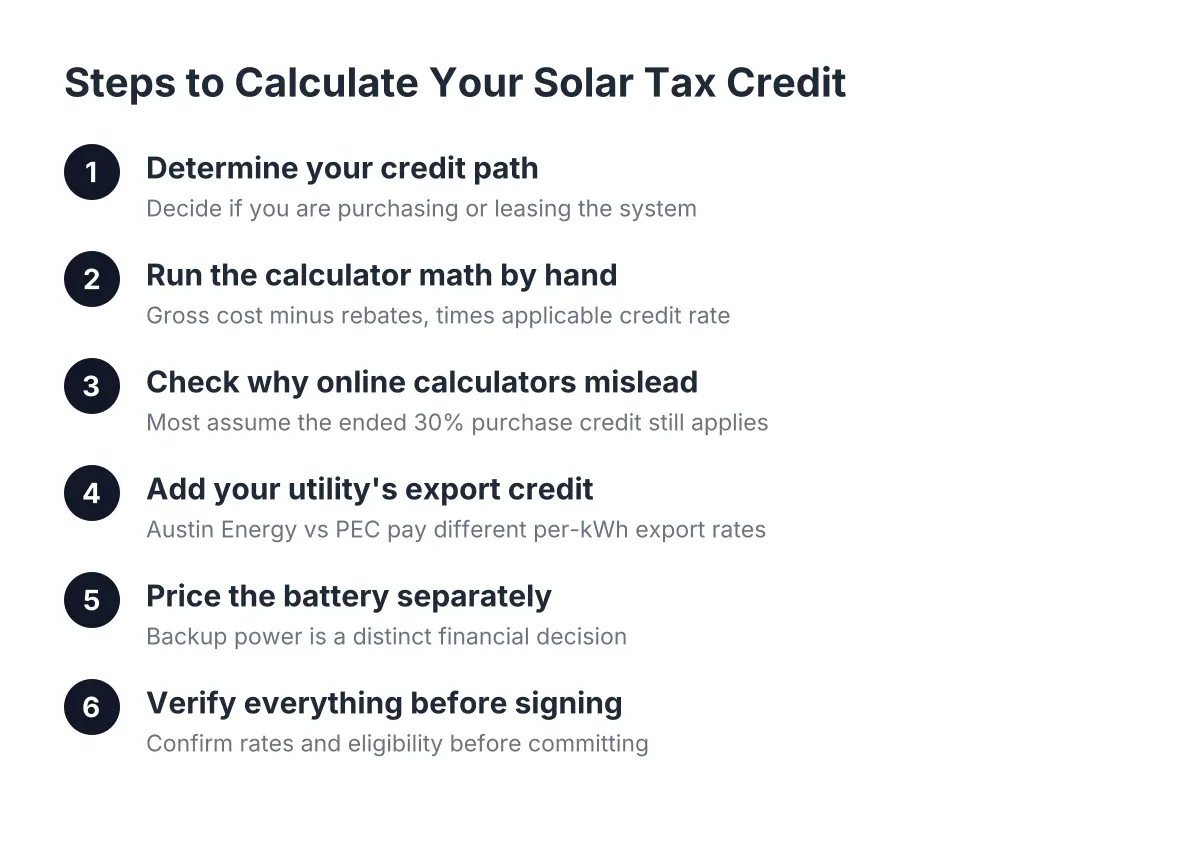
A Step-by-Step Checklist for Claiming What You Can in 2026
Since this is an implementation guide, here is the full sequence for a Bluebonnet or San Marcos homeowner moving forward this year:
- Verify the utility on your bill and download its current interconnection requirements and export credit schedule.
- Decide ownership structure. With the purchase credit gone, run a purchased system with no federal credit against a lease where the leasing company claims the lease credit. Compare total 25-year cost and sale-of-home terms, not monthly payments.
- Get the sales tax exemption applied at purchase. Reputable installers handle this automatically on Texas equipment; confirm it appears on the contract.
- Submit HOA architectural review with the site plan and panel layout. Texas law limits what the HOA can refuse, but the clock starts when you file.
- File interconnection with Bluebonnet or San Marcos and wait for approval before installation energizes.
- After commissioning, file the property tax exemption with your county appraisal district so the system's added value stays off your tax appraisal.
- Keep every document: interconnection agreement, permission to operate, contract, and exemption filings. If you sell the house, the buyer's lender will ask for all of it, and unresolved paperwork at sale is the most common solar headache I see on newer homes.
One scenario deserves a direct answer because it worries new-construction buyers. What happens if you sell before the system pays for itself? With a purchased system, the panels convey with the house like any fixture, and the property tax exemption transfers cleanly. With a leased system, your buyer must qualify to assume the lease or you must buy it out, so get the buyout schedule in writing before signing.
The Bottom Line for 2026
Solar in Bluebonnet and San Marcos territory is a self-consumption game. No utility cash rebate exists as of early 2026, the federal purchase credit ended after 2025, and export credits are set by the utility and subject to change. What remains is still meaningful: avoided electricity purchases, the Texas sales and property tax exemptions, the lease credit path for third-party-owned systems, and the resilience value of a battery or generator in a service area that knows what a long outage feels like.
For a new-construction buyer, the smartest move is often unglamorous: confirm your utility, document your panel capacity, file the HOA paperwork, and decide on your own timeline rather than a salesperson's. The incentives that exist here are not going anywhere this quarter. A decision made with the interconnection rules in hand beats a fast one made from a mailer, every time. And where your situation involves well pumps, medical equipment, or an unusual panel setup, bring in a licensed professional before money changes hands; this guide covers the territory, but your house is the one that matters.
For help with solar with Austin Energy, Austin Solar FAQ is the place to start.
Prefer to talk it through? Call +15125571906 — a quick call is usually the fastest way to get a straight answer for your situation.