Solar Tax Credit Calculator for Austin: Estimate Your Real 2026 Benefit
Every solar tax credit calculator you find online right now has the same problem. Most were built for a world where the 30% federal purchase credit still existed for homeowners who buy their system outright. That world ended for new residential purchases, and in 2026 the math in Austin looks different depending on who sends your electric bill and how you pay for the system. This guide walks you through calculating your actual tax benefit yourself, step by step, with a pencil and your own numbers. No salesman required.
A quick word on why this matters. If you are retired and on a fixed income, the difference between the number a door-knocker quotes and the number the IRS actually allows can be thousands of dollars. You cannot afford a surprise at tax time. So we will do this the slow way, and you will be able to verify every step.
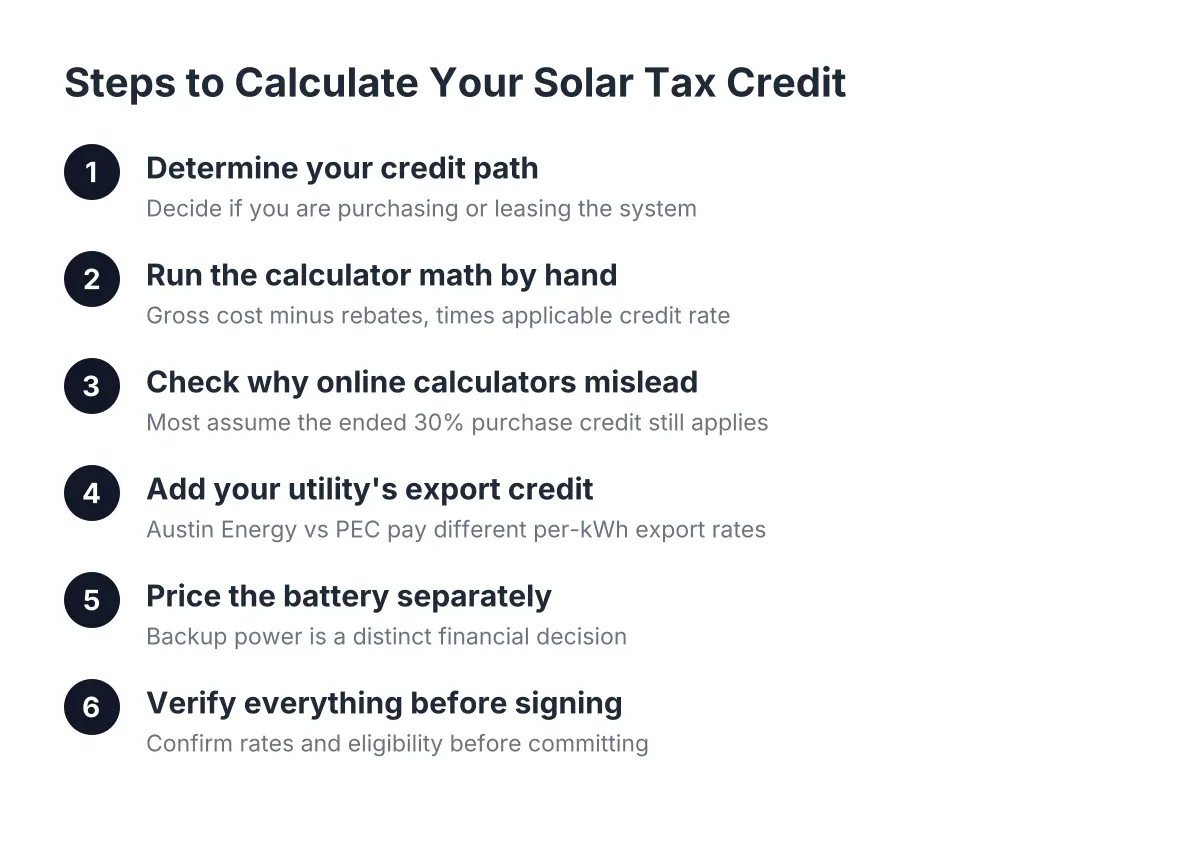
Step 1: Figure Out Which Credit Path You Are Actually On
Before you touch any calculator, answer one question: are you buying the system, or is someone else going to own it?
This is the fork in the road for 2026. The old federal purchase credit, the one under Section 25D that paid homeowners 30% of their system cost, has ended for new residential purchases. According to the Internal Revenue Service, a federal tax credit of 30% has historically applied to the total cost of a residential solar installation, and that is the figure most online calculators still assume. If a calculator shows you 30% back on a cash purchase in 2026, it is out of date.
What survives is what I call the lease credit, the 48E path. Here is how it works in plain English: a commercial entity, usually the leasing or financing company, owns the system on your roof. That company claims a commercial tax credit itself, and a competitive lessor passes some of that value to you through a lower monthly payment. You do not file anything. You also do not own the panels.
Both solar leases and power purchase agreements let you get a system with no upfront cost, but in neither arrangement do you own the system, according to the U.S. Environmental Protection Agency. A solar lease works like a car lease: you pay a fixed monthly amount regardless of how much energy the panels produce, per the EPA. For a retiree worried about a lease outliving their ability to pay, that fixed obligation deserves a hard look before any tax math.
So your Step 1 output is one word: purchase or lease. Everything downstream depends on it.
Step 2: Run the Solar Tax Credit Calculator Math by Hand
A solar tax credit calculator is just three inputs and one multiplication. You can do this on the back of your Austin Energy bill. Here is the hand version for 2026:
- Gross system cost. The full contract price, including panels, inverters, a home battery if you add one, and labor.
- Subtract rebates paid directly to the installer. If a utility rebate reduces what you pay, your creditable basis shrinks too.
- Multiply by the credit rate that applies to your path. For a 2026 cash purchase, that rate is zero at the federal level for the ended purchase credit. For a lease, the rate is applied by the system owner, not you, so your "calculator" result is the discount reflected in your monthly payment.
Suppose a retired homeowner in Allandale gets a quote for a 7 kW system at $21,000, an illustrative figure; your numbers will differ. Under the old purchase credit, she would have penciled in $6,300 back. In 2026, as a cash buyer, that federal line is zero. The same system under a lease might carry a lower monthly payment because the lessor claimed a commercial credit, but she will never see that money as a line on her own tax return.
One more rule the calculators often hide: the federal credit, where it applies, is non-refundable. It offsets taxes you owe; it cannot pay you more than your tax bill. Retirees with modest taxable income historically ran into this ceiling. Timing matters too; eligibility generally turns on when the system was actually completed and placed in service, not when you signed the contract.
Why Most Online Solar Tax Credit Calculators Get Austin Wrong
Why do online solar tax credit calculators produce bad numbers for Austin homeowners? Because they assume three things that are no longer true here: that the 30% purchase credit still exists for new residential buys, that your utility offers retail net metering, and that local rebates are uniform. In the Austin area, all three vary by utility territory and by year.
National templates do not know whether Austin Energy or Pedernales Electric Cooperative sends your bill. That single fact changes your export credit, your rebate eligibility, and therefore the basis you would feed into any credit calculation. Treat any calculator that never asks for your utility as a rough toy, not a planning tool.
Step 3: Add Your Utility's Money to the Worksheet
The federal picture is only half the math. Your utility decides the other half, and in the Austin area the utility, not the town, decides your outcome.
Solar rebates and incentives in Austin are a patchwork, and the pattern is set by service territory:
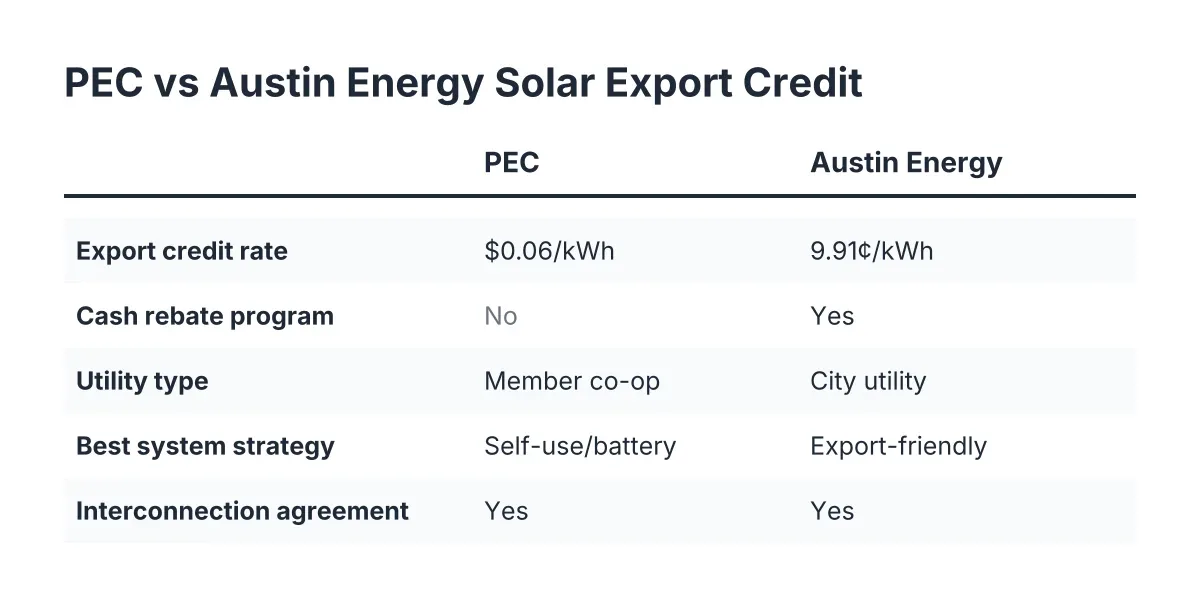
- Austin Energy pays a Value of Solar rate on all your solar production instead of retail net metering. Austin Energy credits every kilowatt-hour a home's panels produce at its Value of Solar rate, 12.89 cents per kWh for systems under 1 MW-AC effective October 1, 2026, and bills the home for all the electricity it uses, according to Austin Energy. That figure carries its own as-of date, and your rate will differ by the time you read this; check the current tariff sheet before you pencil anything in.
- Pedernales Electric Cooperative (PEC) credits surplus solar sent to the co-op at 7.1921 cents per kWh, only toward the Base Power Charge, with unused credits expiring each calendar year-end, according to PEC. Again, confirm the current rate; co-op boards revisit these numbers.
- Oncor territory means retail choice. In deregulated markets, customers can choose among multiple solar buyback plans that credit surplus energy, according to Solar United Neighbors. In regulated areas like Austin Energy or the co-ops, you typically get one option, per the same source.
Texas adds two quiet benefits that no federal calculator shows. Solar equipment is exempt from state sales tax at purchase, and a residential solar installation does not raise your property tax bill even though it can add home value. For someone on a fixed income, the property tax exemption matters; your appraisal district cannot tax you more because panels went up.
While you are stacking incentives, note that the energy efficient home improvement credit 2026 covers a different category of upgrades, things like insulation and heat pumps, under its own rules and limits. It is not a solar credit, but if you are weatherizing anyway, it belongs on the same worksheet.
Step 4: Price the Battery Separately, Because Backup Is a Different Decision
If your real motivation is keeping the lights on, and in PEC or Bluebonnet territory after a multi-day outage it often is, run the battery as its own line item. A home battery paired with solar can qualify for utility program incentives that solar alone does not; some programs pay more for solar-plus-storage, and rebate amounts can depend on system size and even roof orientation.
For example, say a household west of Dripping Springs on PEC lost power for three days last winter and wants backup first, solar maybe later. Their decision is a home battery versus a whole-house standby generator, somewhere in the $12,000 to $35,000 range depending on capacity, an estimate only. The tax treatment differs by path and by what the equipment does, so the calculator math from Step 2 does not transfer cleanly. A battery bought for backup, with or without panels, needs its own eligibility check for the year it is placed in service.
The honest trade-off: a generator has no export credits and no tax angle to speak of, but it runs for days on fuel. A battery is silent and pairs with solar, but its backup duration depends on sizing. Neither is automatically right, and for some houses with heavy loads and long outages, the generator wins.
Step 5: Verify Everything Before You Sign Anything
Now stress-test your worksheet. This is the step the door-knocker hopes you skip.
- Get the credit question answered by a CPA or qualified tax professional, not by a salesperson in your living room. Your taxable income, filing status, and the placed-in-service date all change the answer, and the credit cannot exceed what you owe.
- Confirm your utility's current export credit or buyback rate in writing, with a date on it. Rates quoted from 2022 blog posts are a known trap in this market.
- Ask who owns the system under any lease, what happens if you sell the house, and what the payment escalator is over the full term. A lease that outlives your budget is worse than no solar.
- Expect paperwork and time. Utilities that allow residential interconnection commonly require engineering drawings for review before installation is approved, according to Arizona Public Service, and the same pattern holds with Texas utilities. Rebates, where offered, arrive after inspection, not at signing.
Texas is not a small solar market; the Solar Energy Industries Association reports Texas installed 2.7 GWdc in the first quarter of 2025, more than any other state and 92% ahead of second-ranked Florida. Scale attracts good installers and bad ones alike. Your defense is a worksheet you built yourself, dated figures you verified, and a tax professional who answers to you.
One last plain statement. For some houses, a shaded roof, a low-rate utility, or a short expected stay in the home, solar is a poor fit in 2026, and the honest calculation will tell you so. That is a good outcome too. The point of doing the solar tax credit calculator math by hand is not to justify a purchase; it is to find out whether the purchase justifies itself.
For help with solar with Austin Energy, Austin Solar FAQ is the place to start.
Prefer to talk it through? Call +15125571906 — a quick call is usually the fastest way to get a straight answer for your situation.