Federal Solar Tax Credit in 2026: What Happened to the Residential Clean Energy Credit
If you just closed on a new-construction house in Georgetown, Hutto, or Kyle and a solar mailer showed up within the month, the first question is usually the federal tax credit. Here is the short, honest answer: the residential clean energy credit, the 30% federal credit under Section 25D that most solar math from the last decade assumed, ended for homeowner purchases after December 31, 2025. If you buy a system with cash or a loan in 2026, you cannot claim it. A related credit survives through a different path, the lease path, and understanding the difference matters more than any single rebate number this year.
I will call the ended Section 25D credit the purchase credit and the surviving Section 48E path the lease credit, because that is the distinction that decides your 2026 math. This guide covers who could still claim the purchase credit, how the phase-out worked, what IRS Form 5695 does for 2025 installations, and what the lease credit means for a new-build buyer deciding whether to add solar now or wait.
Is There Still a 30% Solar Tax Credit in 2026?
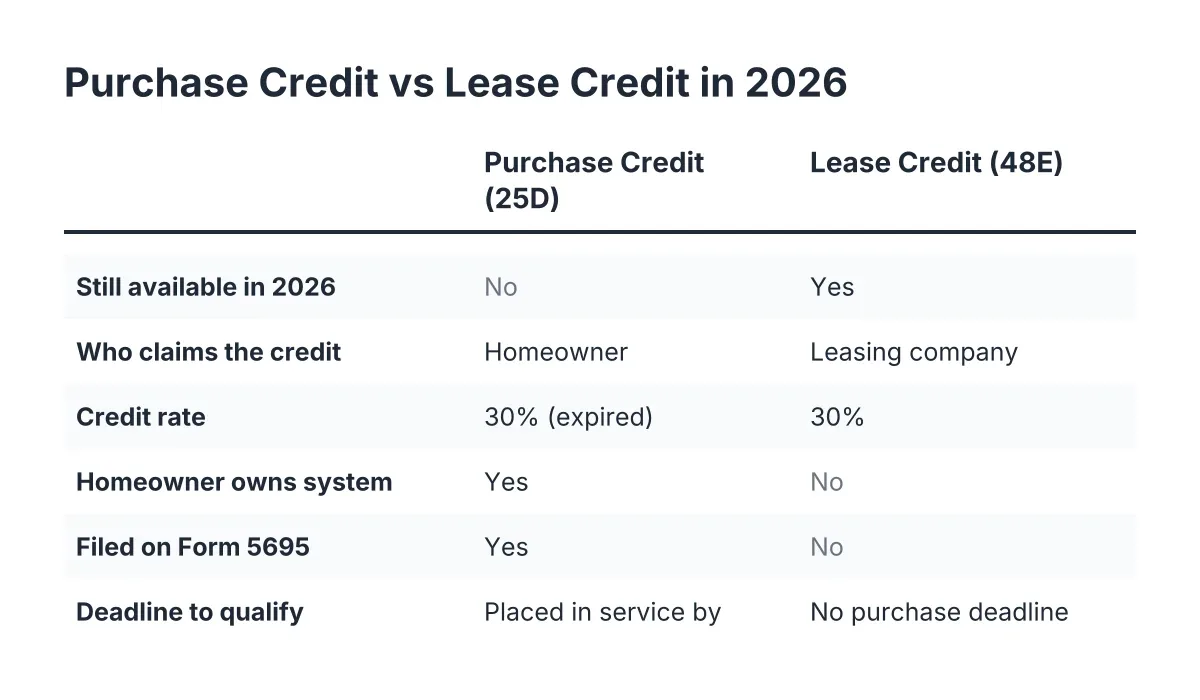
No, not for homeowners who buy their own system. The residential clean energy credit under Section 25D expired for systems placed in service after December 31, 2025. In 2026, a 30% federal credit still exists only through the commercial path under Section 48E, where a leasing company owns the system and claims the credit itself.
That one paragraph contradicts a lot of what still ranks on Google, so it is worth being precise. According to the Internal Revenue Service, a federal tax credit of 30% has historically applied to the total cost of a residential solar installation, and it cut net out-of-pocket cost significantly. For years, installers quoted prices "after the 30% credit" as a matter of habit. That habit has not caught up with the law. If a 2026 quote shows a purchase price reduced by a 30% federal credit you would claim on your own tax return, the quote is wrong, and you should ask the installer to explain it.
The phase-out itself was abrupt rather than gradual. Earlier versions of federal law had the credit stepping down slowly through the early 2030s. Legislation passed in 2025 moved the end date forward, and the purchase credit stopped for residential systems not placed in service by the end of 2025. There was no 26% year, no 22% year, no taper. One day it was 30%, the next it was zero for new purchases.
Who can still claim the residential clean energy credit
Homeowners whose systems were placed in service on or before December 31, 2025 can still claim the credit on the tax return for that year. The deciding fact is the placed-in-service date, not the contract date. Signing in November 2025 did not qualify you; the system had to be installed and operational before the deadline.
This trips people up because the gap between signing and switching on is long. HOA approval in a new subdivision, utility interconnection review, permitting, and inspection routinely add weeks to months. A homeowner in a Bluebonnet or Pedernales Electric Co-op territory who signed in late 2025 and whose system energized in February 2026 does not qualify for the purchase credit, regardless of what the contract said. If you are in that position, talk to a tax professional before filing; the placed-in-service rules have edge cases I am not qualified to resolve for you.
IRS Form 5695: Claiming the Credit for a 2025 Installation
Form 5695 is the solar tax credit form. If your system was placed in service during 2025, you claim the residential clean energy credit on Form 5695, Part I, filed with your 2025 federal return in 2026. The credit equals 30% of qualified expenses, and the result flows to your Form 1040.
Qualified expenses for the credit included the panels, inverters, racking, wiring, labor for installation, permitting fees tied to the install, and home battery storage of 3 kilowatt-hours or more. Sales tax on those items counted too, although in Texas that is less of a factor because the state exempts solar equipment from sales tax at the point of purchase.
Three mechanics of the form matter most:
- The credit is non-refundable. It offsets federal income tax you owe. It cannot push your refund past your total tax liability for the year. The residential clean energy credit limit worksheet in the Form 5695 instructions walks you through this calculation against your other credits.
- Unused credit carries forward. Suppose your 2025 system earned a $9,000 credit but you only owed $6,500 in federal tax. You claim $6,500 for 2025 and carry $2,500 forward to 2026. How carryforwards interact with the credit's expiration is a question for a tax professional; do not guess on this one.
- Keep your documentation. The final invoice, proof of payment, and your utility's permission-to-operate letter establish cost and the placed-in-service date. You do not file these with the return, but you want them if the IRS asks.
Online solar tax credit calculator tools still circulating mostly assume the purchase credit exists for new 2026 installations. Check the assumptions before trusting any output. If a calculator applies 30% to a cash purchase dated 2026, close the tab.
The Lease Credit: How 30% Survives Through Section 48E
The 30% figure did not vanish from the market. It moved. Under Section 48E, a commercial entity that owns a solar system can still claim an investment tax credit. When a leasing company or a third-party owner installs panels on your roof, owns them, and charges you a monthly payment, that company claims the credit, not you.
In practice, this is why 2026 quotes in the Austin area lean so hard toward leases and power purchase agreements. According to the U.S. Environmental Protection Agency, a solar lease works like an equipment lease, similar to a car lease; you pay a fixed monthly amount for the panels regardless of how much energy they produce. The EPA also notes that in both leases and PPAs the building owner never actually owns the system. The lease company captures the lease credit and, in a competitive market, passes some portion of it through as a lower monthly payment.
Whether enough of it passes through is the question a payback-focused reader should be asking. Here is how I would frame the trade-off for someone comparing a 2026 lease against a 2026 cash or loan purchase with no purchase credit:
- Ownership. With a loan, you own the system from day one. With a lease, you do not, and selling the house means the buyer assumes the lease or you buy it out.
- Who captures the credit. The lease company claims the lease credit. Read the monthly payment and escalator carefully to judge how much reaches you.
- Long-run cost. A lease with a 2.9% annual escalator over 25 years can cost more than a purchased system, even one bought without any federal credit. Run both totals.
- Maintenance. Leases usually include monitoring and repairs. Owners handle their own, though panel warranties run 25 years and inverter warranties 10 to 25.
Neither answer is universally right. A household with low federal tax liability never got full value from the non-refundable purchase credit anyway, and for them the lease math changed less than the headlines suggest. A high-income household that would have absorbed the full credit lost real money when the purchase credit ended, and for them a lease deserves a harder look than it did in 2024.
What the Residential Clean Energy Credit's End Means for a New-Build Buyer
If you just moved into a new house, the expiration of the purchase credit changes your timing decision, and in one specific way it lowers the pressure. Through 2025, the calendar created urgency; getting a system placed in service before the deadline was worth thousands. In 2026, that deadline has passed. There is no federal reason to rush, which means you can let your first full year of electric bills tell you how big a system you actually need.
That matters because new-build sizing is guesswork. You have no usage history in the house. A 2,400-square-foot all-electric home in a Georgetown subdivision might run $180 a month in spring and $380 in August, and you will not know until you live through a summer. Sizing a system off the builder's energy model or a neighbor's bill produces systems that are wrong in both directions.
Meanwhile, check what "solar ready" on your builder's spec sheet actually bought you. Usually it means conduit stubbed from the attic to the electrical panel area, and sometimes a panel with spare breaker capacity. That saves an installer a few hundred to a couple thousand dollars of retrofit work. It is worth something; it is not a reason by itself to install in month one. Also pull your HOA's architectural guidelines now. Texas law limits how far an HOA can go in blocking solar, but it does not eliminate the approval step, and new-subdivision HOAs can be slow while the developer still controls the board.
Your utility decides more than the federal credit does
With the purchase credit gone, the local layer, meaning your utility's export credit and any rebate, carries more of the payback math than before. The utility, not your town, decides your outcome, and new-build suburbs around Austin sit in several different territories.
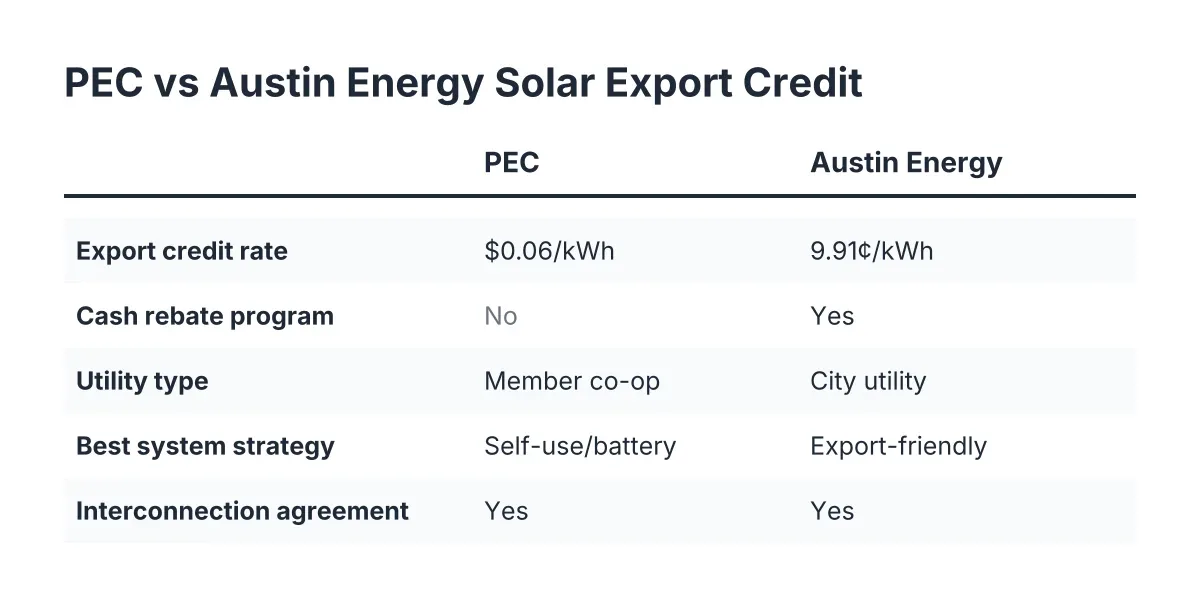
- Austin Energy uses a Value of Solar tariff instead of retail-rate net metering. It credits all of a home's solar production at 12.89 cents per kWh for systems under 1 MW-AC, effective October 1, 2026, and bills the home for all the electricity it uses, according to Austin Energy. That figure carries an as-of date, tariffs get revisited, and your rate will differ by the time you interconnect.
- Pedernales Electric Co-op (PEC), west and north of Austin, credits surplus solar sent to the co-op at 7.1921 cents per kWh, only toward the Base Power Charge, according to PEC. Again, as of that source's publication; confirm the current rate sheet before you sign anything.
- Oncor territory (parts of Hutto and other eastern suburbs) is deregulated. According to Solar United Neighbors, customers in deregulated markets can choose among multiple solar buyback plans, while customers of regulated utilities typically have one or a few options. More choice, more homework.
- Georgetown Utility Systems, Bluebonnet, and San Marcos each run their own buyback terms. None of them mirrors Austin Energy, and assuming your co-op works like the city utility is the single most common mistake I see new-suburb buyers make.
Every one of these utilities requires an interconnection application before your system can operate. Utilities commonly require engineering documentation and drawings for review before approving an installation, a practice Arizona Public Service describes for its own territory and one that holds across the utilities here. Expect that review to take weeks, not days, and longer in fast-growing service areas where the queue is deep.
For a broader map of the local layer, the glossary and territory-by-territory pages in this guide to Solar rebates and incentives in Austin cover what each utility offers and what each term means in plain language.
What Texas Still Offers After the Federal Change
Texas never had a state income tax credit for solar, so nothing at the state level expired. Two durable state-level advantages remain in 2026, and both are structural rather than application-based.
First, solar equipment is exempt from Texas sales tax, which trims cost at the point of purchase without any paperwork on your end. Second, Texas exempts the added value of a residential solar installation from property tax increases. Your system can raise your home's market value without raising your appraisal-driven tax bill. For a payback spreadsheet, that second one quietly matters over a 20-year horizon.
Utility rebates are a separate layer, and they are unaffected by federal tax law changes. Austin Energy's solar rebate programs are formally tracked in the DSIRE incentives database maintained by the NC Clean Energy Technology Center. Utility-run rebates typically come with strings: an approved contractor list, approved equipment, and sometimes a required homeowner education course. Skip the strings and you forfeit the rebate even if the installation itself is fine. If your new build is in Georgetown Utility Systems, Bluebonnet, or PEC territory rather than Austin Energy's, do not assume a comparable rebate exists; check your specific utility's current program page before building it into your math.
The scale of the Texas market is worth one sentence of context. The state installed 2.7 GWdc of solar in the first quarter of 2025, 92% more than second-ranked Florida, according to the Solar Energy Industries Association. The industry here is not shrinking because one federal credit ended; the economics shifted, and the honest response is to re-run the numbers, not to abandon them.
Running 2026 Payback Without the Purchase Credit
Here is an illustrative scenario, with every number framed as an estimate; your numbers will differ. Say a homeowner in a new Hutto subdivision, Oncor territory, is looking at an 8 kW system quoted at $24,000 in early 2026. In 2025, the purchase credit would have returned $7,200 at tax time, bringing net cost to about $16,800. In 2026, the cash price is the price.
Against a $250 average monthly bill, suppose the system offsets $170 a month between avoided purchases and buyback credits under a competitive Oncor-area plan. That is about $2,040 a year, putting simple payback near 11 to 12 years instead of the 8 or so the same house would have seen with the credit. The same system under PEC's 7.1921-cent export credit, which applies only toward the Base Power Charge, would be credited differently again, so run that case with PEC's own figures. In Austin Energy territory the comparison works differently: the Value of Solar credits all production at 12.89 cents per kWh, effective October 1, 2026 according to Austin Energy, and the home is billed for all it uses. Every one of these numbers moves with your usage, your roof, and your utility's current tariff.
Three honest conclusions follow from that kind of math:
- Solar still works for high-usage homes, the all-electric house with a pool or an EV and a $300-plus summer bill. Payback stretched; it did not break.
- Solar is a poor fit in 2026 for low-usage homes. If your bill runs under $100 a month and you do not expect usage growth, a 12-to-15-year payback with no federal credit is hard to defend, and I would tell a neighbor to pass.
- A home battery changes the question. Batteries lost the purchase credit too, but in outage-prone co-op territory the value of backup is partly non-financial. Price it as resilience first and arbitrage second, and compare it honestly against a whole-house standby generator.
One more caution for the spreadsheet-minded. Loan quotes in 2026 sometimes bury dealer fees of 15% to 30% in the financed price to advertise a low interest rate. Without the purchase credit absorbing part of that markup, dealer fees hurt more than they used to. Ask every installer for the cash price and the financed price side by side, and compare the gap.
The Short Version for 2026
The residential clean energy credit, the 30% purchase credit under Section 25D, is gone for systems placed in service after 2025. If yours energized in 2025, claim it on Form 5695 with your 2025 return and mind the non-refundable limit and carryforward rules. In 2026, the 30% figure survives only as a lease credit claimed by a system's commercial owner, which is why lease offers now dominate the mailers landing in new subdivisions.
For a new-construction buyer in Georgetown, Hutto, Kyle, or Dripping Springs, the practical sequence is unglamorous: live through one summer of bills, confirm which utility serves you and read its current export credit terms, pull your HOA's solar guidelines, and only then price owned versus leased systems against each other. The federal deadline pressure is over. Use the time it leaves you to get the local layer right, because in 2026 the utility on your bill decides your solar outcome more than Washington does.
For help with solar with Austin Energy, Austin Solar FAQ is the place to start.
Prefer to talk it through? Call +15125571906 — a quick call is usually the fastest way to get a straight answer for your situation.