Solar Quote Cost Breakdowns Explained: Panels, Inverter, Battery, and Labor
A solar quote with one big number on it tells you almost nothing. Solar quote cost breakdowns—the itemized line items that show what you pay for panels, the inverter, a home battery, and labor—are where you find out whether a proposal is fair or padded. Understanding these solar quote line items is essential because they reveal where your money goes. I have read hundreds of these documents for Austin-area homes. The pattern is consistent: the companies willing to itemize are usually the ones with less to hide. This guide walks through each line item, what it should cost in 2026, and how to spot the ones that get buried.
One note before the numbers. Every dollar figure in this article is an illustrative estimate as of early 2026. Your roof, your utility, and your installer will produce different numbers. Treat everything here as a yardstick, not a price list.
Why a Single Total Price Is a Red Flag
A solar proposal that shows only a total system cost prevents you from checking anything. You cannot verify the panel model, the inverter brand, or whether the battery is included or a separate contract. You also cannot compare it against a competing quote in any meaningful way.
A trustworthy proposal includes an itemized bill of materials. That means each component's make, model number, and price, listed in writing. This matters beyond price-checking. If the quote never names the inverter model, nobody can verify the warranty terms, and missing components have a way of surfacing later as change orders.
For a retiree on a fixed income, this is the first filter. If a salesperson resists itemizing, that tells you something before you ever discuss money. The door-knocker promising "free solar" almost never hands you a bill of materials, because the lease math behind that pitch does not survive itemization.
The Four Big Line Items in Solar Quotes
Nearly every residential solar price in the Austin area divides into four buckets: panels, inverter, battery, and labor plus everything else. Here is what each one covers and what share of the total it usually takes.
Panels: a smaller share than most people expect
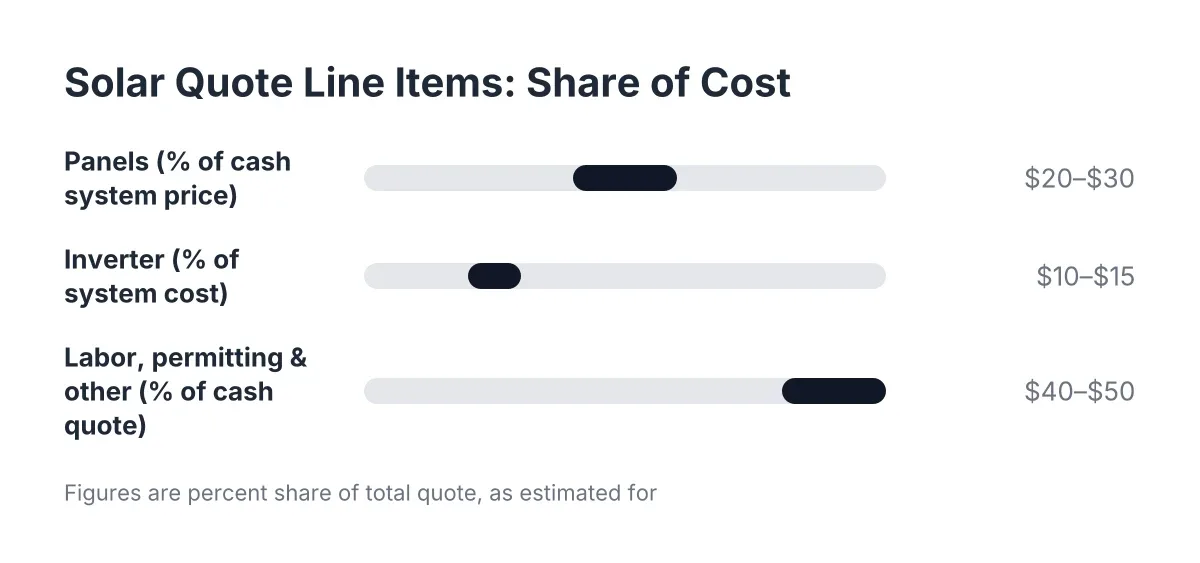
The panels themselves usually account for an estimated 20 to 30 percent of a cash system price in 2026. Hardware prices have fallen for a decade; what you pay for now is mostly everything around the hardware.
Your quote should name the exact panel model, not just a brand. "Qcells 410W" is not a model number. A model number lets you look up the datasheet, the degradation warranty, and whether the panel is still in production. Premium brands carry longer warranties and cost more per watt. For a 65-year-old homeowner, a 25-year panel warranty backed by a stable manufacturer is worth more than a marginally cheaper panel from a company that may not exist in 2036.
Watch for quotes that specify wattage but not brand or model. That wording lets the installer substitute whatever is cheapest on the wholesale market the week of your install.
Inverter: the component most likely to fail first
The inverter converts DC power from the panels into AC power for your house. It typically runs an estimated 10 to 15 percent of system cost. It is also the component most likely to need replacement during the system's life, which is why existing solar owners from the 2012 to 2018 era are now shopping for inverter swaps at $2,000 to $4,000 installed, as a rough 2026 estimate.
Your quote will show one of three architectures. A string inverter is one box, usually the cheapest. Microinverters are small units under each panel, costing more up front but isolating failures to one panel. Power optimizers sit in between. None is wrong; what matters is that the quote names the model so you can check the warranty, which ranges from 10 to 25 years depending on the product.
If you already own solar and are evaluating a battery retrofit, the inverter line is the one to scrutinize. Some batteries pair cleanly with your existing inverter; others force a replacement. A quote that is vague here can swing by thousands of dollars after the site visit.
Battery: the line that doubles the price
A home battery is the single largest optional line item. In 2026, expect an illustrative installed range of $12,000 to $18,000 for one battery, whether that is a Tesla Powerwall, Enphase, or Generac PWRcell system. Two batteries for whole-home backup can push past $25,000.
The battery decision depends heavily on your utility, and this is where the Austin area splits. Austin Energy pays its Value of Solar tariff on every kilowatt-hour your panels produce; according to Austin Energy, that rate is 12.89 cents per kWh for systems under 1 MW-AC, effective October 1, 2026. Pedernales Electric Cooperative credits surplus solar sent to the co-op at 7.1921 cents per kWh, only toward its Base Power Charge, according to PEC. There, a battery that lets you use your own power instead of selling it cheap and buying it back dear changes the math. On Oncor territory with retail choice, buyback plans vary by provider; in deregulated markets you can choose among multiple solar buyback plans, according to Solar United Neighbors, so the battery case depends on which plan you pick.
If you mainly want backup during outages and your solar economics already work, compare the battery line against a whole-house standby generator. A generator often costs less installed and runs indefinitely on natural gas, though it earns nothing on a sunny day. Neither answer is universal.
Labor, Permitting, and Other Line Items in Solar Quotes
Here is the part national cost articles gloss over. Labor, permitting, interconnection paperwork, racking, wiring, design, insurance, and company overhead typically make up an estimated 40 to 50 percent of a cash quote. This is normal, not a scam. Utilities that support residential solar interconnection commonly require engineering documentation and drawings for review before installation is approved, according to Arizona Public Service, and someone has to produce and shepherd that paperwork.
What is not normal is this bucket hiding sales commissions of $5,000 or more, which is common in door-to-door channels. You will not see a line labeled "commission." You see it as a per-watt price far above local market rates. That is why the next section matters.
How to Compare Solar Quotes Line by Line
Comparing solar quotes starts with converting every proposal to price per watt: divide the total cash price before incentives by the system size in watts. In the Austin area in 2026, an estimated $2.40 to $3.20 per watt for a cash purchase without a battery is a workable benchmark. Your numbers will differ by roof complexity, equipment tier, and installer.
Reading and comparing solar quotes gets easier once everything is on the same denominator. A $28,000 quote for a 10 kW system ($2.80 per watt) beats a $24,000 quote for a 7 kW system ($3.43 per watt) on price, even though the total looks higher. Then check what each price includes. A checklist:
- Exact panel make and model number, with quantity
- Exact inverter make, model, and architecture (string, micro, or optimizer)
- Battery make, model, usable capacity, and whether backup wiring is included
- A production estimate in kWh for year one, with the assumed shading and tilt
- Permitting, interconnection, and utility application fees, stated as included or not
- Workmanship warranty length, separate from equipment warranties
- Any roof work, main panel upgrade, or trenching, priced or explicitly excluded
- Financing dealer fees, if you are not paying cash
On production estimates: do not take the installer's number on faith. A solar production calculator such as the free PVWatts tool from the national lab, or the Google Project Sunroof mapping tool, gives you a solar estimate without personal information and without talking to a salesperson. Run your address through one before any site visit. If an installer's projection runs 15 percent above what the calculator shows for your roof, ask why in writing.
Why do solar quotes vary so much between companies?
Solar quotes vary between companies mainly because of sales channel costs, equipment tier, and financing markups, not because one installer buys panels cheaper than another. A door-to-door sale can carry thousands in commission. A premium microinverter system costs more than a budget string inverter system. Dealer fees on loans add 15 to 30 percent that never appears as a line item.
Therefore, get at least three quotes before deciding anything, and never sign under time pressure. "This price expires tonight" is a sales tactic, not a market condition. Hardware prices do not move overnight.
However, do not automatically take the cheapest quote either. A proposal priced far below the others often signals inferior equipment, a thin warranty, or subcontracted labor. If the company installing your system folds, your workmanship warranty folds with it; equipment warranties survive, but you will pay someone else's labor to honor them. A mid-priced quote from an installer with a decade of local history is usually the better risk, especially if you are 68 and the warranty needs to outlast the salesperson's career.
Once the equipment, production estimate, and reputation check out, negotiate. Installers expect it. A homeowner who shows a competing itemized quote and asks for a match or an explanation usually gets one or the other.
What the Incentive Lines Should Say in 2026
The incentive section of a quote deserves as much scrutiny as the hardware, because this is where stale or misleading numbers hide.
First, the federal credit. The 30 percent federal tax credit historically applied to the total cost of a residential installation, according to the Internal Revenue Service. The purchase credit for homeowner-owned systems, the old 25D path, has ended for new residential purchases. Additionally, the lease credit under the 48E path survives for third-party-owned systems, which is why leasing companies can still advertise tax-credit-backed pricing while cash buyers cannot claim it. Any 2026 quote showing a 30 percent purchase credit deducted from your cash price deserves a direct question, in writing, about which credit it refers to and who claims it. Tax situations differ; confirm your own eligibility with a tax professional before you count any credit in your payback math.
Second, utility incentives. Austin Energy has run residential solar rebates, and its solar programs are tracked in the DSIRE incentives database maintained by the NC Clean Energy Technology Center. Rebate amounts and requirements change; verify the current figure on Austin Energy's own site, dated, before letting a quote count it. PEC, Bluebonnet, Georgetown Utility Systems, and San Marcos each have their own export credit rules, and none of them matches the others. The utility that sends your bill decides your payback, not your zip code.
Third, the buyback assumptions inside the savings projection. A quote built on retail-rate net metering is wrong for most of the Austin area. Austin Energy uses the Value of Solar tariff, 12.89 cents per kWh as of the Austin Energy figure cited above. PEC credits 7.1921 cents on exports only. If the proposal's savings chart assumes you earn the full retail rate on exports, the monthly savings number is inflated, and your payback estimate stretches accordingly. Your numbers will differ; pull your utility's current published rate and check it yourself.
A Worked Example: Two Quotes for the Same Pflugerville Roof
Suppose a retired couple in Pflugerville, on Austin Energy, gets two quotes for the same south-facing roof after their August bill came in $110 higher than last year.
Quote A: $31,500 total for "an 8 kW system with premium panels and battery ready wiring." No model numbers. Savings projection shows a $185 monthly saving and a 9-year payback. That is $3.94 per watt, and the projection quietly assumes retail-rate credit on exports.
Quote B: $21,600 for 8 kW. It itemizes 19 panels by model number, a named microinverter system, racking, permitting, interconnection paperwork, and a 10-year workmanship warranty. That is $2.70 per watt. Its projection uses the Value of Solar rate for exports and shows a $130 monthly saving.
In that scenario, Quote B is almost certainly the better document even though it promises less. It promises less because it is honest about what Austin Energy pays. Quote A's higher savings number comes from a wrong buyback assumption, and its $1.24 per watt premium is most plausibly commission. A fixed-income homeowner comparing only the monthly savings figures would pick the worse deal. This couple is hypothetical, but the pattern is one I see constantly.
Run the same exercise on PEC or Bluebonnet territory and the right answer can flip toward adding a battery, because the export-only credit rewards midday exports less. The breakdown is the same; the utility changes which line item earns its keep.
Special Cases: Leases, Existing Systems, and When to Walk Away
A few situations deserve their own math.
If the quote is a lease, read it as a different product entirely. A solar lease works like an equipment lease, similar to a car lease: you pay a fixed monthly amount for the panels regardless of how much energy they produce, according to the U.S. Environmental Protection Agency. In both leases and power purchase agreements you get the system with no upfront cost, but you never own it, per the same EPA source. For a retiree, the questions are blunt. What happens to the payment in year 15? What does the buyout cost? Furthermore, what happens when you sell the house or when the home passes to your children? A lease payment that outlives your ability to pay it is the exact trap to avoid, and the escalator clause is where it hides.
If you already own solar, apply the same breakdown discipline to retrofit quotes. A battery add-on quote should itemize the battery, any inverter or gateway hardware, electrical work, and permitting separately. A lease buyout offer should show the residual value calculation, not just a number. An inverter replacement quote should name the new model and state whether it is compatible with your existing panels' wiring. Owners of 2012-era systems get quoted wildly different retrofit prices for the same work; the itemization is how you tell the difference.
Finally, walk away without guilt when the breakdown does not add up. Getting a quote creates no obligation. Texas leads the country in solar; the state installed 2.7 GWdc in the first quarter of 2025 alone, 92 percent more than second-ranked Florida, according to the Solar Energy Industries Association. A market that large has no shortage of installers willing to show you their line items. The ones who will not are telling you where the money went.
The Short Version
Solar quote line items come down to four buckets: panels at roughly a quarter of the price, the inverter at a tenth, an optional battery that can double the total, and labor plus overhead covering the large remainder. Demand model numbers in writing. Convert every quote to price per watt. Check the production estimate against a free calculator. Confirm the export credit matches what your actual utility, whether Austin Energy, PEC, Oncor retail choice, Georgetown Utility Systems, or Bluebonnet, pays right now in 2026, not what a 2022 template says. Then, and only then, compare totals. The homeowner who reads the lines rarely overpays. The one who reads only the bottom number often does.
Prefer to talk it through? Call +15125571906 — a quick call is usually the fastest way to get a straight answer for your situation.