Hidden Fees in Solar Quotes: 8 Charges Installers Bury in the Fine Print
Hidden fees in solar quotes are the main reason two proposals for the same roof can differ by $10,000 and still look identical on page one. I have read a lot of these documents, and the pattern is consistent: the price per watt on the cover page is the start of the conversation, not the end of it. If you just closed on a new build in Georgetown, Hutto, or a Bluebonnet subdivision, you are getting solar mailers already. Before you sign anything, here are the eight places installers bury cost, in rough order of how much money each one hides.
A quick note on where you live. Your utility, not your town, decides most of your solar outcome. Austin Energy credits every kilowatt-hour a home's panels produce at its Value of Solar rate, 12.89 cents per kWh for systems under 1 MW-AC effective October 1, 2026, and bills the home for all the electricity it uses, according to Austin Energy. Pedernales Electric Cooperative credits surplus solar sent to the co-op at 7.1921 cents per kWh under its regular interconnect rate, applies that credit only toward the Base Power Charge, and expires unused credits at the end of each calendar year, according to PEC. Your numbers will differ, and these rates change, so check the current tariff sheet before you trust any savings projection.
1. Dealer fees and other hidden charges in solar quotes
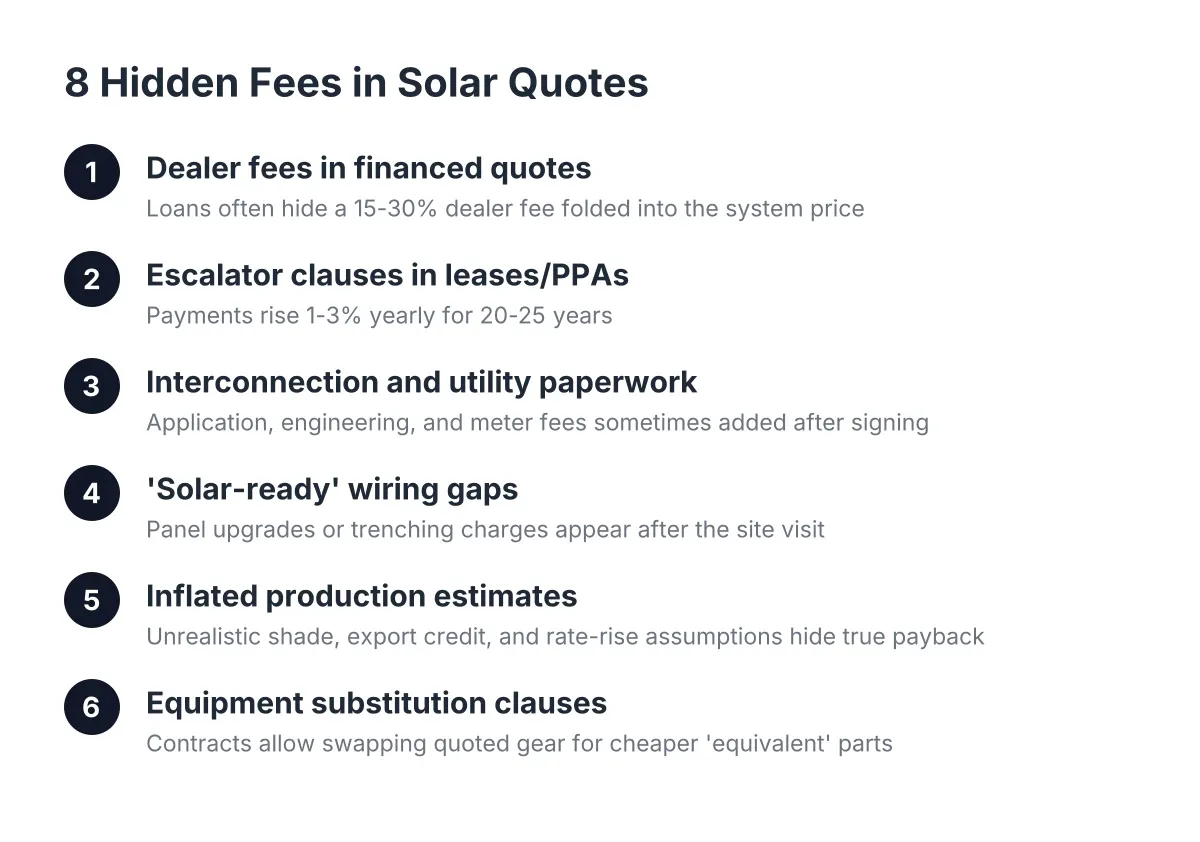
This is the largest hidden fee in most solar quotes, and the hardest to spot. When a loan advertises a rate well below what banks charge, the lender is not being generous. The installer pays the lender a dealer fee, often 15 to 30 percent of the system price, and folds it into your cash price. A system that costs $25,000 in cash might appear as $32,000 on a financed quote with a 3.99 percent rate.
The test is simple. Ask for the cash price and the financed price in writing, side by side. If the installer will not show you both, the gap is the fee. For a new-construction buyer already stretched by closing costs, this matters doubly: you may be comparing a solar loan against rolling the cost into other financing, and you cannot compare honestly without the true cash number.
2. Escalator clauses in leases and power purchase agreements
A solar lease works like a car lease: you pay a fixed monthly amount for the equipment regardless of how much energy it produces, according to the U.S. Environmental Protection Agency. The fine print to find is the escalator, a clause that raises your payment 1 to 3 percent every year for 20 to 25 years. A $120 monthly payment with a 2.9 percent escalator ends above $230 in the final year.
Also check the buyout terms and transfer terms before signing. These provisions decide whether you can sell your house cleanly or exit the contract without a penalty. With the purchase credit (the federal 25D credit for homeowner-owned systems) now ended, more installers push leases because the lease credit (the surviving 48E path) flows to the leasing company, not to you. Ask in writing how much of that credit shows up in your monthly payment.
3. Interconnection and utility paperwork fees your quote assumes away
Every utility in the Austin area requires an interconnection application before your system can legally export power. Utilities commonly require engineering documentation and drawings for review before installation is approved, according to Arizona Public Service, and the same pattern holds here. Some quotes include the application fee, the engineering stamp, and any required meter change. Others list "interconnection assistance" as a separate line that appears after you sign.
For a new build, there is a second trap. If your subdivision's service is still being energized in phases, your co-op may not process interconnection until the development's infrastructure is complete. Ask your installer, in writing, who pays if the utility sits on the application for 90 days, and whether your contract price is locked during the wait.
4. The "solar-ready" wiring that is not actually ready
Builders in Georgetown and Hutto advertise solar-ready construction, and buyers assume it removes cost. Sometimes it does. Often "solar-ready" means one empty conduit from the attic to a wall near the panel, nothing more. The quote then adds line items you did not expect: a main panel upgrade ($1,500 to $3,500 as a rough 2026 estimate; your numbers will differ), a derate of the main breaker, or a trenching charge if the inverter cannot sit where the conduit lands.
Therefore, before you accept any quote, have the installer open your electrical panel and photograph it during the site visit, not after signing. Suppose a homeowner in a new Hutto subdivision gets a $26,000 quote based on satellite photos alone. The crew arrives, finds a 125-amp panel with no spare breaker spaces, and a $2,800 change order follows. That scenario is hypothetical, but the mechanism behind it is routine, and the fix is a real site visit before the contract.
5. Production estimates inflated to hide the real payback
Misleading savings estimates are common enough that even people inside the industry have to slow down to decode some presentations. The trick is not a fake fee; it is a fake benefit that conceals the fees. An installer assumes your panels never see shade, your utility credits exports at full retail, and electricity prices rise 5 percent a year forever. The payback looks like 7 years. With honest inputs, it is 12.
Run the numbers yourself with a solar power calculator that works in kWh, not in dollars of "estimated savings." Then apply your actual utility's credit: 12.89 cents on all production under Austin Energy's Value of Solar (effective October 1, 2026), 7.1921 cents on exports under PEC (toward the Base Power Charge only), and your numbers will differ. Net metering programs can let homeowners earn credits when the system produces more than the home uses, according to Mass.gov, but the credit rate varies by utility, and in co-op territory it is rarely full retail. The gap between the quoted assumption and your tariff is a hidden fee by another name.
6. Equipment substitution clauses and vague hardware lists
Read the equipment section of the contract, not the proposal. Proposals name premium gear; contracts sometimes say "or equivalent." That phrase lets the installer swap in cheaper panels or a different inverter after you sign. Whether you are quoted REC solar panels, a generic tier-one module, or Tesla solar roof tiles on a new build, the contract should name the exact manufacturer, model, wattage, and quantity, plus the inverter and any home battery by model.
In addition, a quote with no itemized breakdown is a red flag on its own. If the installer cannot list what goes on your roof, they cannot plan the job correctly, and missing components surface later as change orders. A one-line price is where fees hide best.
7. Battery and backup charges that appear after signing
If you are buying for outage protection first, which makes sense in PEC and Bluebonnet territory, the battery portion of the quote deserves its own reading. Texans experienced a 17 percent increase in power outage frequency between 2017 and 2022, according to Tesla, so the motivation is sound. The fine print is not always.
Watch for these specific items, each of which can add $800 to $4,000 to a backup installation as rough 2026 estimates; your numbers will differ:
- A "backup gateway" or transfer switch listed separately from the battery price
- A critical-loads subpanel charged as a change order after the site visit
- "Whole-home backup" that quietly requires a second battery not in the base price
- Generator interlock or standby generator pad work billed outside the solar contract
- Extended battery warranties sold as add-ons when the manufacturer warranty already covers the period
Ask one direct question: what exactly stays powered during an outage at this price, for how many hours, and what is excluded? Get the answer in the contract, not in a text message.
8. Roof work, removal fees, and the warranty that does not cover them
On a new build your roof is fresh, which removes the reroofing trap that catches owners of 15-year-old homes. However, two related fees still apply. First, check whether the installer's penetration warranty matches your builder's roof warranty, and whether installing panels voids any part of the builder warranty. Get the builder's answer in writing before the install, not after a leak.
Second, look for the removal and reinstallation clause. If warranty roof work is ever needed, removing and resetting panels can cost $2,000 to $5,000 as a rough 2026 estimate, and most contracts put that cost on you. Your numbers will differ, but the clause assigning the cost will not be hard to find once you look for it.
How to avoid hidden fees and catch problems in solar quotes
Reading and comparing solar quotes is mostly a matter of forcing every document into the same shape so the buried charges have nowhere to hide. Get at least three quotes, and make each installer answer the same checklist in writing:
- Cash price and financed price, side by side, with any dealer fee stated as a number
- Itemized equipment list with manufacturer, model, and quantity, no "or equivalent"
- Who files interconnection with your utility, what it costs, and who pays for delays
- Production estimate inputs: shade assumptions, export credit rate used, and annual degradation
- Everything excluded from the price: panel upgrades, trenching, subpanels, permit fees, and removal costs
One caution on the other direction. A quote far below the others is not automatically a win; it often signals weaker hardware, a thin warranty, or subcontracted labor. The goal is not the lowest page-one number. It is the lowest true cost with the fewest surprises in year three.
Two honest limitations before you act. Solar is a poor fit for some new builds: heavy tree cover, a north-facing primary roof plane, or a co-op export rate that stretches payback past 15 years can all make waiting the right call. And financing terms, HOA architectural rules, and tax situations vary enough that a conversation with a licensed electrician and your own tax professional is worth the time before you commit. The installers worth hiring will not mind you checking their math. The ones who mind are telling you something.
For help with reading and comparing solar quotes, Austin Solar FAQ is the place to start.
Prefer to talk it through? Call +15125571906 — a quick call is usually the fastest way to get a straight answer for your situation.