Why System Size Matters More Than Panel Brand When Comparing Solar Quotes
Two quotes land in your inbox. One pitches premium panels at $32,000. The other uses a standard brand at $26,000. Most homeowners compare the brands first. That is backwards. The number that actually decides your outcome is the system size in kilowatts, and before you can judge either quote, you need to run your own numbers through a solar size calculator and know what size your house, your usage, and your utility actually call for. This guide walks you through that process step by step, written for the Austin area in 2026, where the utility that sends your bill decides more than any panel spec sheet.
One note before the steps. If you just lived through a multi-day outage and your real goal is backup power, system size matters even more for you, not less. An undersized array cannot recharge a home battery during an extended grid event. An oversized one wastes money you could have put toward a second battery. Size is the lever.
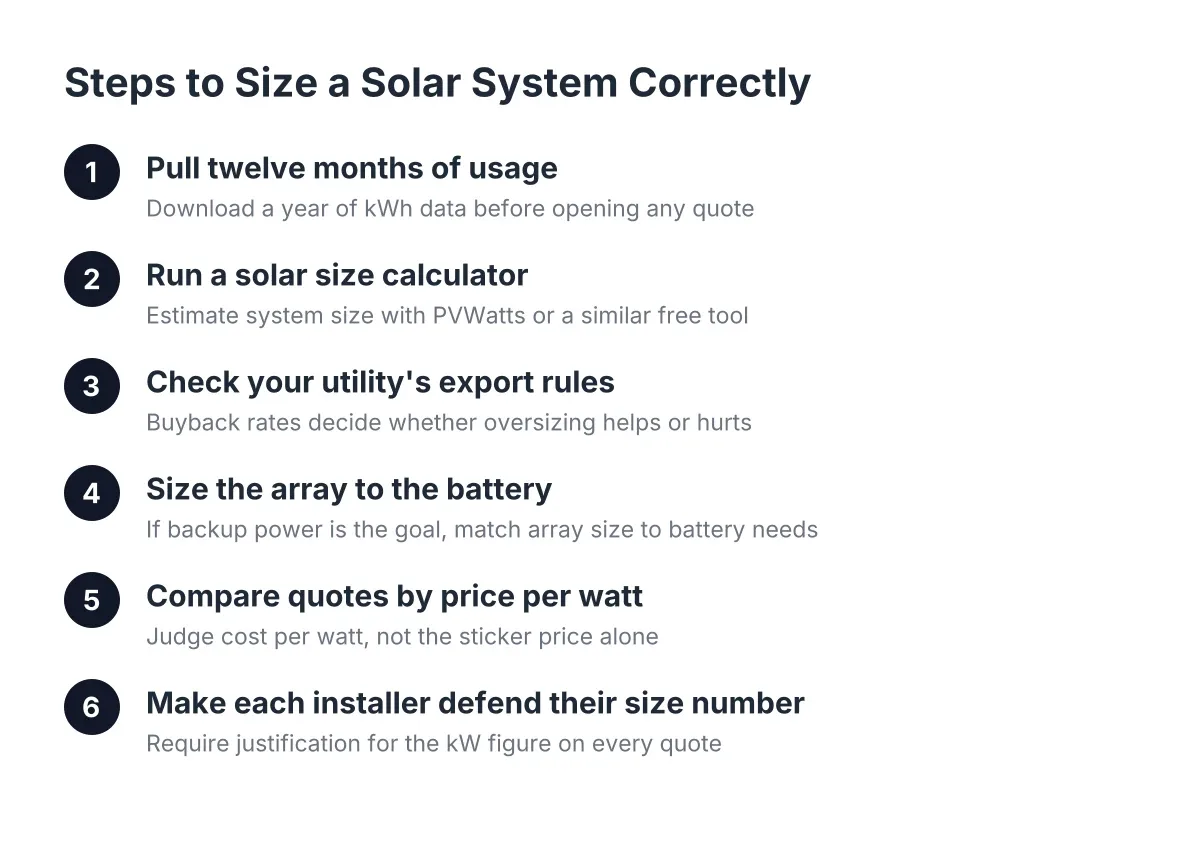
Step 1: Pull Twelve Months of Usage Before You Open Any Quote
Start with your actual consumption, not an installer's estimate. Log in to your utility portal, whether that is Austin Energy, Pedernales Electric Co-op, Bluebonnet, Georgetown Utility Systems, or a retail provider in Oncor territory, and download twelve months of kilowatt-hour usage. Write down your annual total and your highest summer month.
Why twelve months? Central Texas usage is lopsided. A house that burns 2,400 kWh in August might use 900 kWh in April. An installer who sizes from one winter bill will undersize your system; one who sizes from August alone will oversize it. Neither error shows up on the quote itself. It only shows up a year later on your bills.
Sizing comes down to three inputs: your daily usage in kWh, your site's peak sun hours, and the wattage of each panel. You now have the first input, and it is the only one that is unique to your house.
Step 2: Use a Solar Size Calculator to Estimate Your System
Before you trust anyone's proposal, run a free solar calculator on your own. The Google solar calculator built into Project Sunroof style tools will estimate roof area and sun exposure from satellite imagery. PVWatts, from the national lab, lets you enter your address, a trial system size, and your roof tilt, and it returns estimated annual production. Neither is perfect. Both are good enough to catch a quote that is wildly off.
Here is the rough arithmetic a solar size calculator is doing for you. Take your annual usage, say 14,000 kWh. Divide by about 1,450, which is a reasonable annual production figure per kW of installed solar in the Austin area with decent southern exposure. That suggests roughly a 9.7 kW system to offset 100 percent of usage. Shade, roof orientation, and your utility's export rules will push that number up or down. Your numbers will differ.
Write your calculator result down. When quotes arrive at 7.2 kW, 9.8 kW, and 12.4 kW for the same house, you will know which one needs explaining.
What the 33% Rule for Solar Panels Actually Means
The 33% rule is a rough industry habit, not a regulation: panels in real conditions often produce about a third less than their nameplate rating suggests over a full day, because of heat, angle, wiring losses, and clouds. So a 10 kW array does not deliver 10 kW steadily. Treat it as a reminder to discount nameplate numbers, not a precise formula.
This matters when comparing quotes because installers quote nameplate size. Two 10 kW quotes with different panel orientations and shading can produce thousands of kWh apart per year. Ask every installer for estimated annual production in kWh, not just system size in kW. Production is the number that pays you back.
Step 3: Check the Size Against Your Utility's Export Rules
This is the step national guides skip, and it is the one that decides whether extra kilowatts help or hurt. Simply oversizing a system does not cut your bill proportionally, because in most billing structures the surplus gets credited at a lower rate than you pay for power.
The utility, not the town, sets your outcome:
- Austin Energy uses the Value of Solar tariff instead of net metering. It credits 12.89 cents per kWh for every kWh the panels produce, for systems under 1 MW-AC effective October 1, 2026, according to Austin Energy; rates change, so confirm the current figure, and your numbers will differ. Under Value of Solar, every kWh earns the same credit whether you use it or export it, which softens the penalty for modest oversizing.
- Pedernales Electric Co-op credits surplus solar sent to the co-op at 7.1921 cents per kWh, only toward the Base Power Charge, with unused credits expiring each calendar year-end, according to PEC; verify the current rate directly with PEC before signing anything. With an export credit that only offsets the Base Power Charge and expires at year-end, an oversized system in PEC territory earns weak returns on its surplus.
- Oncor territory means retail choice. In deregulated markets, customers can choose among multiple solar buyback plans that credit surplus energy sent to the grid, according to Solar United Neighbors. Your ideal size depends on which plan you pick, and plans change yearly.
- Georgetown Utility Systems and Bluebonnet each set their own export credits. In regulated and co-op areas, homeowners typically have only one or a few buyback options, according to Solar United Neighbors, so the size decision is less forgiving.
The practical rule: in low-buyback territory, size closer to your daytime self-consumption. In territory with stronger export credits, sizing to full annual usage makes more sense. A targeted system design beats an oversized one only when it is built on accurate knowledge of your utility, rate plan, and seasonal usage. An installer who quotes the same size logic in Dripping Springs on PEC lines and in central Austin on Austin Energy lines is not doing the work.
Step 4: If Backup Power Is the Goal, Size the Array to the Battery
Suppose a homeowner in Bluebonnet territory lost power for three days last winter, lost a freezer full of food, and now wants a home battery first and bill savings second. In that scenario, the solar question changes. The array's job during an outage is to recharge the battery each day so the fridge, the internet, and some lights run indefinitely.
A home battery alone, with no solar, runs out when it runs out. Pair it with even a modest 5 to 7 kW array and a typical home can ride through a multi-day event, provided the loads are managed. Running central air conditioning through a Texas summer outage usually takes multiple batteries or a standby generator; be honest with yourself about that trade-off before you size anything.
A solar battery size calculator approach works in reverse from the usage method. List the circuits you must keep alive, estimate their daily kWh draw, then size the battery to cover one night and the array to refill it in one day of winter sun. For whole-house outage coverage including AC, compare that total against a standby generator before committing; the generator often wins on cost for heavy loads, and the battery wins on fuel independence and daily usefulness.
Step 5: Compare Quotes by Price per Watt, Not Sticker Price
Divide each quote's pre-incentive price by its system size in watts. A $26,000 quote for 8 kW is $3.25 per watt. A $32,000 quote for 11 kW is $2.91 per watt, cheaper per unit despite the bigger sticker. Larger systems usually carry lower per-watt costs because fixed expenses like permitting, design, and crew mobilization spread across more panels.
Premium panel brands raise the per-watt price. Sometimes that premium buys a meaningfully better warranty or better performance in heat. Often it buys a logo. A mid-tier panel in a correctly sized system will outperform a premium panel in a wrongly sized one every single year. Reading and comparing solar quotes gets much simpler once you anchor on size and per-watt price first and treat brand as a tiebreaker.
Still require the specifics in writing. A legitimate quote lists exact model numbers for panels and inverters, the system size in kW, and estimated annual production in kWh. Utilities commonly require engineering drawings for review before interconnection approval, according to Arizona Public Service, so a vague quote signals trouble later in the process too.
Is There Still a 30% Solar Tax Credit in 2026?
The 30 percent federal purchase credit for homeowner-owned systems, the old 25D credit, has ended; a 30 percent federal tax credit historically applied to residential solar installations, according to the Internal Revenue Service. In 2026, a related lease credit survives through the 48E path, claimed by the system owner on leased systems, not by you.
This changes the size math. Under a lease, you pay a fixed monthly amount regardless of production, as the U.S. Environmental Protection Agency describes it, and you do not own the system. Whether the lessor passes the lease credit through as a lower payment varies by company. Ask directly, and confirm your personal tax situation with a tax professional before counting on any credit.
Step 6: Make Each Installer Defend Their Size Number
You now have your usage data, your own solar size calculator result, and your utility's export rules. Put every quote through the same five questions:
- What annual usage figure did you size from, and where did you get it?
- What estimated annual production in kWh does this size deliver on my roof?
- How does this size interact with my utility's buyback or Value of Solar rate?
- If I add a home battery later, does this size support recharging it in winter?
- Why this size and not one kilowatt bigger or smaller?
A good installer answers all five without flinching. A bad one pivots to panel brand, which is the tell this whole article exists to flag. Texas installed 2.7 GWdc of solar in the first quarter of 2025 alone, more than any other state and 92 percent ahead of Florida, according to the Solar Energy Industries Association. That volume brings plenty of competent installers and plenty of door-knockers quoting whatever size their commission structure favors.
One honest caveat. Calculators and rules of thumb get you to a defensible range, not a final design. Complex roofs, heavy shading, panel-level electronics decisions, and main panel capacity all need a professional site assessment, and sometimes the honest answer after that assessment is that solar is a poor fit for the house. Hearing that from an installer is a point in their favor, not against.
Get the size right and the brand debate takes care of itself. Get it wrong and no panel on the market can fix it.
For help with reading and comparing solar quotes, Austin Solar FAQ is the place to start.
Prefer to talk it through? Call +15125571906 — a quick call is usually the fastest way to get a straight answer for your situation.