The Five Numbers in a Solar Quote That Actually Predict Your Payback
Your summer electric bill jumped $100 over last year, a salesman knocked on your door promising free solar, and now you have two or three quotes on the kitchen table that disagree with each other by thousands of dollars. A solar calculator can help you check them, but only if you know which numbers to feed it. Most of what fills a solar proposal is decoration. Five numbers predict your payback timeline. The rest is paint.
I work in this industry, and I will tell you plainly: misleading savings estimates are common enough that even people who do this for a living sometimes struggle to decode a proposal. So this guide walks you through pulling the five numbers out yourself, step by step, before you sign anything or add a payment to a fixed budget.
One note before we start. Reading and comparing solar quotes gets easier once you realize that in the Austin area, your utility decides your outcome, not your town and not your installer. A house on Austin Energy and a house across the county line on Pedernales Electric Co-op can have identical roofs and different payback timelines by several years.
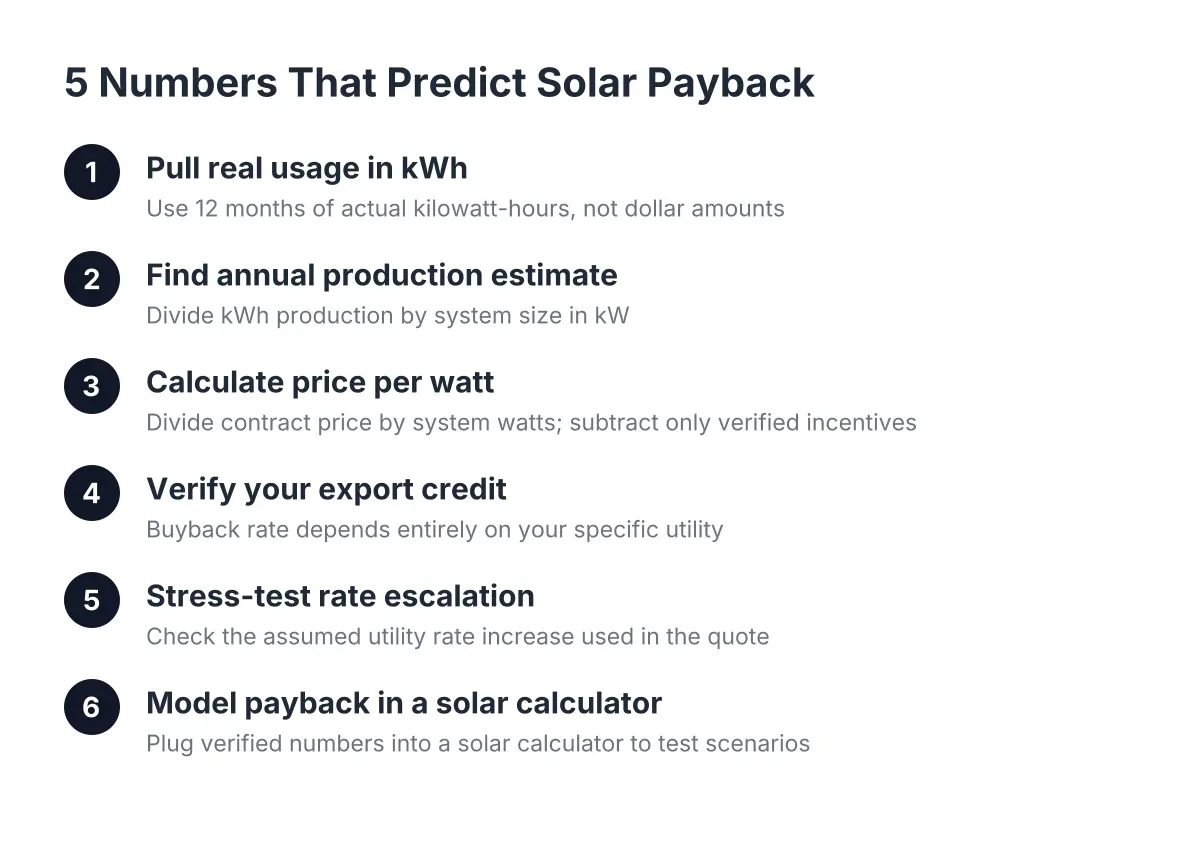
Step 1: Pull Your Real Usage in Kilowatt-Hours, Not Dollars
Start with twelve months of your own bills. Find the kilowatt-hours used each month, not the dollar amount. Dollars mix rates, fees, and usage together; kilowatt-hours are the raw ingredient every honest payback estimate is built from.
Your utility's online account shows this. Austin Energy, PEC, Bluebonnet, and Georgetown Utility Systems all post monthly usage history, and most Oncor-area retail providers do too. Write down the twelve numbers and the annual total.
Why this matters: any quote that was built without your actual usage is a guess dressed up as math. If the salesperson never asked for your bills, the savings number on that proposal has no foundation. This is also the first thing to type into any solar calculator for home use, whether that is PVWatts or a simpler solar cost estimator; garbage usage in, garbage payback out.
Step 2: Find the Annual Production Estimate and Divide
Every legitimate quote states the system size in kilowatts (kW) and the estimated first-year production in kilowatt-hours (kWh). Divide production by size. In the Austin area, an unshaded south-facing roof typically lands around 1,350 to 1,500 kWh per kW per year. That is my working rule of thumb as of early 2026; your roof will differ.
This ratio is the single most honest number on the page. Higher production per installed kilowatt means less shading and better orientation, which means faster payback. A quote claiming 1,700 kWh per kW on a tree-shaded east-facing roof in Dripping Springs is fiction, however polished the brochure.
Check the claim yourself using a solar calculator by address. Google's Project Sunroof works as a rough google solar map of your roof's sun exposure, and NREL's PVWatts lets you enter your zip code, system size, and roof direction for a production estimate with no sales contact attached. If the quote's production number runs more than about 10 percent above what the calculator shows, ask the installer to explain the gap in writing.
Step 3: Calculate Price Per Watt and Subtract Only Real Incentives
Divide the total contract price by the system size in watts. A $30,000 quote for a 10 kW system is $3.00 per watt. As of early 2026, cash quotes in the Austin area mostly land between about $2.50 and $3.50 per watt before incentives; your numbers will differ by roof complexity, equipment, and installer.
Now the part that trips up the most retirees. The federal picture changed. The purchase credit, the old 30 percent federal tax credit for homeowners who buy their system, ended for residential purchases. According to the Internal Revenue Service, that 30 percent credit historically applied to the total cost of a residential installation, which is why older articles and some current sales pitches still assume it. A lease credit path survives, where the leasing company claims the credit and may or may not pass savings through to you.
So when you read a 2026 quote:
- If the quote subtracts a 30 percent "federal tax credit" from a cash purchase price, ask the installer to show you the current IRS basis for it. Do not accept a verbal assurance.
- If it is a lease, ask exactly how much of the leasing company's credit shows up in your monthly payment, in dollars.
- If an Austin Energy rebate is listed, confirm the current amount and requirements directly with Austin Energy before counting it. Rebate programs are tracked in the DSIRE database maintained by the NC Clean Energy Technology Center, and they change.
Your payback math should use only the incentives you can verify yourself. Everything else is a maybe.
Step 4: Verify the Export Credit for Your Specific Utility
This is the number that varies most across the Austin area, and the one stale national pages get wrong most often. When your panels make more power than your house uses at that moment, the surplus goes to the grid. What you get paid for it is the export credit, or buyback, and it depends entirely on who sends your bill.
Here is the landscape as of early 2026. Every figure below carries a date for a reason, and your numbers will differ:
- Austin Energy uses a Value of Solar tariff instead of net metering. According to Austin Energy, it credits all of a home's solar production at 12.89 cents per kWh for systems under 1 MW-AC, effective October 1, 2026, and bills the home for all the electricity it uses. Austin Energy adjusts this tariff periodically, so confirm the current rate with the utility before you model anything.
- Pedernales Electric Co-op credits surplus solar sent to the co-op at 7.1921 cents per kWh, only toward the Base Power Charge, according to PEC, below the full cost of power you buy.
- Oncor territory is deregulated. According to Solar United Neighbors, deregulated-market customers choose among multiple solar buyback plans from retail providers, and those plans vary widely in credit rate and fine print.
- Georgetown Utility Systems and Bluebonnet each set their own terms. Call them and ask for the current export credit in cents per kWh before trusting any quote's assumption.
Why does this number predict payback? Because a kilowatt-hour you export is usually worth less than one you use yourself. A quote that values every kWh your system produces at your full retail rate overstates savings for most PEC and Bluebonnet homes. If your quote does not state the export rate it assumed, it is not a quote you can evaluate.
Step 5: Find the Assumed Utility Rate Escalation and Stress-Test It
Buried in the fine print of every savings projection is an assumed annual utility rate increase, often 3 to 5 percent. This one assumption drives most of the 25-year savings headline. Nudge it from 3 percent to 5 percent and a mediocre deal suddenly looks brilliant on paper.
Ask the installer what escalation rate they used and compare it against your utility's actual rate history, which you can request or find in rate filings. Then rerun the quote's math at a conservative 2 to 3 percent. If the deal only works at 5 percent escalation, it is a bet on future rate hikes, not a savings plan you can count on from a fixed income.
There is a fair counterpoint. Utility rates have historically risen faster than panel output degrades, so real savings tend to grow over a system's life even as production slowly declines. A loan payment that starts slightly above your current bill can end up cheaper over 15 years for that reason. However, you should see that math at a conservative escalation rate, not a hopeful one.
Step 6: Use Your Solar Calculator to Model Payback Scenarios
Now put the five numbers together on your own terms: your annual kWh, the verified production estimate, the real net price, your utility's current export credit, and a conservative escalation rate. A free tool like PVWatts, or a spreadsheet, lets you estimate payback without submitting your phone number to a lead-generation site.
The simple version: divide the verified net cost by your realistic first-year savings. Suppose a retired couple in Cedar Park on PEC gets a $28,000 quote for a 9 kW system. PVWatts estimates 13,000 kWh per year for their roof. They self-consume about 60 percent at roughly 11 cents per kWh and export the rest at PEC's 7.1921-cent credit. That is roughly $858 plus $374, call it $1,230 in first-year savings, and a payback near 23 years. In that illustrative scenario, which is hypothetical and uses rounded early-2026 figures, I would tell them plainly that solar is a poor fit at that price, and that a smaller system or a sharper quote changes the answer.
Compare that against the alternative. Money spent on a 22-year payback could sit in an index fund instead. A deal worth signing in your situation usually pays back inside 10 to 12 years, and faster is better when you are counting your runway in years, not decades. A home battery or standby generator changes the math again, since you are buying backup power, not just savings; a solar calculator with battery options can model that, but treat backup as a separate purchase decision.
What the Five Numbers Cannot Tell You
Texas installed more solar than any other state in the first quarter of 2025, at 2.7 gigawatts, according to the Solar Energy Industries Association. Growth that fast attracts both good installers and bad ones, and no spreadsheet catches a company that disappears before your warranty matters. Check how long the installer has operated under its current name, who holds the workmanship warranty if they fold, and whether the contract has a cancellation window.
Two honest limits to this guide. First, lease and power-purchase agreements need extra scrutiny beyond these five numbers; according to the U.S. Environmental Protection Agency, in neither arrangement do you actually own the system, and a fixed monthly lease payment continues regardless of production. On a fixed income, a lease that outlives your ability to pay it is a bigger risk than a slow payback. Second, if your roof is complex, heavily shaded, or due for replacement, have a professional assess it before you model anything; no calculator sees a 15-year-old roof.
Get at least two or three quotes, pull these five numbers from each, and run them through the same solar calculator with the same assumptions. The quote that survives your own math is the one worth a second conversation. The one that only works with the salesman's assumptions is the one that put the knock on your door.
For help with reading and comparing solar quotes, Austin Solar FAQ is the place to start.
Prefer to talk it through? Call +15125571906 — a quick call is usually the fastest way to get a straight answer for your situation.