Reading Solar Quotes in Austin Energy Territory: The Numbers That Actually Matter
If you have two or three solar proposals sitting in your inbox and they look like they were written in different languages, you are not confused. The quotes are. Reading solar quotes in Austin means untangling documents that use different system sizes, different production estimates, different assumptions about Austin Energy's Value of Solar tariff, and different financing math, all dressed up to look like the obvious winner. This guide walks through the specific numbers that matter when your bill comes from Austin Energy, what a fair comparison looks like in 2026, and the places where a proposal can mislead you without ever technically lying.
One thing up front. I work in this industry. I am not an installer, not a directory, and I do not get paid when you sign with anyone. Additionally, I have no idea which companies quoted you, and I do not care. What I care about is that you can look at three proposals and know which one is priced honestly for your roof.
Why Austin Energy Changes How You Read a Solar Quote
Austin Energy is a municipally owned utility, and it does two things that most Texas utilities do not. It credits all of your solar production through its own tariff, called Value of Solar, instead of retail-rate net metering. And it has historically run its own rebate program with its own list of approved installers and its own paperwork.
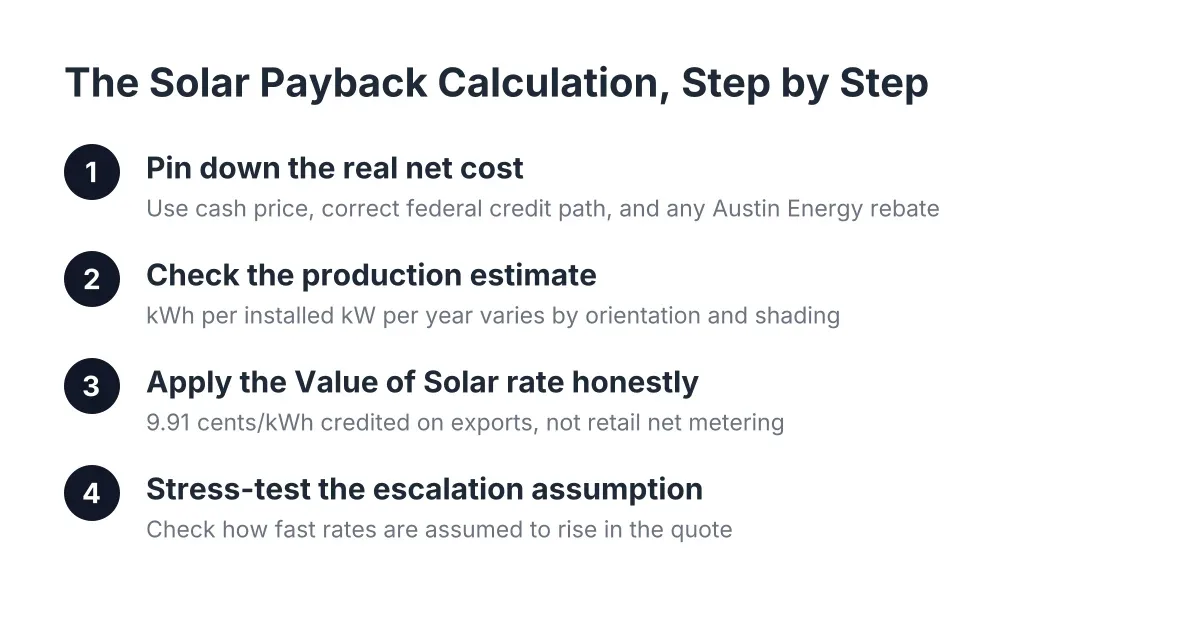
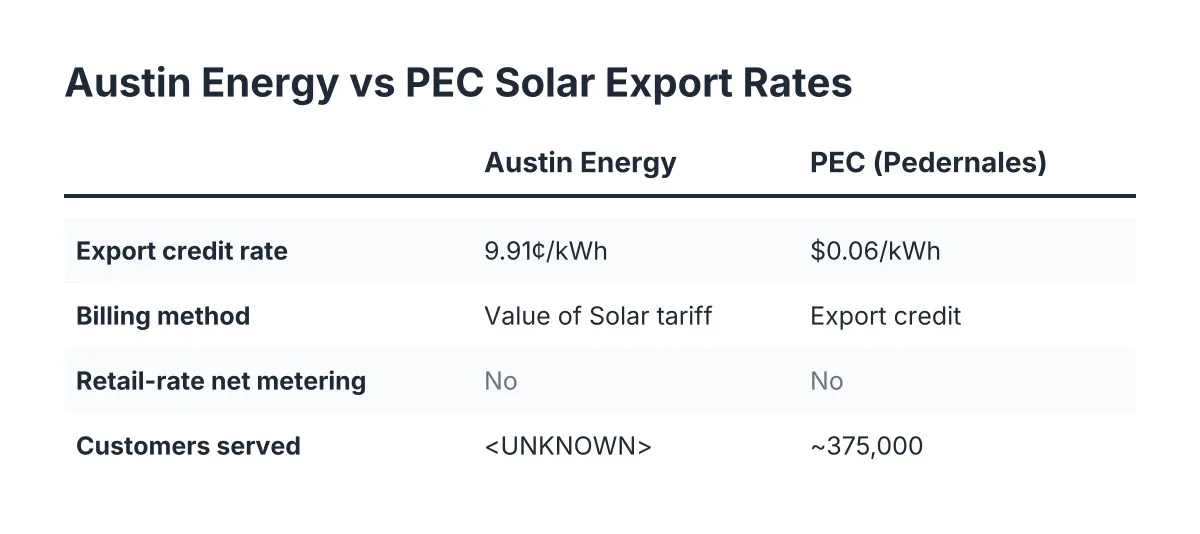
Both of those facts should show up in your quote. If a proposal talks about "net metering" with Austin Energy, that is your first red flag, because Austin Energy does not do retail-rate net metering. According to Austin Energy, the Value of Solar tariff credits 12.89 cents per kWh, for systems under 1 MW-AC effective October 1, 2026, on every unit the panels produce, while the home is billed for all the electricity it uses. That rate changes over time, so treat 12.89 cents as the figure as of this writing; your rate when you interconnect may differ.
Compare that to Pedernales Electric Cooperative next door, which according to PEC credits surplus solar sent to the co-op at 7.1921 cents per kWh, only toward its Base Power Charge. Different utility, different math, different payback. This is why the utility on your bill matters more than your city. A homeowner in Leander might be served by Austin Energy or by PEC depending on the street, and the same quote produces different savings on each side of that line.
So before you compare anything else, confirm which utility and which export rate each quote assumes. A proposal built on the wrong tariff is wrong everywhere else too.
The Four Numbers Every Quote Must Show
Strip away the glossy renderings and the 25-year savings charts. Four numbers let you compare any two solar quotes on equal footing.
- System size in kW DC. The total rated capacity of the panels. This is the denominator for everything else.
- Total contract price before incentives. The full amount you are agreeing to pay, including permitting, interconnection paperwork, and any main panel upgrade. Not the "net cost after incentives" number the rep circles.
- Price per watt. Total contract price divided by system size in watts. This is the single best apples-to-apples figure in the industry.
- Year-one production estimate in kWh. What the installer projects your system will generate in its first year, specific to your roof's orientation and shading.
If a quote does not show all four, ask for them in writing. Any installer who cannot or will not produce these numbers is telling you something.
Price per watt deserves a closer look because it is where lowballing and overcharging both hide. Suppose one quote offers a 7.2 kW system at $21,600 and another offers 8.4 kW at $27,300. The first is $3.00 per watt; the second is $3.25 per watt. The second quote is bigger and more expensive, but the first is cheaper per unit of capacity. Neither is automatically better, but now you are comparing the same thing. In my observation of the Austin market in 2026, cash prices for straightforward rooftop installs tend to land in the high $2s to mid $3s per watt, with batteries, steep roofs, and electrical upgrades pushing that up. Treat that range as illustrative, not a promise; your numbers will differ based on roof complexity, equipment, and the installer's overhead.
Reading Solar Quotes Line by Line: Equipment, Production, and Financials
A proposal has three sections that do real work: equipment, production, and financial projections. Everything else is decoration.
Equipment: what is actually going on your roof
The quote should name the panel model, the inverter type and model, and any battery by brand and capacity. "Tier 1 panels" is not a specification; it is a marketing phrase. If you are comparing a quote that includes Tesla solar panels for your home against one with REC or Qcells modules and Enphase microinverters, you want wattage per panel, the product warranty length, and the production warranty terms side by side.
Inverter choice matters more than most shoppers realize. String inverters, microinverters, and hybrid inverters behave differently with shade, and only certain inverters support battery backup later. If backup power is part of why you are doing this, a quote with a non-hybrid string inverter and no battery provision locks you into extra cost down the road. Say so in your next conversation and watch how the rep responds.
Production: the estimate that drives every savings claim
The year-one production number should come from shade-analysis software using your actual roof, not a generic figure. Divide estimated annual kWh by system size in kW. In the Austin area, an unshaded south-facing array usually lands around 1,350 to 1,500 kWh per kW per year. A quote claiming 1,700 kWh per kW on a tree-lined east-facing roof is inflating production to inflate savings. A quote at 1,100 on a clear south roof may be sandbagging, or the design may be poor.
Also check the assumed degradation rate and the assumed utility rate escalation. A savings chart built on 5 percent annual Austin Energy rate increases will show spectacular 25-year savings. Nobody can promise you that escalation. Ask each installer what escalation rate their projection uses, and if the answers differ, recalculate the optimistic one at the conservative one's rate.
Financials: where the same system becomes three different prices
Here is where interpreting solar quotes in the Austin market gets genuinely hard, because the federal incentive landscape changed. The 30 percent federal tax credit that, according to the Internal Revenue Service, historically applied to the total cost of a residential installation is the figure every older guide still cites. The purchase credit for homeowner-owned systems has ended; a lease credit path survives for third-party-owned systems, which the leasing company claims, not you. Any 2026 quote showing you a 30 percent purchase credit on a cash or loan deal is using stale math, and you should ask the installer to reissue the proposal without it.
That shift changes the lease-versus-loan question. According to the U.S. Environmental Protection Agency, a solar lease works like an equipment lease, similar to a car lease, where you pay a fixed monthly amount regardless of production, and in neither a lease nor a power purchase agreement do you own the system. Because the surviving lease credit flows to the system owner, some leasing companies can price monthly payments lower than an equivalent loan. Whether enough of that credit is passed to you is the question. Ask directly: what is the total of all payments over the lease term, what is the annual escalator, and what happens at sale of the home.
On loans, find the dealer fee. Many solar loans bury a financing fee of 15 to 30 percent inside the contract price, which is why a loan quote's price per watt often runs a dollar or more above the same installer's cash price. If a monthly payment looks too good to be true, divide the total financed amount by system watts and compare that to the cash quotes. The fee will show itself.
Value of Solar Changes the Sizing Math
Under retail-rate net metering, oversizing a system is harmless, because every exported kWh offsets a consumed kWh at full price. Under Austin Energy's Value of Solar, the economics are different, and your quote's system size should reflect that.
With Value of Solar, Austin Energy credits all your solar production at the VoS rate while billing all your consumption at retail rates. The two run on separate ledgers. When the VoS rate sits below your effective retail rate, each additional panel earns less than the panels offsetting your own use, and the marginal payback stretches. When VoS and retail rates are close, as they have been in recent years, sizing is more forgiving. Either way, an installer who sizes your system without discussing the VoS rate has not done Austin Energy math; they have done generic Texas solar math, and those are not the same thing.
This is also the honest answer to a question that fills search results: why is my electric bill not zero with solar? In Texas, even a system producing more than you consume rarely zeroes out the bill, because fixed charges and grid infrastructure costs apply regardless of generation. Your bill separates energy drawn from the grid, energy exported, and the credits applied. Total household consumption includes what your panels fed directly into the house, which never appears as grid usage at all. Any quote promising a $0 bill is promising something Austin Energy's rate structure does not deliver.
For the full mechanics of the tariff, the companion piece on how Value of Solar buyback credits work goes deeper. The broader guide to Solar with Austin Energy covers rebates, timelines, and interconnection in one place.
What a Fair Comparison Looks Like: A Worked Example
Say a homeowner in Circle C has three quotes on the kitchen table. This scenario is hypothetical, with illustrative numbers, but it mirrors what lands in Austin inboxes in 2026.
- Quote A: 8.0 kW, $26,400 cash, $3.30 per watt, projected 11,600 kWh year one, Enphase microinverters, battery-ready.
- Quote B: 8.0 kW, $23,200 cash, $2.90 per watt, projected 13,200 kWh year one, string inverter, no battery path without replacing the inverter.
- Quote C: 7.6 kW, $0 down, $168 per month for 25 years with a 2.9 percent annual escalator, leased, lease credit claimed by the lessor.
Quote B looks cheapest, but its production estimate runs 1,650 kWh per kW, high for most Austin roofs, so its savings projection is inflated. Reprice its savings using Quote A's production assumption and the gap narrows. Quote C's total payments, with the escalator compounding, exceed $62,000 over the term for a system the homeowner never owns. In that scenario, Quote A's higher per-watt price buys verifiable production math and a battery path, which matters if backup power during an outage is part of your motivation. None of these is a universally right answer. The point is that you could not see any of this until all three quotes were converted to the same four numbers.
If outage resilience is the real driver, weigh the battery line items the same way: usable kWh of storage, which circuits are backed up, and whether the quote includes the critical-loads panel or leaves it as a change order. A home battery quoted without backup wiring details is half a quote. For homes where multi-day outages are the concern, compare the battery option against a whole-house standby generator on runtime and fuel, not on brand loyalty.
Red Flags in Austin Quotes and Questions That Expose Them
Texas is a big solar market; according to the Solar Energy Industries Association, the state installed 2.7 GWdc in the first quarter of 2025 alone, more than any other state. A market that size attracts excellent installers and door-knocking operations running the same script. These are the patterns worth catching.
- A 30 percent purchase credit on a 2026 owned-system quote. The purchase credit ended. Ask for a corrected proposal.
- "Net metering" language in Austin Energy territory. The tariff is Value of Solar. An installer who does not know that does not know your utility.
- Deadline pressure tied to a rebate. Rebate budgets and terms do change, but "sign by Friday" is a sales tactic, not a utility policy. Verify any rebate claim against Austin Energy directly before it influences your decision.
- No production guarantee. Good installers back their estimate with a guarantee and a remedy. Ask what happens if year-one production comes in 10 percent low.
- Missing scope items. Main panel upgrades, roof work, and trenching priced as "if needed" become change orders. Get them included or excluded in writing.
- Monthly payment with no total. Always ask for the sum of all payments over the full term, for loans and leases alike.
Two questions do more work than any checklist. First: "What is your cash price per watt for this exact design?" Even if you plan to finance, the cash price exposes the dealer fee. Second: "Who files the Austin Energy interconnection and rebate paperwork, and how long is your current queue?" Utilities that support residential interconnection commonly require engineering documentation for review before installation is approved, according to Arizona Public Service, and Austin Energy's review and inspection steps add weeks to any timeline. An installer with recent Austin Energy projects can tell you their current queue time without hesitating. One who answers vaguely has not done many.
Where Honest Quotes Still Disagree
Two truthful installers can hand you different prices for legitimate reasons. A company with in-house crews, a local office, and a service department costs more to run than a sales organization that subcontracts installation. That overhead buys you something: someone to call in year six when a panel underperforms. Equipment tiers differ in warranty length and inverter architecture, and those differences carry real price gaps. Roof complexity that one designer catches and another misses will diverge the quotes too.
There is also a scenario where the honest answer is no quote at all. A heavily shaded roof, a roof due for replacement within five years, or low usage with a long payback under Value of Solar can make solar a poor fit for a given house. An installer willing to tell you that is worth remembering, even if you never hire them.
A limitation worth stating plainly: this guide covers the quote math, not your taxes or your specific contract terms. Lease assignments, UCC filings on leased systems, and how any surviving credits interact with your tax situation are questions for a CPA and, for large contracts, a lawyer. The hour of professional time costs less than one bad clause.
Finally, keep the scale in perspective. Texas solar is mature; according to Go Solar Texas, the state had 34,907 MW installed as of Q2 2024, enough to power over four million homes. The equipment works and the market is competitive, which cuts in your favor. Convert every proposal to the four numbers, check the Value of Solar assumption, find the dealer fee, and ask for totals instead of monthly payments. Do that, and the quote that deserves your signature tends to identify itself.
For help with reading and comparing solar quotes, Austin Solar FAQ is the place to start.
Prefer to talk it through? Call +15125571906 — a quick call is usually the fastest way to get a straight answer for your situation.