Austin Energy Solar Home Battery Backup: Does the Math Actually Pencil Out in 2026?
If you own an Austin Energy solar home, or you are comparing quotes that include a battery, you have probably noticed the pitch has changed. Five years ago the battery was an upsell. In 2026 it is often the headline. This article works through whether backup power actually pencils out in Austin Energy territory, and examines whether a solar battery is worth the investment, with the numbers on the table and the dates attached to them. I work in this industry, I am not affiliated with Austin Energy or any installer, and I will tell you plainly where the math is thin.
One note before the numbers. Every dollar figure, tariff rate, and rebate amount in this article carries its as-of date, and your numbers will differ. Roof orientation, usage pattern, and the exact month you sign all move the outcome.
Why the Battery Question Is Different in Austin Energy Territory
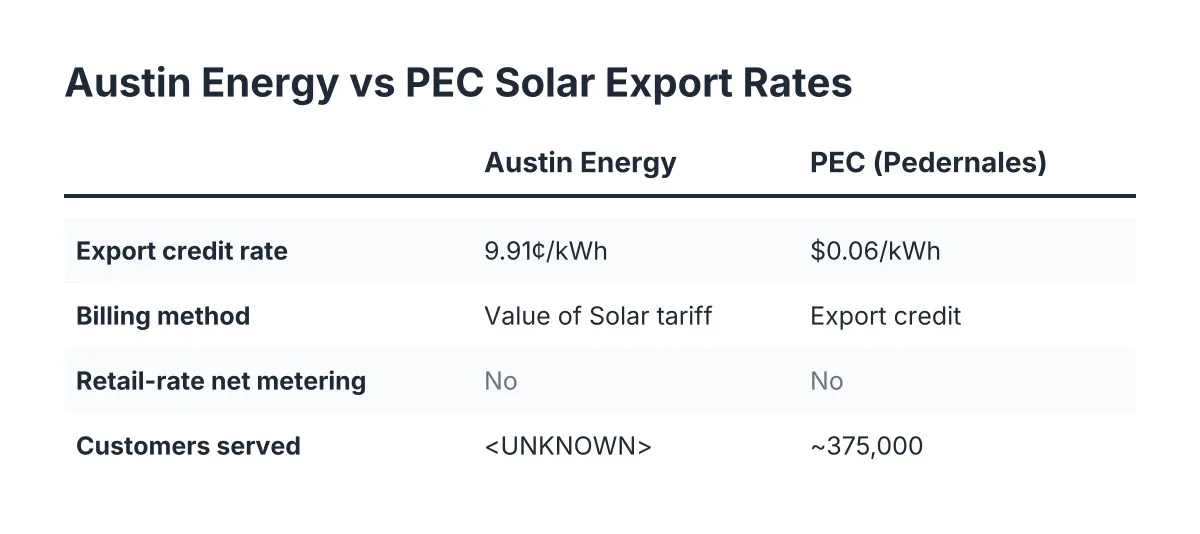
Austin Energy does not run traditional net metering for residential customers. It runs the Value of Solar tariff. Every kilowatt-hour your panels produce gets credited at the Value of Solar rate, and you buy all your consumption at retail. In place of retail-rate net metering, Austin Energy credits every kilowatt-hour a home's panels produce at its Value of Solar rate, 12.89 cents per kWh for systems under 1 MW-AC effective October 1, 2026, and bills the home for all the electricity it uses, according to Austin Energy. That figure was accurate when published; check the current tariff sheet before you sign anything, because your rate at interconnection will differ.
This matters for the battery decision more than most sales reps will explain. Under a weak export credit, a battery earns its keep by storing solar you would otherwise sell cheap and using it instead of buying retail power. Under Value of Solar, the arbitrage case is murkier. You are credited for production whether you use it or export it, so the classic "store cheap, avoid expensive" math that works in other utility territories does not map cleanly onto an Austin Energy solar home.
Compare that to a neighbor outside the city limits. Pedernales Electric Cooperative credits surplus solar sent to the co-op at 7.1921 cents per kWh under its regular interconnect rate, applies that credit only toward the Base Power Charge, and expires unused credits at the end of each calendar year, according to PEC. That is a lower export rate than Austin Energy's Value of Solar figure, which means a PEC homeowner has a stronger financial reason to store energy than an Austin Energy homeowner does. The utility, not the town, decides whether your battery earns money or just sits there as insurance. A homeowner in Leander can be on either utility depending on the street.
So in Austin Energy territory, the honest frame is this: the battery is mostly a backup power purchase, with some secondary value, not an investment that pays for itself through bill savings. Whether a solar battery is worth $12,000 to $20,000 to you depends on what an outage costs you. Those installed-price figures are my illustrative 2026 estimates for a single-battery and a two-battery setup; your quotes will differ.
What a Home Battery Actually Does During an Outage
A home battery with the right hardware keeps selected circuits powered when the grid goes down. Solar panels alone do not do this. A grid-tied system without storage shuts off during an outage for safety, so your panels sit idle on the roof while your refrigerator warms up.
This surprises a lot of existing solar owners. If you bought your system five to fifteen years ago, there is a good chance nobody explained that your panels mainly offset grid usage rather than provide standalone power. During a blackout, excess solar energy with no battery to catch it is simply wasted.
Pair the panels with a battery and the picture changes. During a daytime outage, the panels can power the home directly and recharge the battery at the same time, which extends how long your backup lasts well beyond the battery's rated capacity. A battery-only setup drains and stops. A solar-plus-battery setup can run indefinitely through a multi-day event if your loads are modest and the sun cooperates.
Outage frequency is not a hypothetical concern here. According to Tesla, Texans experienced a 17% increase in power outage frequency between 2017 and 2022. Anyone who lived through the February 2021 freeze does not need a statistic to take the question seriously. The question is not whether outages happen. It is what they cost you, and whether a battery is the right tool for that cost.
Running the Numbers on an Austin Energy Solar Home Battery
Does a home battery pay for itself in Austin Energy territory in 2026? For most households, no, not on bill savings alone. The Value of Solar structure removes most of the storage arbitrage that makes batteries pencil out elsewhere. The battery earns its keep as backup power first, with program payments and export protection as secondary value, and you should price it that way.
Here is the honest breakdown of where a battery can and cannot earn money for an Austin Energy solar home.
Where the battery does not earn much
Under Value of Solar, you get credited for all production at the tariff rate regardless of whether you consume it or export it. Storing your own solar to avoid buying retail power does not change your Value of Solar credit. The self-consumption play that drives battery sales in other markets mostly does not apply here. If a sales rep shows you a payback model built on "avoiding peak rates" with a standard residential Austin Energy plan, ask them to walk you through the tariff line by line. That model usually belongs to a different utility.
Where the Solar Battery Can Earn Income
There are legitimate secondary income paths, and they stack:
- Virtual power plant and grid services programs. Some programs pay homeowners for letting the operator dispatch the battery during grid stress. Enrollment terms, payment levels, and availability change year to year, so confirm what is open to Austin Energy customers at the time you sign, not what a brochure from 2023 says.
- Automated price response. A battery paired with energy management software can store midday production and discharge during price events without you touching anything. The value depends entirely on the plan and programs you are enrolled in.
- Export protection over time. Tariffs change. If export terms worsen in the future, a battery lets you keep more of your generation's value on-site. This is a hedge, not a guaranteed return, and nobody can tell you today what it will be worth.
Add those streams up honestly and they typically shave years off the effective cost of the battery without eliminating it. In my experience watching quotes in this market, a model that shows the battery fully paying for itself in Austin Energy territory is usually leaning on an assumption that deserves a hard question.
The incentive picture in 2026
The federal purchase credit, the 25D credit that historically gave homeowners 30% back on a system they bought outright according to the Internal Revenue Service, has ended for new residential purchases. What survives is the lease credit, the 48E path, which flows through third-party ownership structures like leases and power purchase agreements. That changes the lease-versus-loan math compared to even a year ago, and it is why you are suddenly seeing more lease offers in your inbox.
Keep the ownership trade-off in view, though. As the U.S. Environmental Protection Agency describes it, both solar PPAs and solar leases let you get a system installed with no upfront cost, but in neither arrangement do you own the equipment. A lease works like a car lease: a fixed monthly payment for use of the hardware. Some battery programs go further and retain ownership of the battery itself, using it to sell power to the grid, which subsidizes your upfront cost. That can be a fair trade. Read who controls the battery during an outage and who keeps the grid revenue before you decide. A few battery programs also supply the battery but require you to source and pay for the solar panels separately, so confirm what the monthly payment actually covers.
Austin Energy's residential solar rebate program still exists for the panel side; its current amount and conditions are covered in a separate article on this site about stacking incentives in 2026. Rebate levels change, so verify the figure on Austin Energy's own program page the week you sign. Your numbers will differ from anything printed anywhere, including here.
A Worked Example: Backup Power for a Hypothetical Austin Household
Suppose a homeowner in Allandale has an existing 7 kW system installed in 2016, an aging string inverter, and three battery quotes ranging from $13,500 to $19,800 installed as of early 2026. Those are illustrative figures I consider plausible for this market, not quotes from real companies, and your pricing will differ.
First, the compatibility question. A ten-year-old string inverter often cannot talk to a modern battery directly. The homeowner will likely need either an AC-coupled battery that works alongside the old inverter, or a full inverter replacement bundled into the battery install. The quote that looks $4,000 cheaper may simply be ignoring this. Ask each bidder, in writing, how the battery couples to the existing system and whether the old inverter stays.
Next, the backup scope. One quote backs up the whole house. Two back up a critical loads panel: refrigerator, internet, some lights, and one mini-split. Whole-home backup sounds better until you learn the air conditioner needs a second battery to start reliably. A critical loads design with one battery, recharged daily by the existing panels, can ride through a multi-day outage. A whole-home design with one battery can die in four hours on an August afternoon. Scope, not brand, usually explains the price spread.
Then, the income side. Say a grid services program pays this homeowner a few hundred dollars a year for dispatch rights. Over ten years, that meaningfully offsets the battery cost without ever covering it. The homeowner in this scenario is buying outage insurance at roughly $1,000 to $1,500 per year of effective cost, by my estimate, and should decide on that basis. For a household with medical equipment, a home office, or a chest freezer full of beef, that can be an easy yes. For a household that lost power twice last year for twenty minutes, it is a hard sell, and I would say so.
Battery, Generator, or Neither for Your Austin Energy Solar Home
A whole-house standby generator is the battery's honest competitor, and for some homes it wins. A generator runs on natural gas or propane for as long as fuel flows, handles heavy loads like central air without blinking, and typically costs less per hour of backup for long outages. Its downsides are noise, maintenance, fuel dependence, and zero value on the 360 days a year the grid is up.
The battery is silent, maintenance-light, recharges from your panels, and can earn program income while it waits. Its downside is finite capacity and a higher cost per hour of heavy-load backup. Many homeowners in this market land on a critical-loads battery; some with large homes and gas service land on a generator; a few install both.
There is also a real "neither" case. If your roof is heavily shaded, your bills are low, or the whole proposal only works with a battery doing financial gymnastics, the smarter 2026 move may be attic insulation and a better thermostat, with solar revisited later. Solar with Austin Energy is a reasonable deal for many homes under the Value of Solar structure; it is not a reasonable deal for every home, and a battery cannot rescue a bad solar fit.
Questions That Separate a Fair Battery Quote From a Padded One
You already have quotes. Here is what to ask before you sign any of them:
- How does this battery couple to my existing inverter, and does the price include every component needed to make that work?
- Which circuits are backed up, and what is the realistic runtime in August with the listed loads, with and without sun?
- What export credit rate does your savings model assume, and what is its as-of date? If it is not the current Value of Solar rate, the model is wrong for this utility.
- Which grid services or virtual power plant programs am I eligible for today, what do they pay, and who controls dispatch?
- Is this a purchase, a loan, or a lease, and who owns the battery and claims the 48E lease credit?
- What engineering documents go to the utility, and who handles interconnection? Utilities that support residential solar interconnection commonly require engineering drawings for review before approval, according to Arizona Public Service, and Austin Energy has its own process and approved contractor list. Ask who files what and how long approval typically takes.
- What are the warranty terms on the battery cells versus the electronics, and who services a failure in year eight?
Any installer who answers all seven in writing is worth keeping in the conversation. Any who dodges question three is modeling a different utility's economics and hoping you will not notice.
The Bottom Line on Backup Power in Austin Energy Territory
Solar is well established in this state; Texas had 34,907 megawatts installed as of Q2 2024, enough to power about 4 million homes, according to Go Solar Texas. Batteries are following, pushed by real outage risk and by the shift from the purchase credit to the lease credit. In Austin Energy territory specifically, the Value of Solar tariff means a battery is primarily a backup purchase with modest side income, not a bill-savings machine.
Price it that way. Decide what an outage costs your household, compare the battery against a generator on that basis, and treat any payback model built on avoided retail rates with suspicion in this territory. If your situation involves medical equipment, a complicated electrical panel, or a lease buyout decision on an older system, bring in a licensed electrician or a tax professional before you commit; this article is context, not individual advice. The homeowners who end up happy with a battery here are the ones who bought backup power with their eyes open, not the ones who bought a spreadsheet.
For help with home battery storage and backup, Austin Solar FAQ is the place to start.
Prefer to talk it through? Call +15125571906 — a quick call is usually the fastest way to get a straight answer for your situation.